In the automated landscape of modern industry, the ability to detect the presence or absence of an object without physical contact is fundamental. This capability is provided by proximity switches and sensors, silent workhorses that form the backbone of countless control, safety, and monitoring systems. While the terms are often used interchangeably, a subtle distinction exists: a proximity sensor is the sensing element that generates an electrical signal upon detecting a target, whereas a proximity switch typically refers to a self-contained device that incorporates this sensor and an integrated switching mechanism to directly control a load, like a relay or PLC input. Their core principle is non-contact detection, offering unparalleled advantages over mechanical limit switches, including no moving parts, high reliability, long operational life, and the ability to sense through certain non-metallic materials.
The operation of these devices hinges on various physical principles, leading to distinct types suited for different applications. The most common categories include inductive, capacitive, ultrasonic, and photoelectric sensors.
Inductive proximity sensors are the stalwarts for detecting metallic objects. They generate an electromagnetic oscillating field from a coil in the sensing face. When a ferrous or non-ferrous metal target enters this field, it induces eddy currents, which dampen the oscillation. The sensor's internal circuitry detects this change and triggers a solid-state output switch. They are exceptionally robust, immune to environmental factors like dust or oil (provided they have appropriate IP ratings), and ideal for counting metal parts, determining position in machinery, or as end-of-travel detectors.
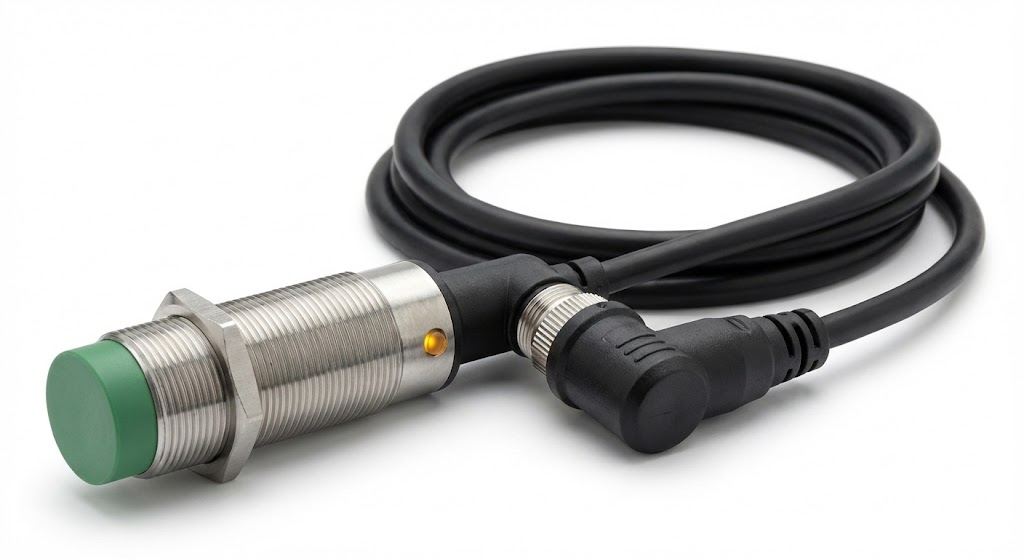
Capacitive proximity sensors, on the other hand, can detect both metallic and non-metallic materials—liquids, plastics, wood, or granules. They function by generating an electrostatic field. Any object that enters this field alters the capacitance of the system. The sensor monitors this capacitance change and switches its output when a preset threshold is reached. This makes them perfect for applications like liquid level detection in non-metallic tanks, monitoring presence of plastic caps on bottles, or sensing powdered materials in hoppers.
For longer-range detection or where the target's material is less relevant, photoelectric sensors emit a beam of light (visible red, infrared, or laser) and detect its reflection or interruption. They come in through-beam, retro-reflective, and diffuse (proximity) modes. The diffuse mode, where the sensor detects light reflected directly from the target, functions as a true proximity switch. Photoelectric sensors are versatile for detecting objects of almost any material, color, or finish at distances far greater than inductive or capacitive types.
Ultrasonic proximity sensors measure the time interval between emitting a high-frequency sound pulse and receiving its echo. The time-of-flight calculation determines the distance to the target. They excel in harsh environments where smoke, dust, or varying light conditions would hinder photoelectric sensors, and are commonly used for bulk level sensing, distance measurement, and detecting transparent objects like glass.
Selecting the right proximity device requires careful consideration of several parameters. The sensing distance, or "rated operating distance," is crucial and is typically specified for a standard target. The mounting style (flush or non-flush for inductive), output type (NPN sinking or PNP sourcing for DC models; NO/NC contacts), and housing material (often nickel-plated brass or stainless steel) must match the application. Environmental factors like temperature extremes, washdown requirements (IP67/IP69K), and potential chemical exposure dictate the needed ingress protection.
In practical industrial settings, proximity switches and sensors are ubiquitous. On an automotive assembly line, inductive sensors verify the presence of engine blocks. In packaging machinery, capacitive sensors ensure a foil seal is present on a food container. Photoelectric sensors count boxes on a conveyor, while ultrasonic sensors monitor the fill level of grain in a silo. They provide essential feedback for Programmable Logic Controllers (PLCs), enabling precise automation sequences, ensuring safety by confirming guard doors are closed, and facilitating predictive maintenance by monitoring machine cycle times.
The evolution continues with the integration of IO-Link communication, a point-to-point serial connection that transforms a standard binary switch into an intelligent device. IO-Link enabled proximity sensors can transmit detailed diagnostic data—such as operating temperature, signal strength, or device health—to the control system, paving the way for Industry 4.0 and smart factory applications. This digital transparency allows for remote configuration, advanced process monitoring, and reduced downtime.
In conclusion, proximity switch and sensor technology is a cornerstone of industrial automation. From the simple, rugged inductive sensor to the sophisticated IO-Link enabled ultrasonic device, these components provide the essential "eyes" of a machine. Understanding their operating principles, types, and key selection criteria is vital for designing efficient, reliable, and intelligent automated systems that drive productivity and innovation across all manufacturing sectors.