Infrared proximity sensors are ubiquitous in modern industrial automation, robotics, and consumer electronics. Their operation hinges on a simple yet elegant principle: the detection of infrared (IR) light reflected from nearby objects. Unlike other sensing methods, they offer non-contact detection, making them ideal for applications involving fragile materials, high-speed processes, or harsh environments. This article delves into the core working principles, key components, and typical applications of these versatile devices.
At its heart, an infrared proximity sensor is an optoelectronic device. It consists of two primary components: an infrared emitter (typically an IR LED) and an infrared receiver (usually a photodiode or phototransistor). The emitter continuously or intermittently transmits a beam of infrared light, which is invisible to the human eye. When an object enters the sensor's detection field, a portion of this emitted IR radiation is reflected back towards the sensor. The receiver detects this reflected light and converts the optical signal into an electrical signal.
The core working principle is based on triangulation or intensity measurement. In the most common intensity-based method, the sensor evaluates the strength of the reflected IR signal. The closer an object is to the sensor, the stronger the reflected intensity received by the photodetector. An internal circuit, often a comparator, processes this signal. It compares the received signal strength against a predefined threshold value. When the reflected intensity exceeds this threshold—indicating an object is within a specified range—the sensor's output state changes, typically switching from a high to a low logic level or vice-versa, thereby signaling the presence of the object.
However, ambient infrared light from sources like sunlight or incandescent lamps can interfere with this simple intensity measurement, causing false triggers. To mitigate this, advanced sensors employ modulation and demodulation techniques. The IR emitter is driven by an oscillator circuit, causing it to pulse at a specific high frequency (e.g., 38 kHz). The receiver circuit is tuned to respond only to light modulated at this exact frequency. This design makes the sensor highly immune to ambient IR noise, as constant ambient light does not carry the specific modulation signature and is effectively filtered out.
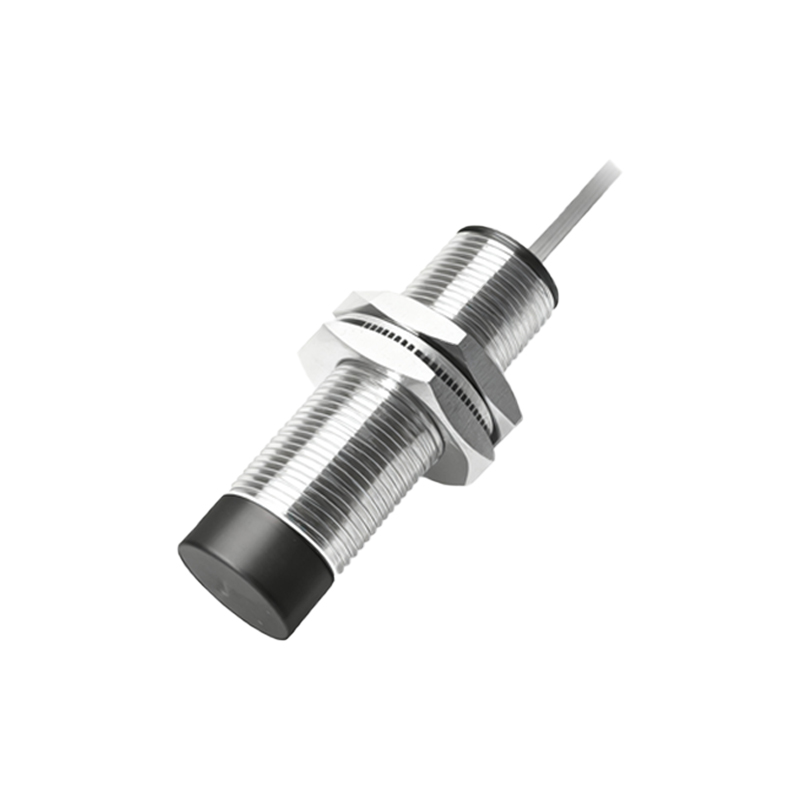
The physical arrangement of the emitter and receiver is crucial. In a diffuse reflective configuration, both elements are mounted side-by-side on the same face of the sensor. This setup is compact and common. The detection range and characteristics are influenced by the object's color, material, and surface texture, as these factors affect reflectivity. Dark, matte, or absorbent surfaces reflect less IR light and thus have a shorter effective detection range compared to bright, shiny surfaces. For more precise distance measurement, some sensors use a triangulation method. Here, the emitter and receiver are placed at a known angle. The position of the reflected light spot on a position-sensitive detector (PSD) changes with the object's distance, allowing for accurate, less material-dependent distance calculation.
Key performance parameters for engineers include sensing distance, response time, repeat accuracy, and the formation of the detection beam. The sensing range can vary from a few millimeters to several meters, depending on the emitter power and receiver sensitivity. Response time is critical in high-speed sorting or counting applications. The beam pattern—whether it's a focused spot, a narrow line, or a wide diffuse field—determines the sensor's suitability for specific tasks, such as detecting small components or large opaque objects.
In industrial settings, infrared proximity sensors are workhorses. They are used for object detection on conveyor belts, jam detection in machinery, non-contact limit switching, and counting parts. In robotics, they provide simple obstacle avoidance for autonomous guided vehicles (AGVs) and robotic arms. The consumer electronics market relies heavily on them; for instance, they disable smartphone touchscreens during calls to prevent accidental input, and they enable automatic faucets and paper towel dispensers. Their reliability, relatively low cost, and robustness make them a fundamental component in the toolkit of automation and control engineering.
In summary, the functionality of an infrared proximity sensor is a sophisticated interplay of optoelectronics and signal processing. By emitting modulated infrared light and intelligently analyzing its reflection, these sensors provide a reliable and non-invasive means of detecting object presence and, in some cases, measuring distance. Understanding their operating principles, including the effects of object surface properties and the importance of modulation for noise immunity, is essential for selecting and deploying the correct sensor for any given industrial or commercial application.