Push button laser sensors represent a sophisticated category of photoelectric sensors widely utilized in industrial automation for precise detection, positioning, and measurement tasks. These devices integrate a laser light source, typically a visible red or infrared laser diode, with a push-button interface for simplified operation and configuration. The fundamental principle revolves around the emission of a highly focused laser beam toward a target object. When the beam encounters the object, it is either reflected, scattered, or absorbed, depending on the surface properties. A receiver component, often a photodiode or phototransistor within the sensor, detects the altered light signal.
The core operation modes include through-beam, retro-reflective, and diffuse reflective sensing. In through-beam mode, the emitter and receiver are separate units; the laser beam travels from the emitter to the receiver, and an object is detected when it interrupts this beam. This mode offers the longest sensing range and high reliability. Retro-reflective mode employs a single housing containing both emitter and receiver, along with a reflector. The laser beam is projected toward the reflector and bounces back to the receiver. Detection occurs when an object blocks the beam path. Diffuse reflective mode, commonly used in push button laser sensors for proximity applications, relies on the reflection of the laser light directly from the target object itself. The sensor detects the light scattered back from the object's surface.

Key to the functionality of push button laser sensors is the modulation of the laser beam. The emitted light is typically pulsed at a specific frequency. The receiver is tuned to this same frequency, enabling the sensor to distinguish between the modulated laser signal and ambient light interference, such as from factory lighting or sunlight. This modulation ensures high stability and accuracy even in challenging environmental conditions. The push-button interface simplifies setup by allowing operators to teach the sensor its detection parameters. By pressing the button while the sensor is in a teach mode, it automatically sets the sensing threshold based on the current target's reflection, adjusting for factors like color, material, and distance.
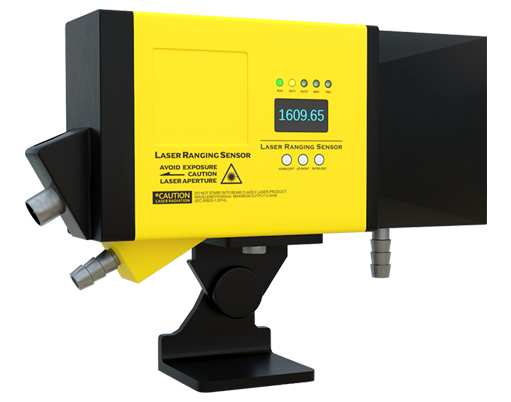
Advanced models incorporate background suppression technology, which uses triangulation principles to limit the sensing range precisely. A position-sensitive detector (PSD) or similar component calculates the angle of the reflected light. Only light reflected from objects within a defined distance range is evaluated, effectively ignoring objects or surfaces beyond this range. This is particularly valuable in applications where the sensor must detect an object on a conveyor belt while ignoring the belt itself or more distant backgrounds.
The laser's coherence and small spot size provide significant advantages. The focused beam allows for the detection of very small objects or precise edges, enabling high-resolution tasks like part counting, width measurement, or alignment. The visible laser dot also facilitates easy alignment during installation and troubleshooting. In terms of electrical output, these sensors typically provide digital switching signals (e.g., PNP/NPN) or analog outputs (e.g., 4-20 mA, 0-10 V) proportional to the detected distance or intensity, interfacing seamlessly with PLCs and control systems.
Applications are extensive across manufacturing, packaging, material handling, and robotics. They are used for object presence verification on assembly lines, fill level control in transparent containers, wafer positioning in semiconductor fabrication, and robot guidance for pick-and-place operations. Their precision and reliability make them indispensable in quality control processes.
When selecting a push button laser sensor, engineers must consider factors such as sensing range, spot size, response time, environmental ratings (IP67 for dust and water resistance is common), housing material (often stainless steel or rugged plastic), and supply voltage. Regular maintenance involves keeping the lens clean from dust or oil contamination and verifying alignment. With ongoing advancements in laser diode efficiency, integrated intelligence, and connectivity for Industry 4.0, push button laser sensors continue to evolve, offering even greater precision, ease of use, and diagnostic capabilities for modern automated systems.