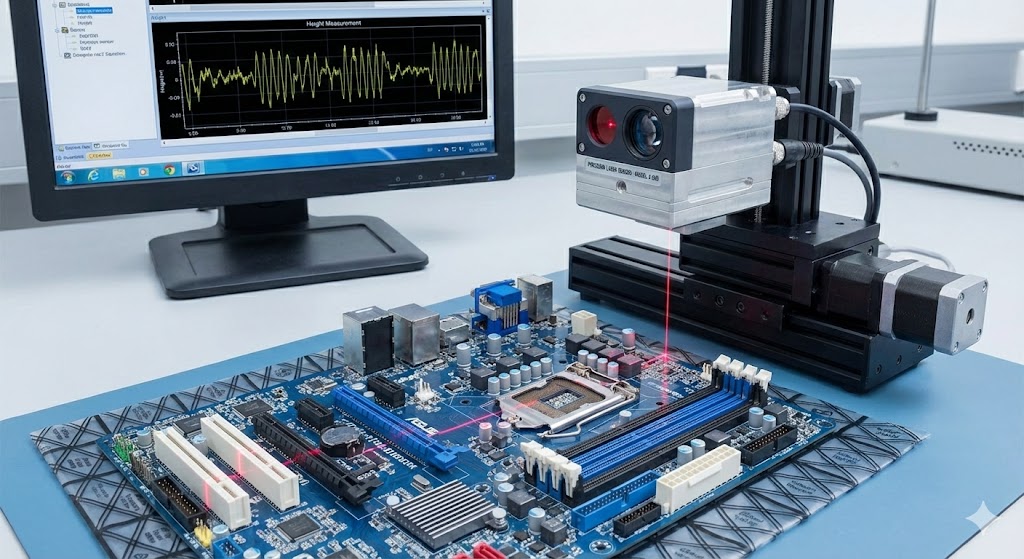
Laser force sensors represent a cutting-edge technology in the field of precision measurement, leveraging the fundamental properties of light to detect and quantify mechanical forces with exceptional accuracy. At their core, these sensors operate on the principle of optical interferometry, where a laser beam is directed onto a reflective surface attached to a force-sensitive element. When an external force is applied, it induces minute deformations or displacements in the sensing structure, altering the path length of the reflected laser beam. This change is meticulously measured by analyzing the interference pattern created between the reference and reflected beams, allowing for precise calculation of the applied force based on known material properties and calibration data.
The key components of a laser force sensor include a stable laser source, typically a helium-neon or semiconductor laser, which emits a coherent and monochromatic light beam. This beam is split into two paths: one serves as a reference, while the other is directed toward the force-sensing element, often a micro-machined diaphragm or a flexure mechanism. As force acts on the sensor, the sensing element undergoes elastic deformation, causing a shift in the optical path length of the measurement beam. The resulting phase difference between the two beams generates an interference fringe pattern, which is captured by a photodetector and processed through advanced signal conditioning electronics.
One of the standout advantages of laser force sensors is their non-contact nature, which eliminates mechanical hysteresis and wear, ensuring long-term reliability and minimal maintenance. They offer high resolution, often down to the nanonewton range, making them ideal for applications requiring ultra-sensitive measurements, such as in semiconductor manufacturing, biomedical research, and aerospace testing. For instance, in micro-electromechanical systems (MEMS) production, these sensors are used to calibrate delicate components without physical contact, preventing damage. Similarly, in material science, they facilitate stress-strain analysis by measuring tiny forces during tensile tests.

Despite their benefits, laser force sensors face challenges like sensitivity to environmental vibrations and thermal fluctuations, which can affect measurement accuracy. To mitigate this, modern designs incorporate temperature compensation algorithms and vibration isolation techniques. Additionally, advancements in fiber-optic integration have led to compact, robust sensors suitable for harsh industrial environments, such as automotive assembly lines or oil and gas pipelines, where they monitor structural loads in real-time.
In summary, laser force sensors harness optical interferometry to provide precise, non-contact force measurements, driving innovation across high-tech industries. Their ability to deliver high-resolution data with minimal interference makes them indispensable for quality control, research, and safety-critical applications, paving the way for smarter, more efficient industrial processes. As technology evolves, we can expect further enhancements in miniaturization, cost-effectiveness, and adaptability, solidifying their role in the future of automation and measurement science.