In the realm of industrial automation and control systems, proximity sensors are indispensable components for detecting the presence or absence of objects without physical contact. Among the critical design choices engineers face is selecting between shielded (also known as flush-mountable) and unshielded (non-flush-mountable) variants. This decision profoundly impacts sensor performance, installation requirements, and application suitability. Understanding the fundamental principles, advantages, and limitations of each type is paramount for optimal system design.
The core distinction lies in their internal construction and resulting magnetic field geometry. A shielded proximity sensor incorporates a ferromagnetic ring, typically made of a material like ferrite, surrounding its sensing face. This ring effectively contains and focuses the sensor's electromagnetic field, directing it axially forward from the face. This design allows the sensor to be mounted flush with, or even embedded within, a metal mounting bracket without the bracket itself being detected and causing false triggers. The focused field provides a precise, narrow detection zone, which is highly beneficial in applications with tight spatial constraints or where sensors are mounted in close proximity to each other. However, this shielding comes at the cost of a reduced nominal sensing range (Sn). The ferromagnetic ring dampens the field strength, typically resulting in a sensing distance 30% to 50% shorter than an equivalently sized unshielded sensor.
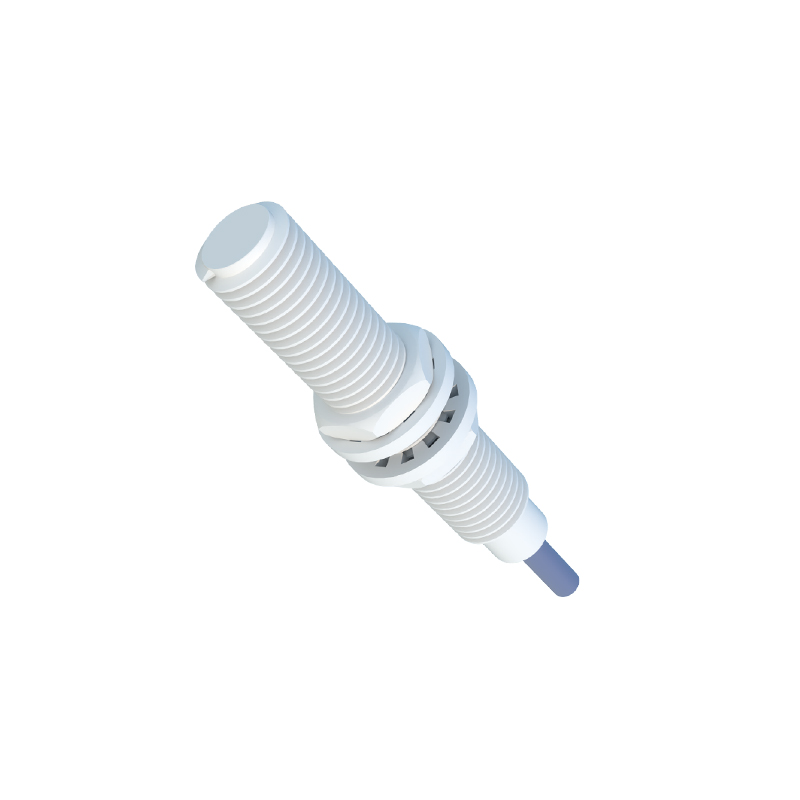
Conversely, an unshielded proximity sensor lacks this surrounding ferromagnetic shield. Its electromagnetic field is allowed to radiate laterally from the sides of the sensing coil as well as axially from the front. This creates a larger, more diffuse detection zone, often described as a "halo" effect around the sensor body. The primary advantage is a significantly longer nominal sensing range for a given sensor diameter. This makes unshielded sensors ideal for applications requiring longer reach or where the target approach path is not perfectly axial. The critical trade-off is that they cannot be mounted flush with surrounding metal. A mandatory mounting clearance, often specified as a non-ferrous zone of one to two times the sensor's diameter, must be maintained around the sides of the sensor. Failure to provide this clearance will cause the mounting material to interact with the lateral field, leading to permanent activation or a drastic reduction in effective sensing distance.
The choice between shielded and unshielded is fundamentally application-driven. Shielded sensors are the default choice for machine tools, robotic arms, and automated guided vehicles (AGVs) where sensors are directly integrated into metal structures, frames, or grippers. Their flush-mounting capability ensures a clean, protected installation, and their focused field prevents crosstalk in dense sensor arrays. They are also preferred in environments with metallic debris or swarf, as the contained field is less susceptible to interference from stray particles.
Unshielded sensors excel in scenarios where mounting in non-metallic materials (e.g., plastic, wood) is possible or where the extended range is the primary requirement. Common applications include material handling on conveyor belts, detecting objects through non-metallic chutes or guards, and position sensing on equipment where maintaining a mounting clearance is straightforward. Their longer range can sometimes allow the use of a smaller, less expensive sensor to achieve the same detection distance as a larger shielded unit, offering a cost-saving opportunity.
Beyond the basic mounting and range considerations, engineers must also evaluate other performance factors. Temperature stability can differ; shielded sensors may exhibit slightly better performance in high-temperature environments due to the shielding's influence on the coil's characteristics. Switching frequency is generally comparable between types of similar technology and quality. The presence of the ferrite ring in shielded sensors can make them marginally more resistant to certain types of electromagnetic interference (EMI), though both types must comply with relevant EMC standards.
In conclusion, there is no universally superior option. The shielded versus unshielded decision is a classic engineering compromise between range, mounting flexibility, and environmental robustness. A shielded sensor offers a compact, rugged, and installation-forgiving solution at the expense of sensing distance. An unshielded sensor provides maximum range but demands careful attention to mounting clearances. A thorough analysis of the mechanical layout, target characteristics, and environmental conditions is essential. By meticulously applying these principles, engineers can ensure reliable, maintenance-free operation, thereby enhancing the overall efficiency and safety of automated industrial systems.