In the realm of industrial automation, precision, reliability, and durability are non-negotiable. Among the myriad of components that ensure seamless operation, proximity sensors stand as silent sentinels, detecting the presence or absence of objects without physical contact. The M163 series of inductive proximity switches represents a pinnacle of engineering in this category, designed to meet the rigorous demands of modern manufacturing, packaging, and material handling systems. This article delves into the technical specifications, operational principles, and key application scenarios of the M163 sensor, providing a detailed overview for engineers and system integrators.
The M163 is an inductive proximity sensor, fundamentally operating on the principle of electromagnetic induction. It generates a high-frequency oscillating electromagnetic field from its active face. When a metallic object enters this detection field, eddy currents are induced on the surface of the target. This causes a change in the oscillation amplitude within the sensor's internal LC tank circuit. This change is detected by the sensor's circuitry, which subsequently triggers a solid-state switching output. The key advantage of this non-contact method is the elimination of mechanical wear, ensuring a long operational life even in high-cycle applications. The M163 typically features a shielded design, allowing for flush mounting in metal without a significant reduction in its nominal sensing range, a critical factor for compact machine designs.
Technical specifications define the M163's performance envelope. Common models offer sensing distances (Sn) ranging from 2mm to 15mm, depending on the specific variant and target material (standardized for mild steel). The sensor is designed to detect all ferrous metals (like iron and steel) and, with a reduced sensing range, non-ferrous metals (such as aluminum, copper, and brass). Most M163 sensors operate on a wide range DC supply voltage, typically from 10-30V DC or 20-250V AC/DC for certain models, providing flexibility in system integration. The output configuration is a crucial selection parameter; options include NPN (sinking) or PNP (sourcing) transistor outputs, NO (Normally Open) or NC (Normally Closed) switching logic, and sometimes analog (4-20mA or 0-10V) or IO-Link versions for smart factory applications. The housing is invariably constructed from robust materials like nickel-plated brass or stainless steel (AISI 303/304), with a high IP rating (IP67 or IP69K) guaranteeing resistance to dust, water jets, and even temporary immersion, making it suitable for harsh washdown environments in food and beverage or pharmaceutical industries.
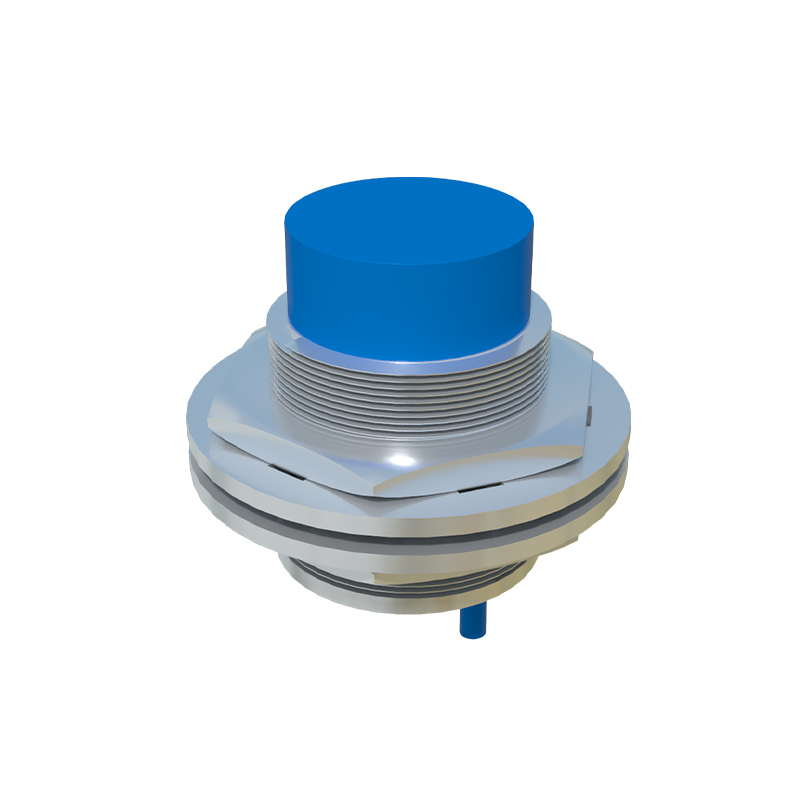
Installation and wiring of the M163 follow industry-standard practices. For DC models, the standard 3-wire or 4-wire configuration is employed: brown wire for positive supply (+V), blue wire for common negative (0V), and black wire (and sometimes white) for the switched output signal. Proper grounding and the use of shielded cables are recommended in electrically noisy environments to prevent false triggering. It is essential to consider the hysteresis—the difference between the switch-on and switch-off points—which prevents output chattering when a target is at the exact sensing limit. Furthermore, attention must be paid to the temperature operating range, usually from -25°C to +70°C, ensuring stable performance in most industrial settings.
The application portfolio for the M163 proximity sensor is vast. A primary use is in position sensing and end-of-travel detection on linear actuators, cylinders, and slides. It verifies if a pneumatic or hydraulic cylinder rod is fully extended or retracted. In conveyor systems, M163 sensors are deployed for part detection, counting, and jam monitoring. On rotary indexing tables or in assembly machines, they provide precise angular position feedback. In metalworking machinery, they can be used for tool breakage detection or to confirm the presence of a workpiece in a fixture. The robust construction also makes it ideal for use in automated guided vehicles (AGVs) for obstacle detection or alignment. When selecting an M163 for an application, engineers must consider the target material, required sensing distance, environmental conditions (temperature, chemicals), electrical interface, and required response frequency.
In conclusion, the M163 inductive proximity sensor is a versatile and robust workhorse in industrial automation. Its non-contact sensing principle, coupled with rugged construction and reliable performance, makes it an indispensable component for ensuring machine safety, precision, and efficiency. By understanding its technical parameters and correctly applying it within a system, engineers can leverage the M163 to build more reliable, maintainable, and productive automated solutions. As industries move towards greater connectivity, the evolution of the M163 series with integrated IO-Link functionality further positions it as a future-proof component in the Industrial Internet of Things (IIoT) landscape, providing not just a switch signal but valuable diagnostic and parameterization data.