Laser precision sensors represent a critical advancement in industrial measurement and automation, offering unparalleled accuracy, speed, and reliability. These devices operate on fundamental principles of optics and photonics, enabling non-contact detection, positioning, and inspection with micron-level precision. The core working mechanism typically involves the emission of a focused, coherent laser beam toward a target object. The interaction between this laser light and the target surface generates a response—such as reflection, scattering, or diffraction—which is then captured and analyzed by a sensitive photodetector within the sensor.
One of the most common principles employed is triangulation. In a triangulation sensor, the laser emitter projects a spot onto the target surface. The reflected light is received by a position-sensitive detector (PSD) or a CMOS/CCD array at a specific angle relative to the emitter. Any change in the target's distance causes a proportional shift in the position of the reflected spot on the detector. By precisely calculating this displacement, the sensor determines the exact distance to the object. This method is highly effective for precise distance measurement, profile scanning, and thickness gauging in applications ranging from semiconductor manufacturing to automotive assembly.
Another key principle is time-of-flight (ToF). Here, the sensor measures the time it takes for a short laser pulse to travel to the target and back. Since the speed of light is constant, the distance can be calculated directly from the time delay. Modern ToF sensors use sophisticated electronics to measure these nanosecond-scale intervals with extreme accuracy. This technology is favored for longer-range measurements and 3D imaging in logistics, robotics, and autonomous vehicle navigation.
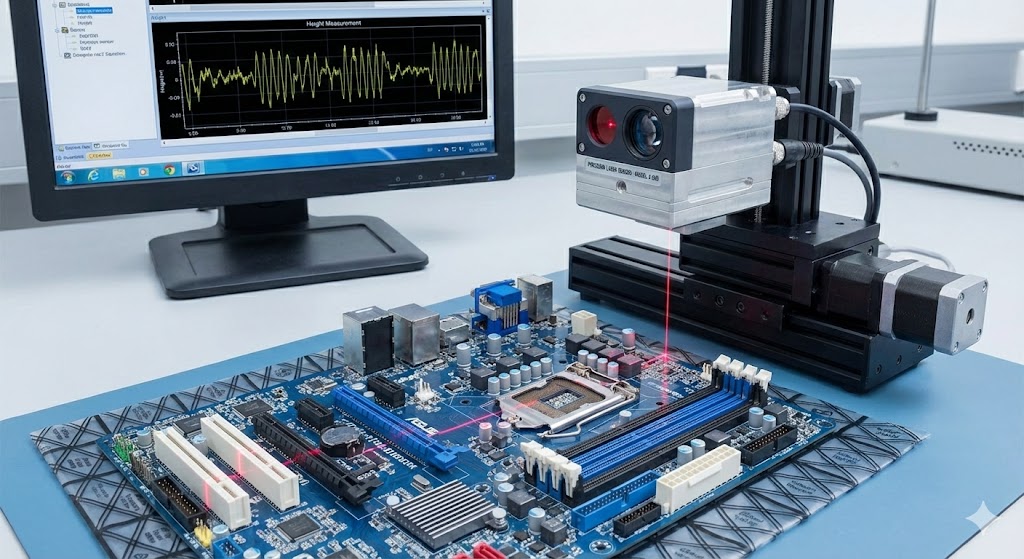
Laser confocal sensors offer even higher resolution for microscopic measurements. They use a spatial pinhole to eliminate out-of-focus light, allowing only light from a very specific focal plane to reach the detector. By rapidly scanning the laser wavelength or moving the focal point, these sensors can generate precise topographical maps of surfaces, essential in quality control for optical components, precision machining, and biomedical device inspection.
Interferometry represents the pinnacle of laser-based measurement for ultra-high precision. Sensors based on laser interferometry split the laser beam into a reference path and a measurement path. The beam reflected from the target recombines with the reference beam, creating an interference pattern. Minute changes in the target's position—down to nanometer scales—alter this pattern, allowing for exceptionally precise displacement and vibration analysis. This principle is indispensable in metrology labs, precision stage calibration, and advanced research and development.
The performance of a laser precision sensor is governed by several key parameters: measurement range, resolution, repeatability, linearity, and response time. Environmental factors such as ambient light, temperature fluctuations, and target surface characteristics (color, reflectivity, texture) must also be carefully considered during selection and integration. Modern sensors incorporate advanced signal processing, automatic calibration, and intelligent algorithms to compensate for these variables, ensuring stable and reliable operation in harsh industrial environments.

Applications are vast and transformative. In factory automation, laser sensors provide precise part presence verification, robotic guidance, and assembly verification. In process industries, they monitor dimensions, detect edges, and control web tension. In electronics manufacturing, they enable the precise placement of microchips and inspection of solder joints and circuit traces. The non-contact nature of laser sensing prevents damage to delicate objects and allows for measurement of hot, moving, or otherwise inaccessible targets.
Future trends point toward miniaturization, increased integration with IoT (Industrial Internet of Things) platforms for predictive maintenance and data analytics, and the development of multi-function sensors that combine distance measurement with spectral analysis for material identification. As Industry 4.0 and smart manufacturing evolve, the role of laser precision sensors as the "eyes" of automated systems will only become more central, driving efficiencies, enhancing quality, and enabling new levels of operational intelligence.
In conclusion, the principle of operation for laser precision sensors—whether based on triangulation, time-of-flight, confocal, or interferometric methods—provides a foundation for critical measurement tasks. Their ability to deliver fast, accurate, and reliable data without physical contact makes them an indispensable tool across the modern industrial landscape, continuously pushing the boundaries of what is measurable and controllable in automated production and quality assurance processes.