In the realm of industrial automation, construction, surveying, and security, the ability to measure distances with high accuracy over vast expanses is not just a convenience—it's a critical operational requirement. Long range laser distance sensors have emerged as the definitive solution for these demanding tasks, offering unparalleled precision where traditional measuring tools fall short. These sophisticated devices operate on the principle of time-of-flight or phase-shift measurement, emitting a focused laser beam towards a target and calculating the distance based on the time it takes for the light to reflect back to the sensor's receiver.
The core technology behind these sensors is deceptively simple in concept but highly complex in execution. A pulsed laser diode emits short, intense bursts of light. For extremely long ranges, often classified as distances over 100 meters and extending to several kilometers, the sensors require powerful, coherent light sources and highly sensitive receivers capable of detecting the faint return signal. Environmental factors pose significant challenges; atmospheric conditions like fog, rain, or heat haze can scatter or distort the laser beam. Advanced models incorporate signal processing algorithms and filtering techniques to distinguish the true return signal from background noise, ensuring reliable readings even in suboptimal conditions.
Applications for long-range laser sensors are diverse and impactful. In the construction and civil engineering sectors, they are indispensable for monitoring structural deformations in bridges, dams, and skyscrapers, measuring earthwork volumes, and guiding heavy machinery with pinpoint accuracy. Surveyors rely on them for topographic mapping, where speed and precision over long baselines drastically improve fieldwork efficiency. The industrial domain uses them for inventory management in large warehouses, measuring roll diameters in paper and steel mills, and positioning cranes and gantries in shipping ports.

The transportation industry leverages this technology for vehicle speed enforcement and traffic monitoring systems. In the field of security and perimeter protection, invisible laser curtains can detect intrusions across fences, borders, or open areas spanning hundreds of meters, providing an early warning system that is difficult to bypass. Furthermore, in forestry and agriculture, these sensors assist in measuring tree heights, canopy density, and land topography for resource management and planning.
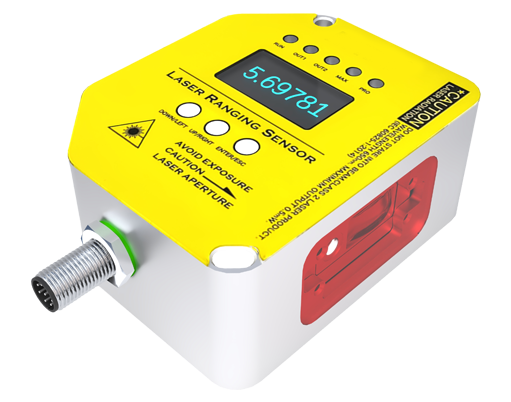
Selecting the appropriate long-range laser sensor requires careful consideration of several key parameters beyond just the maximum range. Measurement accuracy and repeatability are paramount; high-end sensors can achieve millimeter-level accuracy even at distances of hundreds of meters. The laser's wavelength, typically in the near-infrared spectrum for long-range units, affects its visibility and performance in different environments. The type of target is also crucial—a cooperative reflector (a prism or retro-reflective tape) will return a much stronger signal than a diffuse, non-reflective surface like rough concrete or soil, effectively extending the sensor's usable range.
Robustness and ingress protection (IP) ratings are non-negotiable for sensors deployed outdoors. They must withstand temperature extremes, humidity, dust, and vibration. Connectivity options, such as analog outputs, Ethernet, or various industrial fieldbus protocols, ensure seamless integration into larger control and data acquisition systems. Modern sensors often feature onboard data logging, software for configuration and analysis, and even built-in inclination sensors for combined distance and angle measurement.
The evolution of long-range laser distance sensing continues, driven by advancements in laser diode efficiency, optical design, and computational power. Emerging trends include the integration of scanning capabilities to create 3D profiles of large areas and the use of eye-safe laser classes to broaden their applicability in public spaces. As industries push for greater automation, efficiency, and data-driven decision-making, the role of the long-range laser distance sensor as a fundamental tool for precise spatial awareness will only become more central. Their ability to deliver reliable, contact-free measurement over challenging distances transforms complex tasks into manageable, automated processes, solidifying their status as a cornerstone of modern measurement technology.