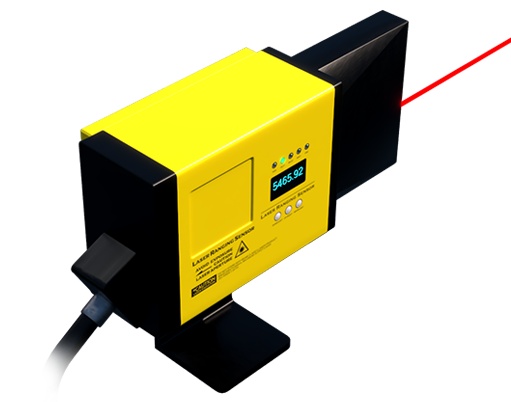
In the realm of industrial automation, robotics, and advanced surveying, laser distance positioning sensors have emerged as a cornerstone technology for achieving high-precision, non-contact measurement. These sophisticated devices operate on the principle of emitting a focused laser beam toward a target object and analyzing the reflected light to calculate distance with remarkable accuracy. The core methodologies employed include time-of-flight (ToF), phase-shift measurement, and triangulation, each suited to specific application ranges and precision requirements. Time-of-flight sensors measure the round-trip time of a laser pulse, ideal for long-range measurements up to several hundred meters, commonly used in construction layout and large-scale metrology. Phase-shift sensors, by contrast, modulate the laser beam's amplitude and compare the phase difference between emitted and reflected waves, offering superior accuracy at medium ranges, which is critical in manufacturing quality control. Triangulation-based sensors, where a laser spot is projected onto a target and viewed from an offset angle by a receiver, excel in short-range, micron-level resolution tasks, such as in semiconductor wafer inspection or assembly line verification.
The operational advantages of laser distance sensors are manifold. Their non-contact nature eliminates mechanical wear and prevents damage to delicate surfaces, while the high sampling rates—often in the kilohertz range—enable real-time monitoring and control in dynamic processes. Environmental robustness is another key benefit; modern sensors are engineered with ingress protection (IP) ratings to withstand dust, moisture, and vibration, ensuring reliable performance in harsh industrial settings like steel mills or outdoor construction sites. Furthermore, integration with industrial networks (e.g., PROFINET, EtherCAT) and IoT platforms facilitates seamless data exchange for predictive maintenance and process optimization. However, challenges persist, including interference from ambient light, particularly direct sunlight, and limitations with highly reflective or absorbent surfaces. Advanced models incorporate background suppression algorithms and adaptive power control to mitigate these issues.
Applications span diverse sectors. In logistics, laser sensors precisely measure parcel dimensions for automated sorting and volumetric pricing. In automotive assembly, they ensure gap and flushness between body panels to micron-level tolerances. Robotics relies on them for accurate positioning and obstacle detection, enabling collaborative robots to operate safely alongside human workers. The future trajectory points toward miniaturization, enhanced multi-sensor fusion (combining laser data with vision or inertial measurements), and the integration of AI-driven analytics for anomaly detection. As Industry 4.0 advances, the role of laser distance positioning sensors as enablers of smart, adaptive manufacturing and precise spatial awareness will only become more pivotal, driving efficiencies and unlocking new capabilities in automation and measurement science.
