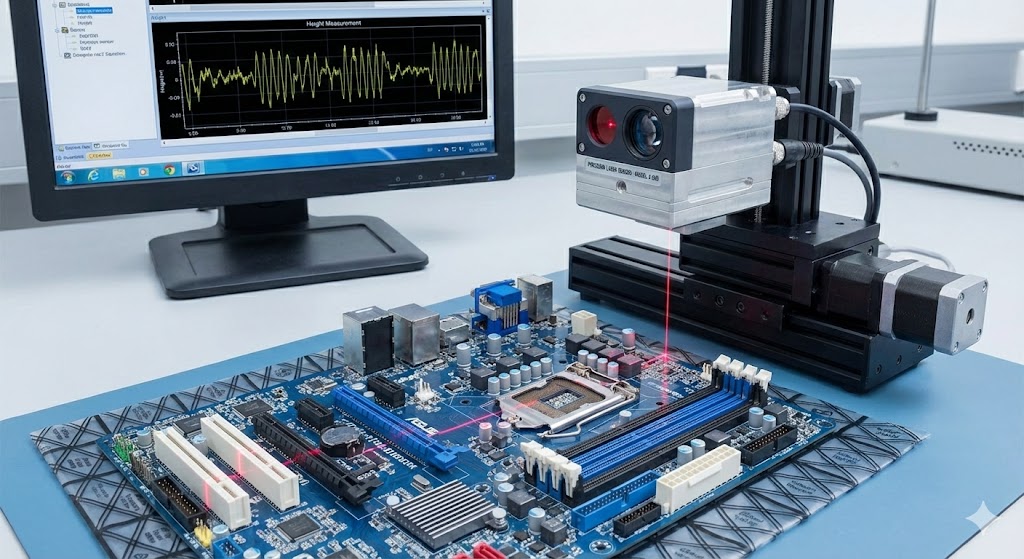
Laser photoelectric sensors are pivotal components in modern industrial automation, offering unparalleled precision, reliability, and versatility. Unlike traditional photoelectric sensors that use LED light sources, laser sensors employ a highly focused, coherent beam of light. This fundamental difference grants them superior performance in applications demanding exact detection, precise measurement, or operation over long distances. The core principle remains the same: a transmitter emits a laser beam, which is then either reflected back to a receiver (retro-reflective or diffuse reflective modes) or aimed directly at a separate receiver (through-beam mode). The sensor's output signal changes state when the target object interrupts or reflects this beam.
The advantages of laser sensors are numerous. Their extremely small, intense light spot allows for the detection of minuscule objects or precise edges, crucial in electronics assembly or precision machining. They offer exceptional sensing ranges; a through-beam laser sensor can reliably detect objects several hundred meters away, far surpassing standard photoelectric sensors. Furthermore, the high intensity and focus of the laser beam make it less susceptible to ambient light interference and provide stable operation even with low-reflectivity targets like black rubber or matte-finished metals. This stability reduces false triggers and increases system uptime.

In practical industrial settings, laser photoelectric sensors are deployed in a wide array of tasks. Common applications include precise positioning and edge detection in web guiding systems for paper, film, or textiles. They are indispensable in semiconductor manufacturing for wafer alignment and chip counting. In logistics and packaging, they ensure accurate fill-level control and label registration. Their long-range capability makes them ideal for large-scale object detection in warehouse automation and crane positioning systems. The choice of sensing mode—through-beam, retro-reflective, or diffuse reflective—depends on the specific installation constraints and target characteristics.
When integrating a laser photoelectric sensor, several critical factors must be considered. First is the selection of the appropriate sensing mode for the application. Environmental conditions are paramount; while lasers are robust, excessive dust, steam, or heavy vibration can affect performance, potentially necessitating protective housings or air purge systems. Safety is a non-negotiable aspect. Class 2 laser sensors are common in industry and are considered safe for momentary viewing, but Class 3R or higher lasers require stringent safety measures, including interlocks, warning labels, and operator training to prevent eye injury. Regular maintenance, such as lens cleaning and alignment checks, ensures long-term reliability and accuracy.
The future of laser sensing technology is closely tied to advancements in Industry 4.0 and smart manufacturing. Modern laser sensors increasingly feature IO-Link communication, enabling digital parameter setting, real-time diagnostics, and condition monitoring. This connectivity allows for predictive maintenance, where sensors can report decreasing signal strength or contamination levels before a failure occurs. Furthermore, miniaturization continues, allowing laser sensing capabilities to be embedded into increasingly compact machinery. The integration of background suppression technology in diffuse reflective models further enhances their ability to ignore irrelevant background objects, focusing only on the target.
In conclusion, laser photoelectric sensors represent a sophisticated and essential tool for engineers designing automated systems. Their precision, long range, and reliability solve complex detection challenges that other sensor types cannot address. By carefully considering the application requirements, environmental factors, and safety protocols, engineers can leverage laser sensor technology to build more efficient, accurate, and intelligent industrial automation solutions, driving productivity and quality to new heights.
