In the industrial automation and electrical engineering sectors, the question "Is there an M4 proximity sensor?" arises frequently among professionals specifying components for machinery and control systems. To address this directly: there is no standardized "M4" model or series universally recognized as a proximity sensor category. The confusion often stems from a mix-up in terminology, where "M4" typically refers to a metric thread size—specifically a 4mm diameter screw thread—commonly used for mounting sensors or housing fittings, rather than denoting a sensor type itself.
Proximity sensors are pivotal in detecting the presence or absence of objects without physical contact, leveraging technologies such as inductive, capacitive, ultrasonic, or photoelectric principles. In industrial nomenclature, sensors are usually identified by key parameters: sensing technology, sensing range, output type (e.g., PNP/NPN), housing material, and electrical connections. For instance, an inductive proximity sensor might be labeled with its thread size (e.g., M4, M8, M12, M18, M30) to indicate the mounting dimensions, but this is just one facet of its specification. An "M4 proximity sensor" would, in practice, describe a compact sensor with an M4 threaded barrel, often used in space-constrained applications like small robotics, precision assembly, or electronic devices, where miniaturization is critical.
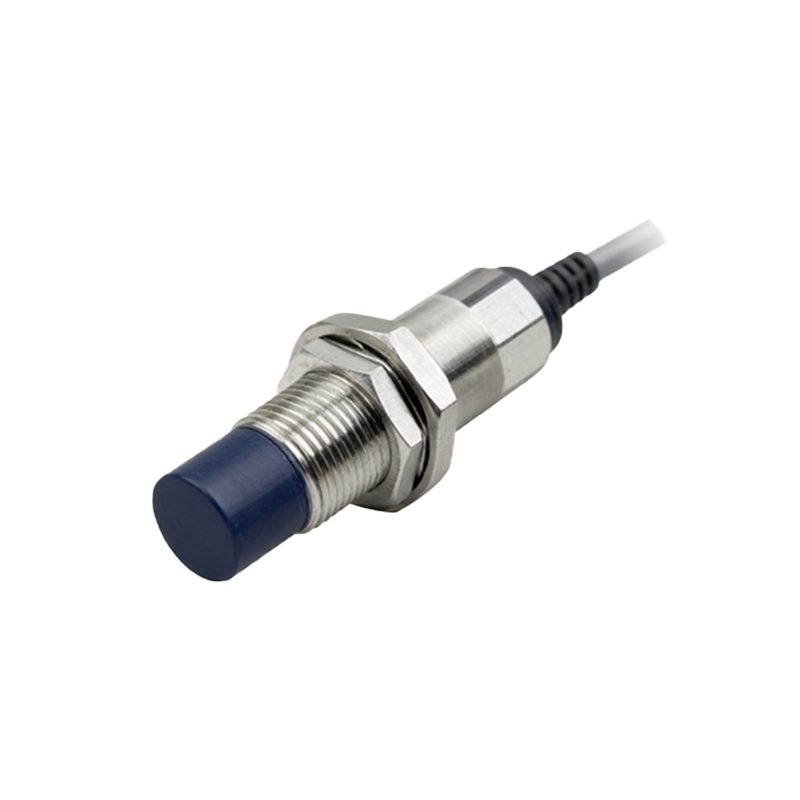
When selecting a proximity sensor, engineers must consider several factors beyond thread size. The operating environment dictates the choice: inductive sensors are ideal for metallic objects in harsh conditions, while capacitive sensors handle non-metallic materials. Sensing distance, response frequency, and supply voltage (commonly 10-30V DC) are crucial for integration into control systems like PLCs. For example, an M4-threaded inductive sensor might offer a sensing range of 1-2mm, suitable for detecting tiny components in high-speed automation. Misinterpreting "M4" as a model could lead to procurement errors, emphasizing the need to review datasheets for full specifications, including IP ratings for dust and water resistance.
In global markets, manufacturers like Omron, Schneider Electric, and Siemens produce proximity sensors with M4 threads, but they market them under specific series names (e.g., Omron's E2E or Schneider's XS). These sensors are favored in industries like automotive manufacturing, packaging, and electronics for their reliability and compact design. A typical application involves installing an M4-threaded inductive sensor on a conveyor belt to detect miniature metal parts, ensuring seamless operation without downtime.
To avoid confusion, professionals should adopt precise terminology. Instead of asking for an "M4 proximity sensor," specify requirements: "I need an inductive proximity sensor with M4 threading, 2mm sensing range, PNP output, and 12-24V DC supply." This clarity enhances compatibility and performance. As technology advances, trends like IO-Link connectivity and smart sensors are emerging, but thread sizes like M4 remain relevant for mechanical integration.
In summary, while "M4" isn't a sensor model, it's a valid descriptor for mounting threads in proximity sensors. Understanding this distinction is key to effective selection and deployment in electrical engineering projects, ensuring systems run efficiently and safely. Always consult technical manuals and supplier guidelines to match the sensor to your application needs.