In industrial automation and control systems, metal proximity sensors are indispensable components for non-contact detection of metallic objects. These sensors operate on various physical principles, each suited to specific applications, environmental conditions, and performance requirements. Understanding the different types is crucial for selecting the optimal sensor to ensure reliability, efficiency, and safety in operations. This article explores the primary categories of metal proximity sensors, detailing their working mechanisms, key characteristics, and typical use cases.
Inductive proximity sensors are the most common type used for detecting ferrous and non-ferrous metals without physical contact. They generate an electromagnetic field via a coil and oscillator circuit. When a metal object enters this field, it induces eddy currents, causing a change in oscillation amplitude or frequency. This change is detected by the sensor's circuitry, triggering an output signal. Inductive sensors excel in harsh industrial environments due to their robustness, resistance to dirt, dust, and moisture, and fast response times. They are ideal for applications like position sensing, counting, and end-of-travel detection in machinery. However, their sensing range is limited, typically from a few millimeters to about 60 millimeters, and they are generally ineffective for non-metallic materials.
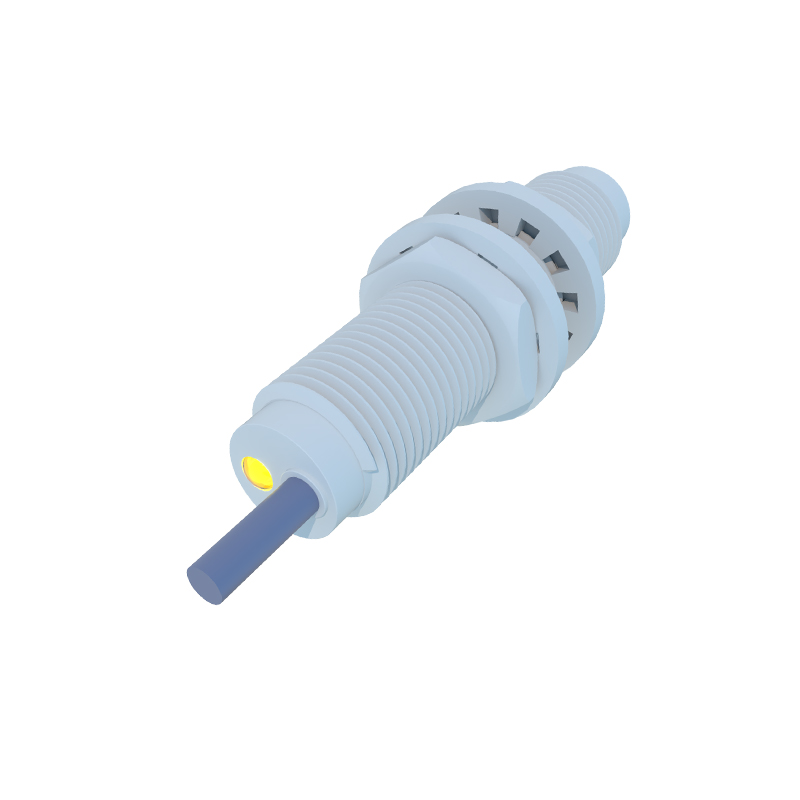
Capacitive proximity sensors can detect both metallic and non-metallic objects, but they are specifically tuned for metals in many industrial settings. These sensors function by generating an electrostatic field between two electrodes. The presence of a metal object alters the capacitance of the system, which is measured to trigger an output. Capacitive sensors offer greater sensing distances compared to inductive types for metals and can detect through non-metallic barriers like glass or plastic. They are commonly used in level detection for liquids or granular materials stored in metal containers, as well as in material handling and assembly lines. Sensitivity adjustments allow them to ignore non-target materials, making them versatile but sometimes requiring careful calibration to avoid false triggers.
Ultrasonic proximity sensors utilize sound waves beyond human hearing to detect objects, including metals. They emit high-frequency ultrasonic pulses and measure the time taken for the echo to return after reflecting off a target. For metal surfaces, which provide excellent reflectivity, these sensors offer long-range detection capabilities—often up to several meters—and are unaffected by color, transparency, or ambient light conditions. They are widely employed in distance measurement, object presence detection in logistics, and collision avoidance systems. While highly effective, their performance can be influenced by temperature variations, air turbulence, and soft or absorbent materials that dampen sound waves.
Magnetic proximity sensors, specifically reed switches or Hall effect sensors, detect the presence of magnetic fields, often from permanent magnets attached to moving metal parts. Reed switches consist of ferromagnetic reeds sealed in a glass tube; when a magnet approaches, the reeds contact each other to close a circuit. Hall effect sensors generate a voltage proportional to the magnetic field strength. These types are particularly useful for detecting the position of metal components in safety interlocks, door sensors, or rotational speed sensing. They offer high reliability, long operational life, and immunity to environmental contaminants, but require a magnet to be integrated with the target metal object.
Photoelectric sensors, while primarily used for general object detection, can be configured for metals by leveraging reflective properties. They emit a light beam (infrared, visible, or laser) and detect changes in the received light due to reflection, interruption, or convergence. For shiny metal surfaces, reflective or retro-reflective modes are effective, whereas through-beam sensors provide high accuracy for precise detection. Photoelectric sensors support very long ranges and fast response, making them suitable for conveyor systems, packaging, and automated inspection. However, they may be susceptible to interference from ambient light, dust, or oil mist, requiring protective housings in dirty environments.
Each type of metal proximity sensor has distinct advantages and limitations. Inductive sensors are prized for durability in tough conditions, capacitive sensors for versatility across materials, ultrasonic sensors for long-range and non-contact measurement, magnetic sensors for simplicity and reliability with magnetized targets, and photoelectric sensors for speed and precision. Selection depends on factors such as the metal type, required sensing distance, environmental challenges (e.g., temperature, humidity, contaminants), response speed, and installation constraints. In practice, engineers often conduct tests under real operating conditions to validate sensor performance, ensuring seamless integration into control systems for enhanced productivity and safety. As technology advances, hybrid sensors and smart versions with IoT connectivity are emerging, offering diagnostic features and adaptive sensing capabilities for Industry 4.0 applications.