Laser distance sensors have become indispensable tools in modern industrial automation, offering unparalleled precision in non-contact measurement. At the core of their functionality lies the sophisticated processing of optical signals to determine distance with remarkable accuracy. This article delves into the nature of these signals, their generation, and their interpretation in practical settings.
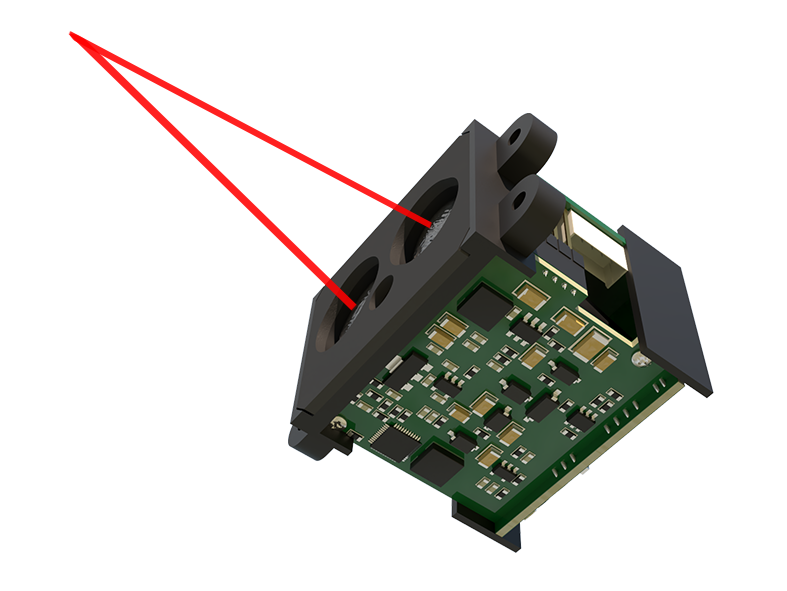
The fundamental principle involves emitting a focused laser beam toward a target. The sensor then captures the reflected light. The key signal processed is typically the time-of-flight (ToF) or phase shift of the returned laser pulse. In ToF sensors, the elapsed time between emission and reception is directly proportional to the distance. The sensor's internal circuitry converts this time interval into a corresponding electrical signal, usually a digital pulse train or an analog voltage/current output. For phase-shift measurement, the sensor modulates the laser beam's intensity with a known frequency. The phase difference between the emitted and reflected modulated light is analyzed to calculate the distance, resulting in a highly precise, continuous signal.
Signal integrity is paramount. Factors like target surface properties (reflectivity, color, texture), environmental conditions (ambient light, dust, fog), and mechanical vibrations can introduce noise or signal attenuation. A highly reflective, smooth surface provides a strong return signal, while dark, matte, or transparent surfaces may scatter or absorb the beam, weakening the signal. Modern sensors incorporate advanced signal processing algorithms to filter out noise, compensate for environmental variables, and ensure stable readings. Features like background suppression and peak detection are common for handling challenging surfaces.

The output signal format is crucial for system integration. Common industrial outputs include:
* Analog (0-10V, 4-20mA): Provides a continuous voltage or current proportional to the measured distance, ideal for PLCs and analog input modules.
* Digital (Push-Pull, NPN/PNP): Offers switching signals for presence detection or discrete positioning tasks.
* Serial Communication (RS-232, RS-485): Enables bidirectional data exchange for configuration and reading precise values.
* Industrial Ethernet (Profinet, EtherNet/IP): Facilitates high-speed, networked integration in Industry 4.0 environments.
Understanding the signal chain—from photon emission to processed electrical output—is essential for selecting the right sensor. For instance, in high-speed packaging lines, a sensor with a fast digital output and robust signal processing is needed to track moving objects. In precision assembly, an analog sensor with high resolution provides fine positional feedback. Calibration ensures the output signal accurately corresponds to the physical distance scale. Regular maintenance, including lens cleaning and verification against a known reference, preserves signal fidelity over time.
In conclusion, the laser distance sensor's signal is more than just a number; it is a carefully engineered data point derived from complex optical-electronic conversion. Its reliability directly impacts the efficiency and accuracy of automated systems, from robotic guidance and level monitoring to dimensional inspection and logistics. By mastering the characteristics and requirements of these signals, engineers can unlock their full potential for smarter, more responsive industrial automation.