Laser sensors are fundamental components in modern industrial automation, offering high precision, non-contact measurement, and reliability across diverse applications. Their operation is grounded in the principles of optics and electronics, enabling accurate detection, positioning, and inspection tasks. This article delves into the core working mechanisms, types, and key considerations for implementing laser sensors in industrial settings.
At its essence, a laser sensor operates by emitting a focused beam of coherent light—typically from a laser diode—toward a target object. The sensor then detects the interaction of this beam with the target. The most common operational principles are based on triangulation, time-of-flight (ToF), and laser reflection or interruption.
In triangulation-based sensors, the emitted laser beam strikes the target surface and is reflected at an angle. A receiving element, such as a position-sensitive detector (PSD) or a charge-coupled device (CCD), captures the reflected spot. The position of this spot on the detector shifts proportionally to the distance of the target. By calculating this displacement using geometric triangulation, the sensor determines the exact distance or height of the object with micron-level resolution. This method is prevalent in applications requiring high precision, such as thickness gauging, surface profiling, and dimensional inspection.
Time-of-flight laser sensors measure distance by calculating the time interval between the emission of a laser pulse and the reception of its reflection. Given the constant speed of light, the distance to the target is derived from the formula: Distance = (Speed of Light × Time Delay) / 2. These sensors are suitable for longer ranges, from a few meters to several hundred meters, and are commonly used in level monitoring, vehicle detection, and large-scale metrology. They offer fast response times but generally with lower resolution compared to triangulation sensors.
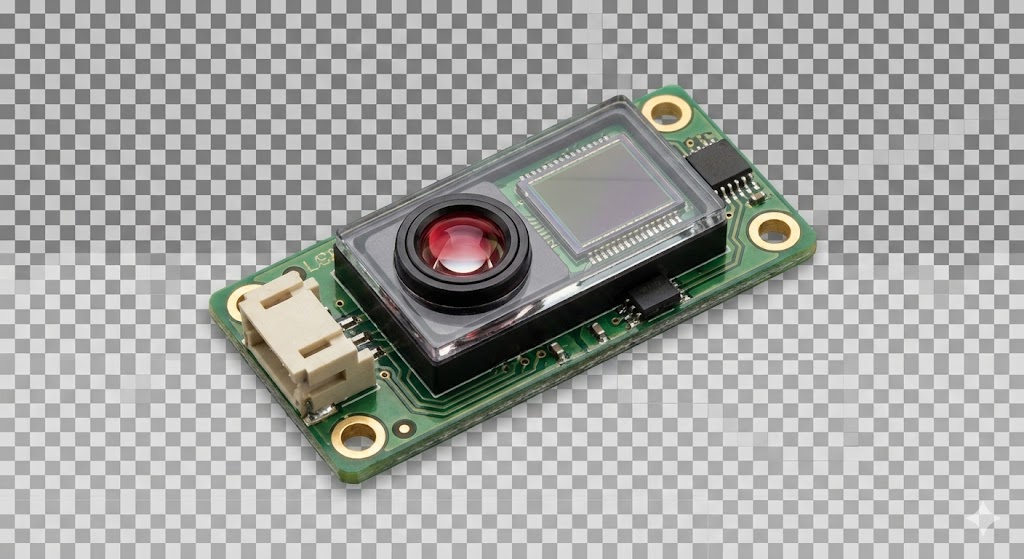
Another widespread type is the through-beam or retro-reflective laser sensor. Here, an emitter and a receiver are placed opposite each other. The sensor detects an object when it interrupts the laser beam. Alternatively, in a diffuse-reflective configuration, the emitter and receiver are housed in the same unit, detecting light reflected directly from the target. These modes are ideal for presence detection, counting, and edge detection on production lines.
Key to laser sensor performance is the wavelength of the laser light, often in the visible red or infrared spectrum. Infrared lasers are less susceptible to ambient light interference, enhancing stability in industrial environments. Additionally, factors like beam spot size, response time, and environmental ratings (e.g., IP67 for dust and water resistance) are critical for selection.
Advanced laser sensors integrate sophisticated electronics for signal processing, enabling features like background suppression, which ignores reflections from surfaces beyond a set range, and teach-in functions for easy configuration. They interface seamlessly with programmable logic controllers (PLCs) via digital outputs (e.g., PNP/NPN) or analog signals (e.g., 4-20 mA, 0-10 V).
In practice, laser sensors must be chosen based on application requirements: precision, range, target material, and environmental conditions. For instance, a glossy or transparent target may require a sensor with polarized filters to reduce false signals, while outdoor applications demand robust housings and temperature compensation. Regular maintenance, including lens cleaning and alignment checks, ensures long-term accuracy.
In summary, laser sensors leverage precise optical principles to deliver non-contact measurement solutions vital for automation. Understanding their working principles—triangulation, time-of-flight, and reflection-based detection—empowers engineers to select and deploy the right sensor, enhancing efficiency, quality control, and safety in industrial operations. As technology advances, innovations like laser line projection for 3D scanning and integrated IoT capabilities continue to expand their utility, solidifying their role as indispensable tools in smart manufacturing.