In the realm of modern electronics, the proximity sensor stands as a fundamental yet often invisible component, enabling seamless interaction between devices and their environment. These sensors detect the presence or absence of nearby objects without any physical contact, a capability that has become integral to countless applications. At its core, a proximity sensor works by emitting an electromagnetic field or a beam of radiation, such as infrared light, and then looking for changes in the field or return signal. The object being sensed is often referred to as the sensor's target.
The underlying technology varies, leading to several common types. Inductive proximity sensors are widely used for detecting metallic objects. They generate an oscillating electromagnetic field from a coil. When a metal target enters this field, it induces eddy currents, which dampen the oscillation amplitude. This change is detected by the sensor's circuitry, triggering an output signal. These sensors are robust, resistant to environmental factors like dust or oil, and are staples in industrial automation for tasks like counting, positioning, and machine safety.
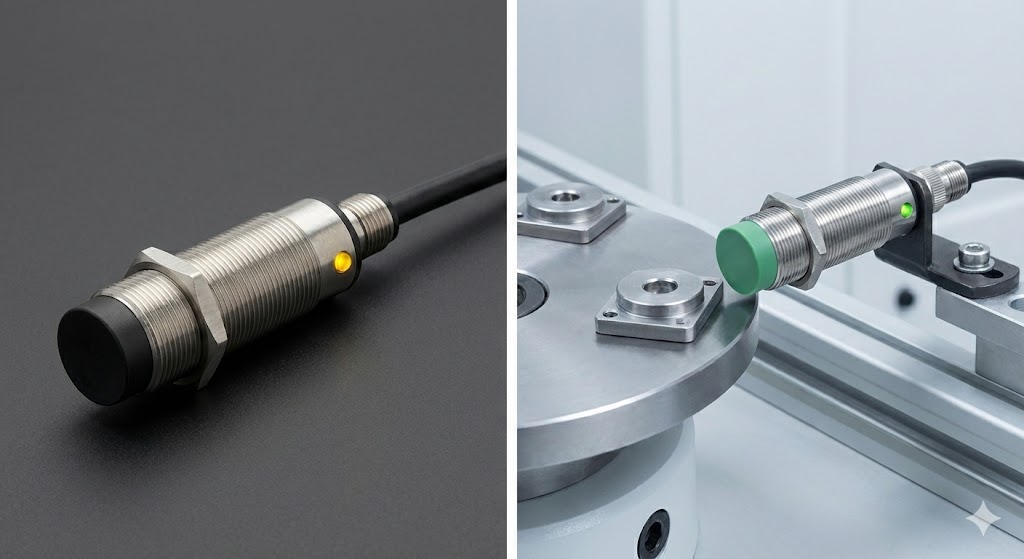
Capacitive proximity sensors, on the other hand, can detect both metallic and non-metallic materials, including liquids, powders, and plastics. They function by generating an electrostatic field. When a target object enters this field, it alters the capacitance of the circuit. This alteration is measured, and the sensor responds accordingly. This makes them ideal for applications in the food and beverage industry, material handling, and liquid level detection.
Optical proximity sensors, often using infrared (IR) light, consist of an emitter and a receiver. The emitter sends out a beam of light. In a reflective-type sensor, the receiver detects the light reflected back from the target. In a through-beam type, the receiver is positioned opposite the emitter, and detection occurs when the target interrupts the beam. These sensors offer high precision and fast response times, making them perfect for object detection on assembly lines, in touchscreen devices to disable the screen during a call, and in robotics.
Ultrasonic sensors represent another major category. They work on a principle similar to sonar, emitting high-frequency sound waves and evaluating the echo received back. The time interval between sending the signal and receiving the echo is calculated to determine the distance to the target. They are excellent for detecting objects of various materials and shapes, and are commonly used in parking assist systems, tank level monitoring, and collision avoidance.
The applications of proximity sensors are vast and deeply embedded in daily life and industry. In consumer electronics, they are the reason a smartphone screen turns off when held to the ear during a call, conserving battery and preventing accidental touches. In automotive systems, they form the backbone of parking sensors and blind-spot monitoring, enhancing driver safety. Industrial manufacturing relies heavily on them for precise positioning of parts on conveyor belts, robotic guidance, and ensuring machine safety by detecting the presence of operators in hazardous zones. Furthermore, they enable touchless faucets and soap dispensers in public restrooms, promoting hygiene.
Looking forward, the evolution of proximity sensing is intertwined with trends like the Internet of Things (IoT) and miniaturization. Sensors are becoming smaller, more energy-efficient, and smarter, with integrated processing capabilities. The development of time-of-flight (ToF) sensors, which use laser light to measure distance with extreme accuracy, is opening new frontiers in 3D imaging, facial recognition, and augmented reality. Furthermore, sensor fusion—combining data from proximity sensors with other sensors like accelerometers and gyroscopes—is creating more context-aware and intelligent systems.
Despite their sophistication, the design and implementation of proximity sensors require careful consideration. Factors such as sensing range, target material, environmental conditions (like temperature, humidity, or ambient light), response time, and output type (digital or analog) must be matched to the specific application. Electrical noise and cross-talk between multiple sensors are also practical challenges that engineers must address.
In conclusion, the proximity sensor is a quintessential example of a simple concept enabling complex automation and interaction. From safeguarding heavy machinery to making our personal devices more intuitive, these silent sentinels continuously monitor the immediate physical world, providing critical data that drives decision-making in electronic systems. As technology advances, their role will only expand, becoming more precise, integrated, and vital to the smart, connected world of the future.