In the realm of industrial automation and precision measurement, sector laser sensors have emerged as a critical technology, offering unparalleled accuracy and adaptability. Unlike traditional point or line lasers, a sector laser projects a fan-shaped beam of light, creating a two-dimensional plane of detection. This unique characteristic allows for the simultaneous measurement of an object's presence, position, height, and even profile across a wide area, making it indispensable in complex manufacturing and quality control environments.
The core operating principle of a sector laser sensor involves the emission of a laser diode's light through a specialized cylindrical lens. This lens diffuses the concentrated beam into a thin, wide fan. When this planar light strikes an object within its field of view, the sensor's high-resolution CMOS or CCD receiver captures the deformation or interruption of the light line. Sophisticated internal processors then analyze this data in real-time. By calculating the triangulation between the laser source, the object's edge, and the receiver, the sensor can determine precise dimensional values, such as height steps, gaps, or edge positions, with micron-level resolution.
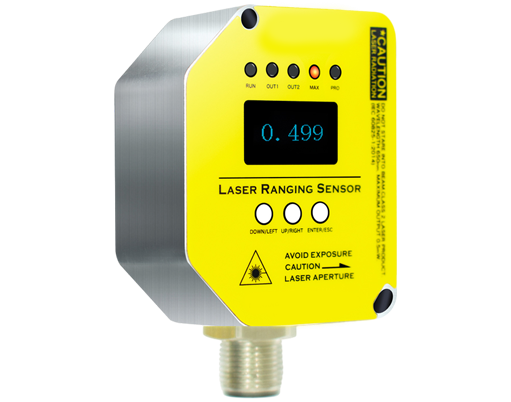
The applications for sector laser sensors are vast and varied. In automotive assembly lines, they are deployed for precise gap and flush measurement between body panels, ensuring aesthetic quality and aerodynamic performance. In electronics manufacturing, these sensors verify the coplanarity of surface-mount components on PCBs, preventing soldering defects. The logistics and packaging industry utilizes them for height profiling to control fill levels, detect overfilled boxes, or sort packages by size. Furthermore, in robotic guidance systems, the sector laser provides a rich data profile, enabling robots to accurately locate and pick irregularly shaped objects from bins or conveyor belts.

Several key advantages distinguish sector laser sensors from other optical measurement tools. First is their non-contact nature, which eliminates the risk of damaging delicate surfaces and allows for high-speed inspection on moving production lines. Second, their wide measurement range and large field of view enable the inspection of large or multiple features in a single scan, boosting throughput. Third, their robustness against ambient light interference and varying surface colors or textures—often through the use of modulated laser light and advanced filtering algorithms—ensures reliable performance in harsh industrial settings. Finally, their ability to generate profile data, rather than just a binary on/off signal, provides a deeper layer of process intelligence for predictive maintenance and statistical process control (SPC).
When integrating a sector laser sensor, engineers must consider several parameters to optimize performance. The selection of the appropriate measurement range and stand-off distance is paramount. The width and thickness of the laser fan, along with its divergence angle, define the inspection area. Resolution, typically specified in micrometers, determines the smallest detectable feature. Response time and sampling rate must align with the line speed to avoid data aliasing. Communication interfaces, such as Ethernet/IP, PROFINET, or simple digital I/O, must be compatible with the existing factory network. Proper mounting, alignment, and calibration are also crucial steps to ensure measurement accuracy and long-term stability.
Looking ahead, the evolution of sector laser sensors is closely tied to trends in Industry 4.0. The integration of embedded intelligence and IoT connectivity is turning these sensors into smart edge devices capable of preliminary data analysis and direct communication with cloud platforms. Advancements in laser safety (e.g., Class 1 or 2M) are simplifying their deployment without extensive safety enclosures. Furthermore, the fusion of 2D laser profile data with 3D vision systems is opening new frontiers for comprehensive volumetric inspection and digital twin creation.
In conclusion, the sector laser sensor stands as a testament to the power of focused optical innovation in solving industrial challenges. Its ability to deliver high-precision, two-dimensional profile data in real-time makes it a cornerstone technology for enhancing quality, efficiency, and intelligence in modern automated systems. As manufacturing demands grow more complex, the versatility and reliability of the sector laser sensor will continue to solidify its role as an essential tool for engineers driving the future of automation.