Laser sensors have revolutionized distance measurement across numerous industries, offering unparalleled accuracy, speed, and reliability. At their core, these devices operate on fundamental principles of physics, primarily utilizing time-of-flight (ToF) or triangulation methods to determine the distance to a target object.
The time-of-flight principle is one of the most common and straightforward techniques. In this method, the sensor emits a short pulse of laser light towards the target. The light reflects off the target's surface and returns to a detector within the sensor. An internal high-precision clock measures the elapsed time between the emission and the reception of the reflected pulse. Since the speed of light (c) is a known constant (approximately 299,792,458 meters per second), the distance (d) to the target can be calculated using the simple formula: d = (c * t) / 2, where 't' is the measured time. The division by two accounts for the round-trip journey of the light. Modern ToF sensors can achieve sub-millimeter accuracy over several meters, making them ideal for applications like industrial automation, robotics navigation, and warehouse logistics where long-range and high-speed measurements are critical.
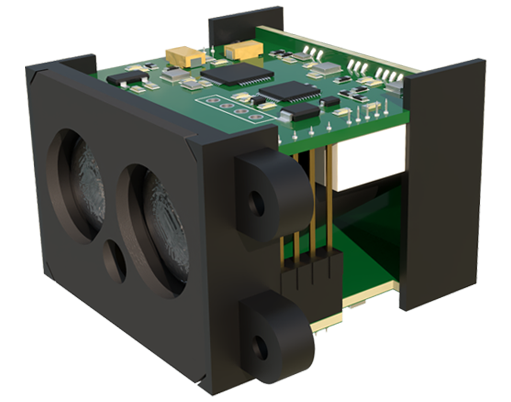
Another prevalent method is laser triangulation. Here, the sensor projects a focused laser spot onto the target surface. The reflected light from this spot is imaged onto a position-sensitive detector, typically a CCD or CMOS array, at a known angle relative to the outgoing laser beam. As the target distance changes, the position of the reflected spot shifts linearly across the detector. Using basic trigonometric relationships within this fixed geometric setup—comprising the laser source, the detected spot position, and the known baseline distance between the laser emitter and the detector—the sensor's processor calculates the exact distance to the target. Triangulation sensors excel in high-resolution, short to medium-range measurements, often down to micrometer-level precision. They are extensively used in quality control for profiling, thickness measurement, and surface inspection in manufacturing.
Beyond these primary methods, phase-shift analysis is a sophisticated variant used in some high-precision ToF sensors. Instead of measuring a single pulse's travel time, the sensor emits a continuous wave of amplitude-modulated laser light. The phase difference between the emitted wave and the reflected wave is measured. This phase shift is directly proportional to the distance traveled. This technique allows for extremely fine resolution, often surpassing pure pulse-based ToF, but is generally effective over shorter distances.
The performance of a laser distance sensor is influenced by several key factors. The reflectivity and color of the target surface significantly impact the strength of the return signal; a matte white surface provides an ideal reflection, while dark or shiny surfaces can pose challenges. Advanced sensors compensate for this with automatic exposure control or by using specialized algorithms. Environmental conditions like ambient light, dust, fog, or temperature variations can also affect performance, necessitating robust sensor housing and filtering technologies. Modern sensors integrate intelligent features such as background suppression, which ignores objects beyond a set distance, and multi-echo evaluation, which can select the strongest or first return signal to penetrate optical noise like dust or steam.
Applications are vast and growing. In autonomous vehicles, LiDAR (Light Detection and Ranging) systems, which are essentially advanced arrays of laser ToF sensors, create real-time 3D maps of the environment. In construction, laser distance meters are ubiquitous for surveying and layout work. On factory floors, they precisely position robotic arms, control material handling systems, and verify part dimensions. The agility and non-contact nature of laser measurement prevent part wear and enable inspection of delicate or hot objects.
In conclusion, laser distance sensors are a cornerstone of modern industrial measurement. By leveraging the consistent speed of light and clever geometric or phase-based interpretations, they deliver fast, accurate, and reliable distance data. The choice between ToF, triangulation, or phase-shift technology depends on the specific requirements for range, precision, speed, and target properties. As laser and detector technologies continue to advance, these sensors will push the boundaries of what is measurable, driving further innovation in automation, safety, and quality assurance across all technical fields.