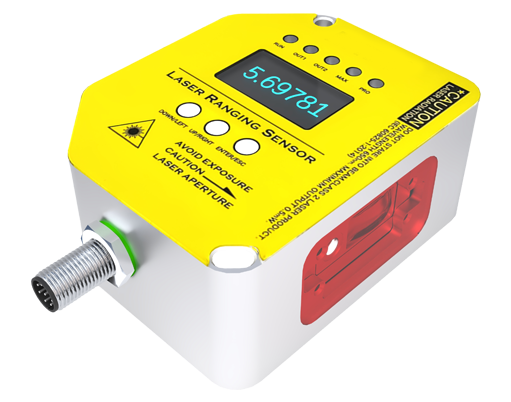
In modern industrial automation, laser sensors have emerged as a critical component for achieving unparalleled precision in motor control systems. These sensors utilize focused light beams to detect minute changes in position, speed, or alignment, enabling real-time feedback that traditional mechanical or ultrasonic sensors cannot match. The integration of laser-based sensing with motor drives—whether AC, DC, or servo—facilitates closed-loop control mechanisms that significantly enhance accuracy, reduce energy consumption, and minimize mechanical wear.
The operational principle hinges on the laser sensor emitting a coherent light beam toward a target surface attached to the motor shaft or a moving part. Reflections or interruptions in the beam are captured by a receiver, which converts optical data into electrical signals. These signals are processed by a microcontroller or programmable logic controller (PLC) to adjust motor parameters instantaneously. For instance, in conveyor systems, laser sensors can detect object presence and size, triggering motors to start, stop, or vary speed accordingly, thus optimizing throughput and preventing jams.
Key advantages include high-resolution measurement capabilities, often down to micrometer levels, and immunity to electromagnetic interference common in industrial environments. Laser sensors also offer non-contact operation, eliminating friction and maintenance issues associated with physical encoders. In robotics, this technology enables precise articulation of joints and end-effectors, while in CNC machinery, it ensures exact tool positioning for intricate machining tasks.
Implementation requires careful calibration to account for environmental factors like ambient light, dust, or vibration. Advanced models incorporate adaptive algorithms that compensate for such disturbances, ensuring reliable performance. Additionally, integrating laser sensors with IoT platforms allows for predictive maintenance, where data analytics forecast potential motor failures before they occur, reducing downtime.

Looking ahead, innovations in fiber-optic laser sensors and miniaturized designs are expanding applications to sectors like aerospace and medical devices. As Industry 4.0 evolves, the synergy between laser sensing and motor control will continue to drive efficiency, safety, and automation across global industries.