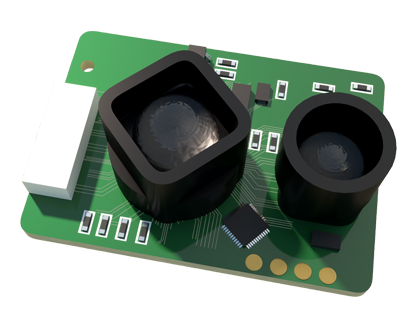
Laser distance sensors, also known as laser rangefinders or LiDAR sensors in specific configurations, represent a cornerstone technology in modern industrial automation, robotics, and measurement systems. Their core principle is elegantly simple yet incredibly precise: they emit a focused beam of laser light towards a target and measure the time it takes for the reflection to return to the sensor. This time-of-flight (ToF) measurement, when multiplied by the speed of light, provides an exceptionally accurate distance reading. Alternative phase-shift measurement methods are also employed for very high precision over shorter ranges. Unlike ultrasonic or inductive sensors, laser sensors offer unparalleled advantages in terms of accuracy, resolution, and response speed, making them indispensable for demanding applications.
The operational principle hinges on the properties of coherent light. A laser diode generates a highly concentrated, monochromatic beam. This beam is directed at the target object. Upon striking the surface, the light is scattered, with a small portion reflected back towards the sensor's receiver optics. A photodetector, typically an avalanche photodiode (APD) or a position-sensitive device (PSD) in triangulation-based sensors, captures this returning signal. For Time-of-Flight sensors, an internal high-speed clock precisely measures the interval between emission and reception. Given the constant speed of light (~3x10^8 m/s), even nanosecond differences translate into millimeter or sub-millimeter distance measurements. Advanced signal processing algorithms filter out ambient light noise and compensate for factors like target surface color or reflectivity, though highly absorptive or transparent materials can pose challenges.

The applications of laser distance sensors are vast and continuously expanding. In industrial automation, they are critical for precise positioning of robotic arms, controlling web tension in rolling mills, monitoring fill levels in containers, and measuring part dimensions for quality control. The logistics sector relies on them for palletizing, warehouse automation, and dimensioning packages. In construction and civil engineering, handheld laser distance meters have revolutionized surveying and layout work. Furthermore, they form the essential perception system for autonomous mobile robots (AMRs) and autonomous vehicles, creating real-time 3D maps of the environment. Emerging uses include drone-based surveying, forestry management, and even healthcare for patient positioning and non-contact monitoring.
Selecting the appropriate laser distance sensor requires careful consideration of several key parameters. First is the measuring range, which can vary from a few centimeters to several hundred meters, depending on the model and laser class. Accuracy and resolution are paramount; high-precision applications in semiconductor manufacturing may require micron-level resolution, while warehouse navigation might suffice with centimeter accuracy. The response time or sampling rate determines how quickly the sensor can update measurements, crucial for high-speed production lines or dynamic robotics. Laser class (typically Class 1 or Class 2 for eye-safe operation in factories) is a critical safety consideration. The output interface (analog 4-20mA, voltage, RS-232, RS-485, Ethernet/IP, PROFINET, etc.) must be compatible with the existing control system. Environmental factors like ambient temperature, dust, moisture (IP rating), and vibration resistance are also decisive, especially in harsh industrial settings. Finally, the target properties—its color, material, surface finish, and even angle—can significantly affect performance and may necessitate sensors with specialized background suppression or multi-echo evaluation capabilities.
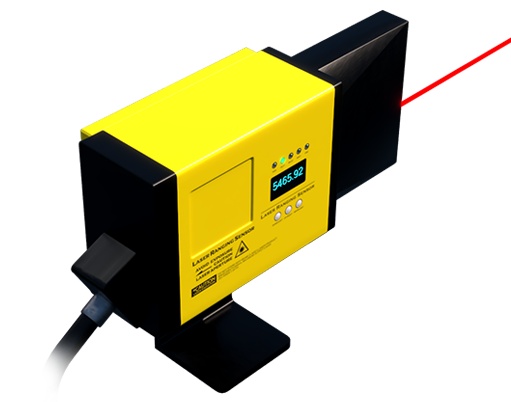
Installation and maintenance are straightforward but require attention to detail. The sensor must be securely mounted to minimize vibration. The laser beam should be perpendicular to the target surface for optimal signal return, and the optical lenses must be kept clean from dust, oil, or condensation to prevent signal attenuation. Regular calibration checks against a known reference are recommended for mission-critical applications. Modern sensors often feature built-in diagnostics and configuration via software, simplifying setup and troubleshooting.
Looking ahead, the evolution of laser distance sensing technology points towards even greater miniaturization, lower power consumption, and enhanced intelligence. The integration of sensor fusion, combining laser data with camera vision or inertial measurement units (IMUs), will enable more robust and context-aware systems. Furthermore, the development of solid-state LiDAR without moving parts is making high-resolution 3D sensing more affordable and reliable for mass-market applications. As Industry 4.0 and smart manufacturing advance, the role of the laser distance sensor as a fundamental enabler of precision, efficiency, and autonomy will only become more pronounced. Engineers and system integrators who master its principles and applications will be well-equipped to solve the complex positioning and measurement challenges of the future.