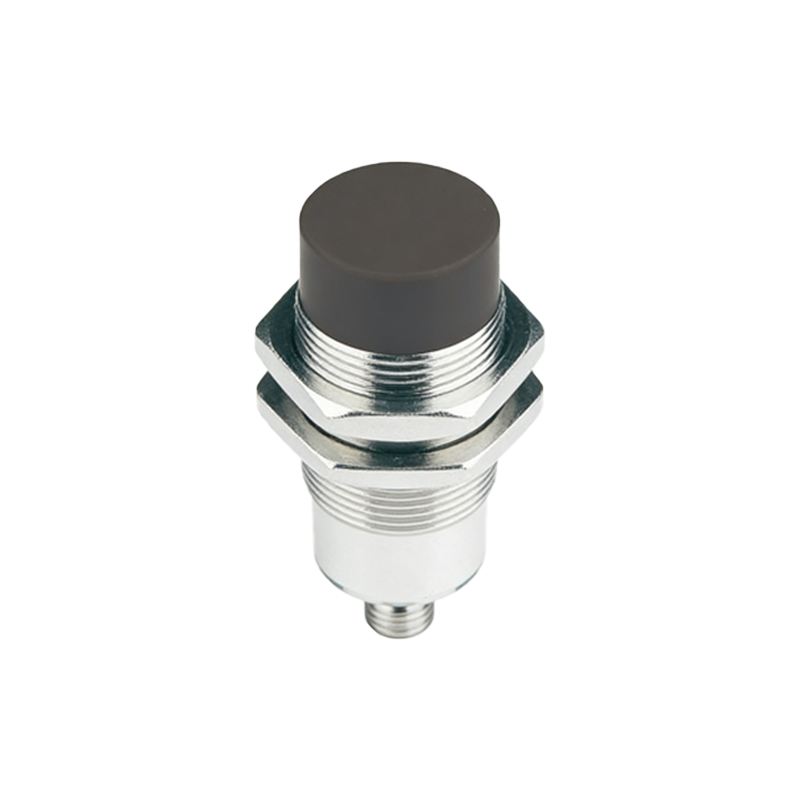
The E2EX10MF1-Z is a high-performance inductive proximity sensor designed for demanding industrial automation applications. As a member of the Omron E2E-X series, this cylindrical metal-body sensor offers exceptional reliability, precision, and durability in detecting metallic objects. Its core operating principle is based on electromagnetic induction. The sensor generates a high-frequency oscillating electromagnetic field from its sensing face. When a metallic target enters this detection field, it induces eddy currents within the target, causing a change in the oscillation amplitude within the sensor's coil circuit. This change is detected by the internal circuitry, which subsequently triggers a solid-state output switch.
A key specification of the E2EX10MF1-Z is its 10mm nominal sensing distance (Sn). This distance is calibrated for a standard target, typically a square of mild steel (Fe 37) measuring 1mm thick with sides equal to the sensor's diameter or three times the nominal sensing distance, whichever is greater. It is crucial to note that the sensing distance can vary with different target materials. For instance, the effective sensing distance for stainless steel (SUS304) is approximately 0.7 to 0.8 times that for mild steel, while for brass and aluminum, it can reduce to 0.3-0.4 times and 0.2-0.3 times, respectively. This factor must be carefully accounted for during system design and installation.
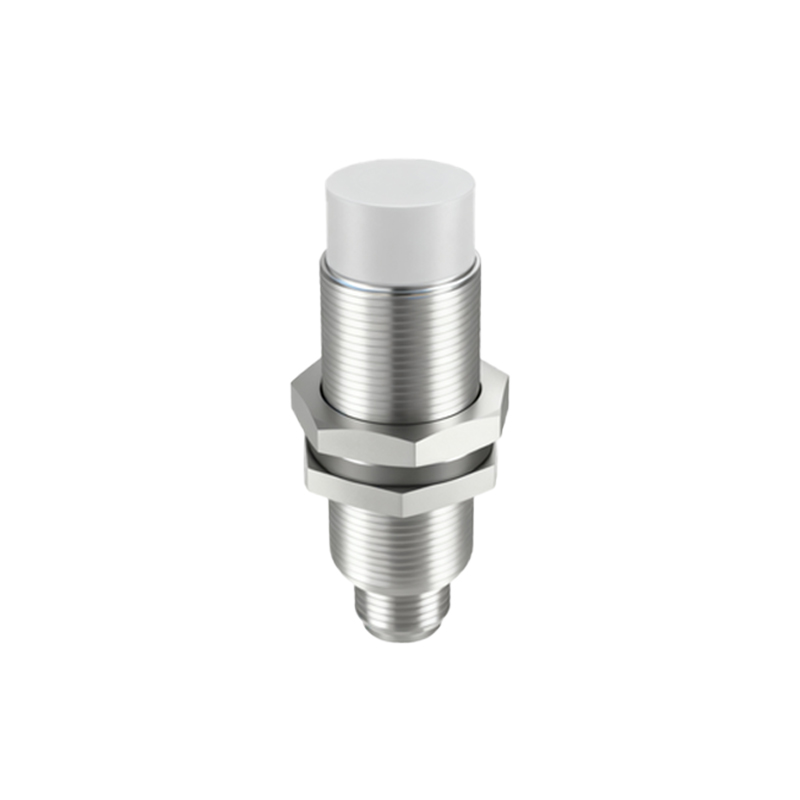
The sensor features a built-in amplifier and is available in a DC 3-wire configuration. The "MF1" in the model number indicates a M12 size, 4-pin quick-disconnect connector, which simplifies wiring and maintenance. The "Z" suffix denotes a normally open (NO) output configuration. It operates on a supply voltage range of 12-24 VDC, with a maximum leakage current of 0.8 mA and a voltage drop of 2.5 V max. Its output is an NPN transistor sink type, capable of switching loads up to 200 mA. The response frequency is a robust 1 kHz, allowing for the detection of fast-moving objects on production lines. The housing is constructed from nickel-plated brass, providing excellent resistance to corrosion, oils, and coolants commonly found in industrial environments. It carries an IP67 ingress protection rating, making it suitable for use in areas exposed to dust and temporary immersion in water.
Installation requires careful consideration of the surrounding metallic environment. To ensure stable operation, a non-metallic space must be maintained around the sensor's sensing face and along its sides. The recommended installation distance between two identical sensors mounted side-by-side is at least twice the sensor's diameter to prevent mutual interference. For flush-mountable models like the E2EX10MF1-Z, they can be embedded in a metal bracket without a loss of sensing distance, which is a significant advantage in space-constrained applications.
Typical applications for the E2EX10MF1-Z are widespread across factory automation. It is extensively used for position detection, such as verifying the presence of a metal part at a robotic pick-up station, confirming the closed position of a metal door or guard, or counting metallic products on a conveyor. Its high-speed response makes it ideal for rotary encoder applications or detecting passing teeth on a gear to monitor rotational speed. In machine tools, it is employed for tool breakage detection or end-of-stroke limit sensing on actuators. The sensor's robustness also lends itself to harsh environments like welding lines, where it can detect metal fixtures or parts despite spatter, provided a protective cover is used.
When integrating the E2EX10MF1-Z, proper electrical connection is paramount. The brown wire is connected to the positive supply voltage (+V), the blue wire to the common negative (0V), and the black wire is the switched output load line. The load (such as a PLC input, relay coil, or indicator lamp) is connected between the black wire and the positive supply. Always refer to the official datasheet for the precise wiring diagram. For longevity, it is advised to use a stable, regulated power supply and incorporate protective circuits like surge suppressors when connecting to inductive loads. Regular maintenance should include cleaning the sensing face of any accumulated debris, metal chips, or oil film, as these contaminants can reduce the effective sensing range.
In summary, the Omron E2EX10MF1-Z inductive proximity sensor represents a reliable and versatile solution for non-contact metal detection. Its 10mm range, compact M12 form factor, solid-state reliability, and industrial-grade construction make it a preferred component for engineers designing robust and efficient automated systems. Understanding its specifications, material factors, installation guidelines, and application best practices is essential for maximizing performance and ensuring long-term operational success in any control system.