Proximity switch sensors are essential components in modern industrial automation, providing non-contact detection of metallic and non-metallic objects. The detection circuit is the core of these sensors, determining their reliability, accuracy, and response speed. This article delves into the design principles, key components, and practical considerations for building effective proximity sensor detection circuits.
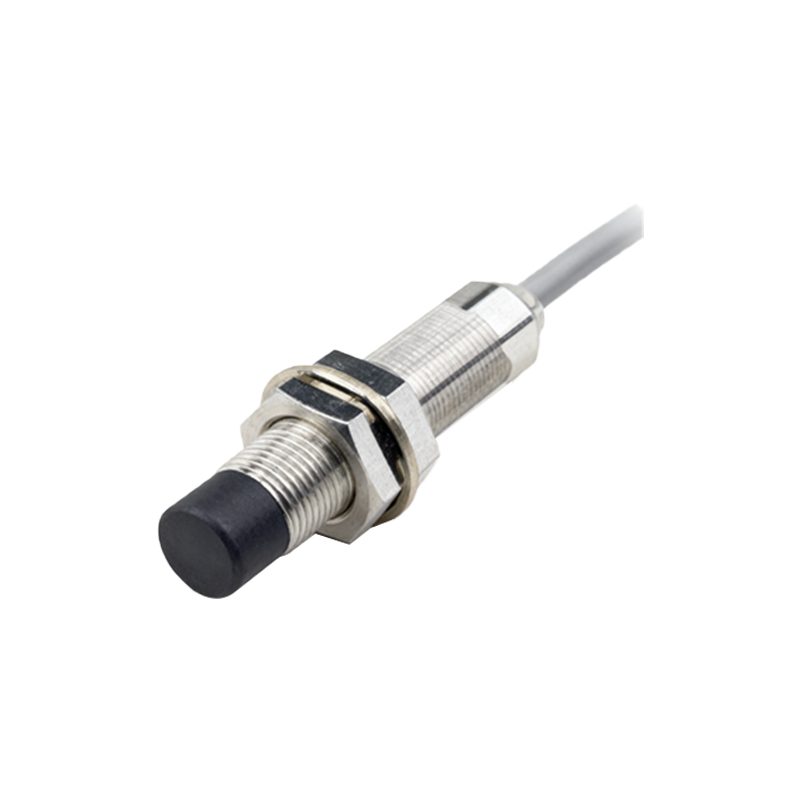
The fundamental operation of a proximity sensor relies on electromagnetic, capacitive, or inductive principles. Inductive proximity switches, the most common type for metal detection, utilize a coil to generate an oscillating electromagnetic field. When a metallic object enters this field, eddy currents are induced, causing a change in the oscillation amplitude or frequency. The detection circuit monitors this change and triggers a switching action. A typical circuit comprises an oscillator, a demodulator, a Schmitt trigger, and an output stage.
The oscillator generates a high-frequency signal, usually in the range of 100 kHz to 1 MHz. Its stability is paramount; even minor drifts can lead to false triggering. Common designs use a Colpitts or Hartley oscillator configuration with a temperature-compensated LC tank circuit. The choice of core material for the coil—often ferrite—affects the sensing range and frequency response. The demodulator converts the AC signal from the oscillator into a DC voltage proportional to the oscillation's amplitude. Peak detection or envelope detection circuits are typically employed here.
Following demodulation, the signal passes through a Schmitt trigger. This component provides hysteresis, a critical feature that prevents output chatter when the target object is at the borderline of the sensing range. By setting distinct upper and lower threshold voltages, the Schmitt trigger ensures a clean, definitive switch from high to low state (or vice versa) without rapid oscillation. The output stage then interfaces with the control system. Common outputs include NPN/PNP transistors for DC sensors, relay contacts, or solid-state switches. For noise immunity in industrial environments, circuits often incorporate shielding, filtering capacitors, and transient voltage suppression diodes.
Designing a robust detection circuit requires careful attention to several factors. Power supply stability is crucial; voltage regulators and decoupling capacitors must be used to mitigate ripple and noise. Environmental conditions like temperature extremes, humidity, and electromagnetic interference (EMI) from nearby motors or welders can severely impact performance. Employing differential signal paths, twisted-pair wiring, and metal enclosures enhances EMI resistance. Furthermore, the circuit must be designed for the specific sensing material. While inductive sensors detect metals, capacitive variants can sense non-metals like plastics or liquids by detecting changes in dielectric constant. Their circuits involve measuring capacitance changes in an RC oscillator.
Modern advancements integrate microcontrollers into detection circuits. A microcontroller can digitally process the oscillator signal, implementing advanced algorithms for temperature compensation, sensitivity adjustment, and diagnostics. It can also communicate via protocols like IO-Link, providing detailed status information beyond a simple on/off signal. This digital integration allows for programmable sensing distances, output delays, and operating modes, increasing flexibility.
In practical application, calibration and testing are vital. Using a calibrated target at the specified sensing distance, engineers adjust potentiometers or digital registers to set the optimal trigger point. The circuit's response time, typically in microseconds to milliseconds, must be verified to ensure it meets the application's speed requirements, such as in high-speed counting or position verification on conveyor lines.
In conclusion, the effectiveness of a proximity switch hinges on its detection circuit. A well-designed circuit balances sensitivity, stability, and noise immunity. By understanding the interplay between the oscillator, signal conditioning stages, and output interface, engineers can develop sensors that deliver consistent performance in demanding industrial settings, contributing to enhanced automation efficiency and safety.