In the realm of industrial automation and precision engineering, laser positioning sensors have become indispensable tools for achieving high-accuracy measurements and control. These sensors utilize laser technology to detect, measure, and position objects with exceptional precision, playing a critical role in applications ranging from robotics and manufacturing to quality inspection and logistics. The accuracy of a laser positioning sensor is a paramount factor that directly impacts system performance, product quality, and operational efficiency. This article delves into the key aspects influencing laser sensor accuracy, common challenges, and best practices for optimization.
Accuracy in laser positioning sensors refers to the closeness of the measured value to the true position of a target. It is typically expressed in units such as micrometers (µm) or millimeters (mm), depending on the sensor's range and application. Several factors contribute to the overall accuracy of these devices. First, the quality of the laser source and optics is fundamental. A stable, coherent laser beam with minimal divergence ensures consistent measurement points. High-grade lenses and mirrors help maintain beam integrity, reducing errors from scattering or distortion. Environmental conditions also play a significant role. Temperature fluctuations, humidity, vibrations, and ambient light can interfere with laser signals, leading to inaccuracies. For instance, thermal expansion may alter sensor components or target positions, while dust or smoke can scatter the laser beam. To mitigate these effects, many industrial sensors incorporate compensation algorithms and protective enclosures.

The type of laser sensor technology used affects accuracy as well. Common variants include time-of-flight (ToF) sensors, triangulation-based sensors, and confocal sensors. ToF sensors measure distance by calculating the time taken for a laser pulse to reflect off a target, offering good accuracy over long ranges but potentially limited in fine detail. Triangulation sensors, which use a laser, a receiver, and geometric principles, excel in high-precision short-range applications, often achieving sub-micrometer accuracy. Confocal sensors provide even higher resolution by focusing laser light at specific points, ideal for measuring surface profiles or thin materials. Selecting the right technology based on range, resolution, and environmental factors is crucial for optimal accuracy.
Calibration and alignment are critical for maintaining sensor accuracy over time. Regular calibration against known standards ensures that measurements remain reliable. Misalignment due to mechanical shifts or wear can introduce systematic errors, so periodic checks and adjustments are necessary. Additionally, the surface properties of the target object influence accuracy. Reflective, transparent, or dark surfaces may absorb or scatter laser light differently, causing measurement deviations. Advanced sensors often feature adjustable settings or multiple detection modes to handle diverse materials. For example, some models use wavelength variations or polarization techniques to improve performance on challenging surfaces.
In practical applications, integrating laser positioning sensors with control systems requires attention to data processing and communication. High-speed processors and noise-filtering algorithms enhance accuracy by reducing signal interference. Real-time feedback loops enable dynamic adjustments in automated processes, such as robotic assembly lines where precise part placement is essential. Case studies from industries like automotive manufacturing highlight how laser sensors achieve accuracies within ±10 µm for welding or painting robots, ensuring consistent product quality. Similarly, in semiconductor fabrication, sensors with nanometer-level accuracy are used for wafer alignment, where even minor errors can lead to defects.
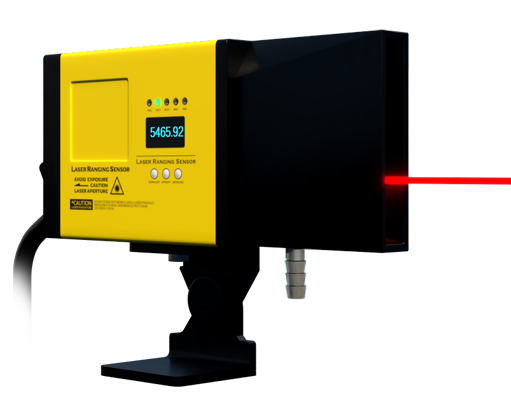
Despite advancements, challenges persist in pushing the boundaries of laser sensor accuracy. Factors like multi-path interference (where reflections from multiple surfaces cause signal confusion) or rapid target movements can degrade performance. Ongoing research focuses on improving sensor designs, such as using multiple lasers or advanced signal processing techniques like machine learning to predict and correct errors. As industries demand higher precision for miniaturization and smart manufacturing, laser positioning sensors continue to evolve, with emerging trends like LiDAR integration and quantum sensing promising even greater accuracy.
To maximize accuracy, users should follow best practices: choose sensors with specifications matching application needs, ensure proper installation and shielding from environmental disturbances, implement routine maintenance schedules, and leverage software tools for calibration and diagnostics. By understanding the intricacies of laser positioning sensor accuracy, engineers and operators can enhance system reliability, reduce waste, and drive innovation in precision-dependent fields. Ultimately, the pursuit of higher accuracy not only improves operational outcomes but also supports advancements in technology and industrial automation.
