In the realm of industrial automation and precision engineering, the ability to detect objects with minute dimensions—often down to sub-millimeter scales—is not merely an advantage but a fundamental requirement. Proximity sensors, particularly inductive and capacitive types, are at the forefront of this capability. This article delves into the technical considerations, selection criteria, and application best practices for using proximity sensors in detecting extremely small or fine-featured targets.
The core challenge in detecting minute dimensions lies in the sensor's sensing field characteristics. A standard proximity sensor has a defined nominal sensing range (Sn). However, for tiny objects like a thin wire, a small screw head, or the edge of a micro-component, the effective sensing distance can be drastically reduced. This is because the target's surface area interacting with the sensor's electromagnetic or electrostatic field is insufficient. The "reduction factor," a critical parameter in datasheets, quantifies this effect. For instance, a sensor with an Sn of 5mm might only detect a 0.5mm diameter wire at 1mm or less. Engineers must calculate the effective sensing distance by applying the reduction factor specific to the target material and size.
Material composition is equally paramount. Inductive proximity sensors excel at detecting ferrous (e.g., steel) and non-ferrous metals (e.g., aluminum, copper), but their sensitivity varies. A small steel ball bearing is detected at a longer range than an aluminum one of the same size. For non-metallic minute objects—such as a plastic fiber, a glass vial, or a thin film—capacitive proximity sensors are the tool of choice. They respond to changes in dielectric constant, allowing them to sense materials regardless of color or opacity, provided the material's permittivity differs sufficiently from air.
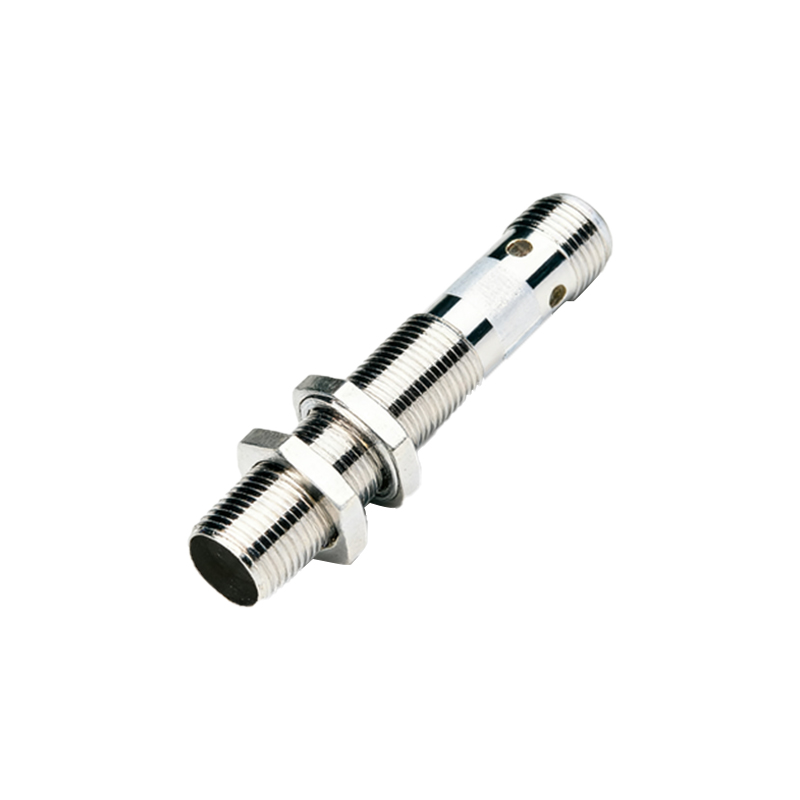
Sensor selection must prioritize size and sensing face design. For detecting fine features, a sensor with a physically small sensing face is often necessary to achieve a concentrated and precise field. Tubular sensors in M5, M8, or even M3 housings are common. Furthermore, "factor 1" sensors, designed to detect all metals at the same range, offer more predictable performance for mixed-material applications involving small parts. Shielding (flush-mounted) designs are frequently preferred over unshielded (non-flush) types in confined spaces, as they limit the lateral spread of the sensing field, reducing the risk of false triggers from adjacent objects.
Environmental interference is a magnified concern. Electrical noise from variable frequency drives (VFDs) or welding equipment can cause erratic behavior in sensitive amplifiers. Electrically isolated designs and sensors with robust noise immunity ratings (e.g., 10V/m per EN 60947-5-2) are essential. Temperature fluctuations can also slightly alter the oscillation circuit's characteristics, potentially affecting repeatability for micron-level positioning tasks. Choosing sensors with wide operating temperature ranges and stable temperature compensation is crucial for high-precision environments.
Installation and alignment become precision tasks themselves. A misalignment of a few tenths of a millimeter can mean the difference between reliable detection and failure. Rigid mounting brackets, fine-adjustment fixtures, and the use of alignment tools are recommended. The sensing axis must be perpendicular to the target surface for optimal coupling. For detecting the presence of a tiny hole or a missing tooth on a micro-gear, a through-beam photoelectric sensor might sometimes be a more suitable alternative, though it lacks the durability and contamination resistance of a solid-state proximity sensor in harsh conditions.
Finally, integration with the control system demands attention to signal stability. The output signal from the sensor, when detecting a minute target operating at the edge of its capability, may exhibit chatter or a weakened signal. Using a programmable logic controller (PLC) with a high-speed input card and implementing a short software filter (debounce delay) can ensure a clean, reliable signal for downstream processes like counting, sorting, or robotic pick-and-place.
In conclusion, successfully detecting minute dimensions with proximity sensors is a multifaceted engineering exercise. It requires a deep understanding of sensor physics, meticulous review of datasheet specifications—especially reduction factors and temperature coefficients—and careful consideration of the mechanical and electrical installation environment. By adhering to these principles, engineers can leverage these robust devices to enable new levels of precision in manufacturing, assembly, and inspection systems.