In the realm of industrial automation and machinery, space is often at a premium. This is where the 5mm proximity sensor, a marvel of miniaturized sensing technology, becomes an indispensable component. These compact, non-contact sensors are engineered to detect the presence or absence of metallic or non-metallic objects within a very short range, typically up to their nominal sensing distance. Their small form factor, often cylindrical or rectangular, allows for installation in tight spaces where larger sensors simply cannot fit, enabling sophisticated automation in applications from precision assembly to intricate robotic grippers.
The core operating principle of most 5mm inductive proximity sensors is based on electromagnetic induction. The sensor generates a high-frequency oscillating electromagnetic field from its active face. When a metallic target, typically ferrous metals like steel or iron, enters this field, eddy currents are induced on the target's surface. This causes a change in the oscillation amplitude within the sensor's coil circuit. An internal evaluation circuit detects this change and triggers a solid-state switching output, signaling the object's presence. For detecting non-metallic materials such as plastic, glass, or liquids, 5mm capacitive proximity sensors are employed. These operate by detecting changes in capacitance caused by the dielectric properties of the target material as it approaches the sensor's face.
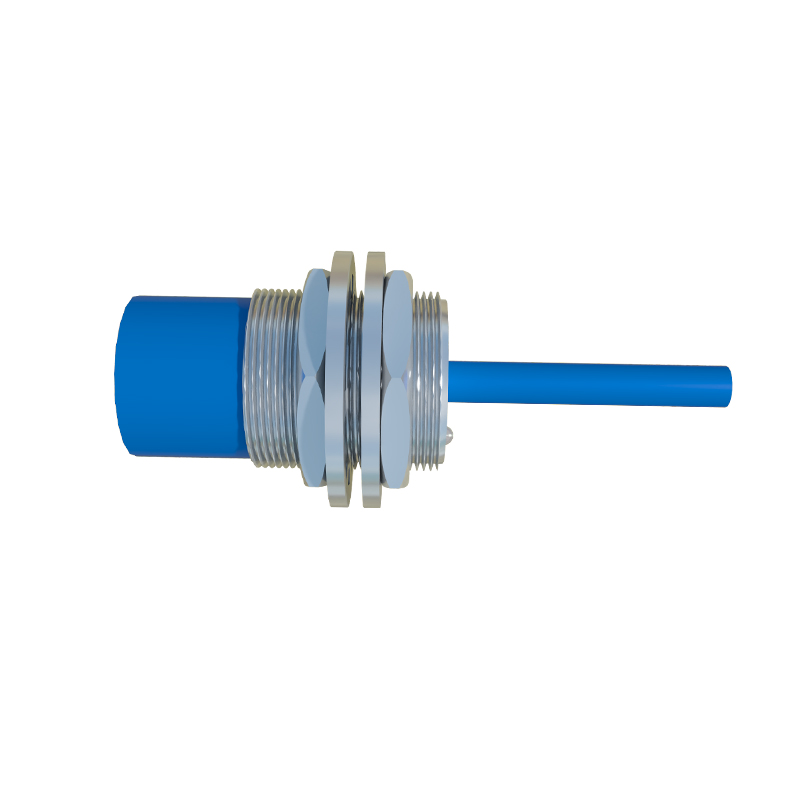
The defining characteristic of the 5mm sensor is its ultra-short sensing range. Unlike larger sensors that may detect objects from tens of millimeters away, the 5mm variant is designed for precise, close-range detection. This precision is critical in applications requiring exact positioning, such as verifying the placement of a tiny electronic component on a circuit board, counting small parts on a high-speed conveyor, or acting as an end-position limit switch in a compact linear actuator. The short range also provides inherent immunity to background interference, making readings highly reliable in dense mechanical environments.
Selecting the right 5mm proximity sensor requires careful consideration of several technical parameters. First is the sensing technology: inductive for metals or capacitive for various materials. The sensing distance, often rated at 1.5mm to 2mm for a standard steel target, must be suitable for the application. Output type is crucial; common configurations include NPN (sinking) or PNP (sourcing) transistor outputs, which interface directly with programmable logic controllers (PLCs). The housing material, typically nickel-plated brass or stainless steel, determines environmental durability against coolants, oils, and metal chips. Furthermore, factors like switching frequency (response speed), voltage range (commonly 10-30V DC), and protection class (e.g., IP67 for dust and temporary immersion) are vital for ensuring long-term performance.
Installation and application best practices are paramount for optimal functionality. Proper mounting is essential; flush-mounted sensors can be installed without a lateral clearance, while non-flush types require space around the sensing face for their extended field. Engineers must account for the target material, size, and approach direction, as these directly affect the effective sensing distance. A common application is in miniature pneumatic cylinders, where a 5mm sensor is embedded to confirm piston rod position. They are also extensively used in semiconductor manufacturing equipment, small-scale packaging machinery, precision CNC tooling for tool breakage detection, and within compact consumer electronics assembly lines. Their reliability in providing a binary "on/off" signal makes them the perfect choice for high-speed counting and precise position verification tasks.
In conclusion, the 5mm proximity sensor represents a critical evolution in sensor technology, packing robust detection capabilities into an extremely small package. Its ability to deliver reliable, non-contact sensing in confined spaces unlocks new possibilities for machine design, allowing for more compact, efficient, and intelligent automated systems. As industries continue to push for miniaturization and higher precision, the demand for these precise and rugged sensors is poised to grow, solidifying their role as a fundamental building block in modern industrial automation.