In the realm of industrial automation, robotics, and quality control, the demand for high-precision, non-contact measurement has never been greater. Enter the multi-point laser distance sensor, a sophisticated technological advancement that is fundamentally reshaping how industries capture spatial data, monitor processes, and ensure product integrity. Unlike traditional single-point sensors that provide a single measurement at a time, these systems deploy multiple laser beams—either through an array of discrete sensors or via scanning mechanisms—to capture distance data across a line or area simultaneously. This capability unlocks a new dimension of efficiency and insight.
The core principle remains based on laser triangulation or time-of-flight (ToF) measurement. In triangulation, a laser diode projects a spot onto a target surface. The reflected light is focused onto a position-sensitive detector (like a CCD or CMOS array). The position of the light spot on the detector shifts proportionally to the distance of the target, allowing for precise calculation. A multi-point sensor essentially replicates this system multiple times or uses a single laser line projector and a 2D sensor to capture an entire profile at once. Time-of-flight sensors, often used for longer ranges, measure the phase shift or direct flight time of a laser pulse; multi-point variants use scanning mirrors or arrays to cover wider areas.
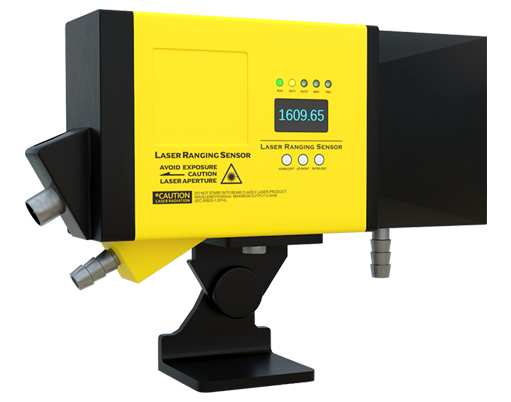
The applications for multi-point laser distance sensors are vast and transformative. In automotive manufacturing, they are indispensable for inspecting body panel gaps and flushness. Multiple sensors positioned around a vehicle frame can measure the precise distance between doors, hoods, and fenders at several critical points in a single pass, ensuring consistent quality and fit. On robotic assembly lines, these sensors provide rich 3D profile data, enabling robots to perform complex bin-picking tasks, precisely place components, or conduct in-line inspections without halting production. The logistics and warehousing sector leverages them for pallet profiling, dimensioning packages, and guiding automated guided vehicles (AGVs) by creating detailed maps of their surroundings.
Furthermore, in the semiconductor and electronics industry, where tolerances are microscopic, multi-point sensors monitor wafer warpage, component coplanarity, and solder paste height across an entire circuit board. In civil engineering and construction, they facilitate the monitoring of structural deformations, tunnel profiles, and flatness of large concrete slabs, providing a dense cloud of data points that single-point measurements could never achieve efficiently.
The advantages over single-point sensors are compelling. The most significant is a dramatic increase in measurement speed and throughput. Capturing an entire profile in one shot eliminates the need for mechanical scanning or multiple sensor passes, which is critical for high-speed production lines. This also reduces system complexity and potential points of mechanical failure. The data richness is another key benefit. By measuring multiple points concurrently, these sensors can calculate not just distance but also derive parameters like width, height, step height, and even surface tilt or orientation. This holistic view enables more robust decision-making in automated systems.

However, implementing multi-point laser sensors requires careful consideration. Environmental factors such as ambient light, particularly direct sunlight, can interfere with the laser's reception. The characteristics of the target surface—its color, reflectivity, and texture—also significantly impact performance. Highly reflective or transparent materials may require special filters or sensor settings. Data processing demands are higher, as the system must handle a stream of data from multiple points or a continuous profile, necessitating powerful processors and sophisticated software algorithms for real-time analysis.
When selecting a multi-point laser sensor, engineers must evaluate key specifications: measurement range, the number of measurement points or resolution of the profile, sampling speed, accuracy, and repeatability. The choice between a fixed array and a scanning system depends on the application's need for flexibility versus point density. Integration with factory networks (Ethernet/IP, PROFINET, etc.) and software development kits (SDKs) for custom application development are also crucial factors for seamless implementation.
Looking ahead, the evolution of multi-point laser sensing is intertwined with advancements in artificial intelligence and machine vision. AI algorithms can be trained on the rich profile data to identify defects, classify objects, or predict maintenance needs with unprecedented accuracy. Miniaturization and cost reduction will continue to drive adoption into new markets. As Industry 4.0 and smart factories become the standard, the role of multi-point laser distance sensors as essential data acquisition nodes will only solidify. They provide the precise, real-time spatial intelligence that automated systems need to see, understand, and interact with the physical world reliably. By transforming single points of data into comprehensive digital profiles, they are not just measuring distance—they are building the foundation for a more precise, efficient, and autonomous industrial future.
