Inductive proximity sensors are non-contact electronic devices designed to detect the presence or absence of metallic objects without physical contact. Their operation hinges on a fundamental principle of electromagnetism. At the core of the sensor is a coil wound around a ferrite core, which forms part of an oscillator circuit. When energized, this coil generates a high-frequency electromagnetic field that radiates from the active face of the sensor.
When a conductive metal object enters this oscillating field, eddy currents are induced on the surface of the target. These eddy currents draw energy from the oscillator circuit, causing a measurable change in its amplitude or frequency. The sensor's internal circuitry, typically a trigger circuit or a Schmitt trigger, detects this change and switches the sensor's output state accordingly—from "off" to "on" or vice versa. Once the metal object moves out of the sensing range, the oscillator returns to its initial state, and the output reverts.
The primary function of these sensors is precise, reliable position detection. They excel in determining if a metal part is present at a specific point in a machine's cycle, such as checking for a piston at the end of its stroke, verifying the closure of a metal door, or confirming the placement of a component on an assembly line. Because they operate without physical contact, they eliminate mechanical wear and tear, leading to exceptionally long service life and reduced maintenance costs compared to mechanical limit switches.
Another critical function is counting. Inductive sensors can accurately count metallic objects passing by on a conveyor belt, such as cans, machined parts, or automotive components. Their fast response times and high switching frequencies allow them to handle high-speed production lines without missing a count. This capability is vital for inventory management, batch control, and production monitoring.
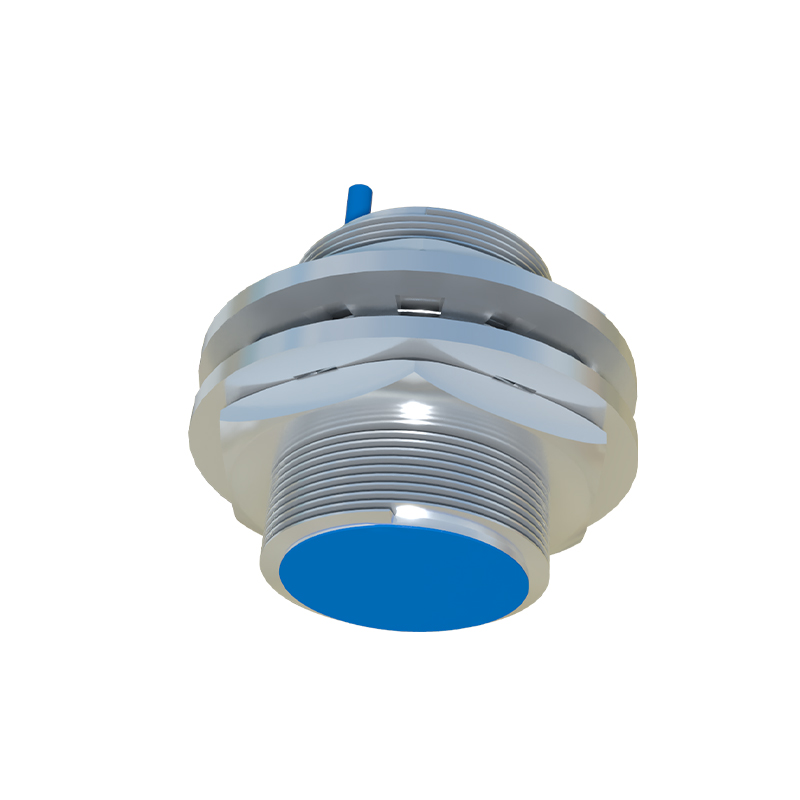
They also serve a crucial role in speed and rotation monitoring. By detecting the teeth of a metal gear or tabs on a rotating shaft, an inductive sensor can generate a pulse train. This signal can be processed to calculate rotational speed (RPM), monitor for sudden stops, or detect slippage in drive systems. This application is common in motor control, conveyor speed verification, and safety interlocks on rotating machinery.
A significant advantage is their robustness in harsh industrial environments. Sealed in robust housings made of materials like nickel-plated brass, stainless steel, or PBT plastic, they are inherently resistant to dust, dirt, oil, coolants, and vibrations. Unlike optical sensors, their performance is unaffected by ambient light, smoke, or opaque fluids. This makes them ideal for use in machine tools, welding equipment, foundries, and automated manufacturing cells.
It is important to understand their limitations to ensure correct application. Inductive proximity sensors only detect metallic objects. Their effective sensing range, or nominal range (Sn), is specified for a standard target of mild steel (Fe360). The sensing distance can vary for different metals; for instance, it reduces for stainless steel and is significantly less for non-ferrous metals like aluminum or copper. Factors like the target's size, shape, and approach direction can also influence performance. For optimal results, the target should be at least as large as the sensor's active face and approach it axially.
Modern advancements have expanded their functionality. Analog output versions provide a continuous voltage or current signal proportional to the distance to the target, enabling tasks like gap detection or thickness measurement. Specialized models offer extended sensing ranges, high-temperature resistance, or weld-field immunity to withstand the intense magnetic interference from resistance welding processes.
In summary, the core function of an inductive proximity sensor is to provide a reliable, wear-free switching signal based on the detection of nearby metallic objects. From simple presence detection to complex motion control, their durability, speed, and precision make them indispensable components in industrial automation, robotics, automotive manufacturing, and material handling systems, forming the backbone of countless automated processes worldwide.