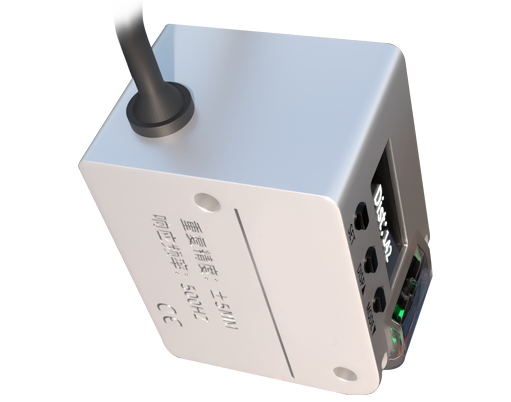
In the world of industrial automation and precise measurement, laser diffuse reflection sensors have become indispensable tools. Unlike their through-beam or retro-reflective counterparts, these sensors operate on a single-unit principle, making them remarkably versatile and easy to install. At their core, these devices emit a focused beam of laser light towards a target object. The key differentiator lies in what happens next: instead of looking for a beam broken or reflected directly back along the same path, the sensor detects the light that is scattered or "diffusely reflected" off the surface of the object. This scattered light, which radiates in many directions, is captured by the sensor's receiver. By analyzing the intensity of this returned light, the sensor can determine the presence, absence, or even certain characteristics of the target.
The working principle hinges on the nature of the target's surface. Matte, rough, or non-shiny surfaces are ideal as they scatter light effectively, providing a strong signal for the receiver. Highly polished or mirror-like surfaces can pose a challenge, as they specularly reflect the beam away, potentially resulting in a missed detection. Modern sensors combat this with advanced optics and evaluation algorithms to ensure reliability across a wider range of materials. The typical sensing range for standard diffuse reflection sensors is shorter than through-beam types, often from a few millimeters up to several hundred millimeters, with specialized models extending further.
The advantages of using laser diffuse reflection sensors are numerous. Their compact, single-body design simplifies mounting and alignment, reducing installation time and cost. They require no separate reflector or receiver unit, saving space in cramped machinery. The focused laser spot allows for the detection of very small objects or precise positioning. Furthermore, many models offer background suppression technology. This clever feature allows the sensor to ignore objects beyond a programmed distance, only triggering for targets within a specific "window." This is invaluable for applications like detecting objects on a conveyor belt while ignoring the belt itself or the machinery behind it.
Applications for these sensors span virtually every industry. In packaging, they count bottles, verify lid placement, and control filling levels. In automotive assembly, they ensure components are present before a robot welds or installs a part. In electronics manufacturing, they detect tiny components on circuit boards. Material handling systems use them to monitor stack heights, control sorting gates, and detect jams. Their precision makes them suitable for tasks like edge detection on webs of material or controlling the loop in printing presses.

Selecting the right laser diffuse reflection sensor requires careful consideration of several parameters. First, define the required sensing distance and the size, color, and material of the target object. Dark, absorbent materials may require a sensor with higher excess gain or a shorter nominal range. The required response time and switching frequency are critical for high-speed production lines. Environmental factors cannot be ignored; models with robust housings (IP67/IP69K ratings) are necessary for washdown areas, while others are designed for extreme temperatures or resist chemicals. The output type (PNP/NPN, analog, IO-Link) must be compatible with the control system. Finally, features like adjustable sensitivity, teach-in functionality for easy setup, and visible or visible-red laser classes (Class 1 or 2 for safety) enhance usability.

In conclusion, laser diffuse reflection sensors offer a powerful blend of simplicity, precision, and flexibility. By understanding their operating principle—relying on scattered light from a target's surface—engineers and technicians can effectively deploy them to solve a vast array of presence detection, positioning, and inspection challenges. Their continued evolution, integrating smarter diagnostics and connectivity, ensures they will remain a fundamental component in building more efficient, reliable, and automated systems for years to come.