Inductive proximity sensors, often referred to as magnetic reluctance or eddy-current sensors, are fundamental components in modern industrial automation. These non-contact devices detect the presence or absence of metallic objects without physical touch, offering reliability and longevity in demanding environments. Their operation hinges on a simple yet elegant electromagnetic principle, making them indispensable for tasks ranging from position sensing to object counting on high-speed production lines.
At the heart of an inductive proximity sensor lies an oscillator circuit that generates a high-frequency electromagnetic field from a coil wound around a ferrite core. This field emanates from the active face of the sensor. When a conductive metal target enters this field, eddy currents are induced on the target's surface. These eddy currents draw energy from the oscillator, causing a measurable change in its amplitude. An evaluation circuit within the sensor detects this amplitude reduction and triggers a solid-state output switch, signaling the target's presence. The sensor's sensitivity and effective sensing range are primarily influenced by the target's material properties. Ferrous metals like iron and steel, due to their high magnetic permeability, are detected at the greatest distances. Non-ferrous metals such as aluminum, copper, or brass have lower permeability, resulting in a reduced sensing range, typically 30-60% of the nominal range for steel.
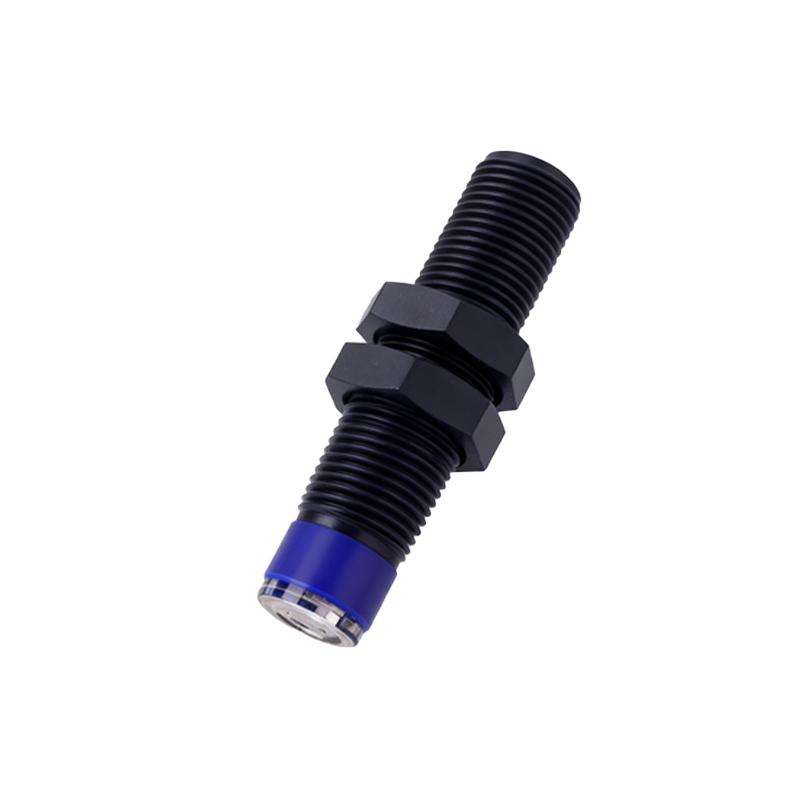
The core advantages of these sensors are numerous. Their non-contact nature eliminates mechanical wear, ensuring a virtually infinite operational life. They are robust, typically housed in metal or high-grade plastic bodies resistant to vibration, shock, and harsh industrial contaminants like oil, coolants, and dust. With no moving parts, they offer high switching speeds, capable of detecting objects thousands of times per minute. Furthermore, they are immune to ambient light conditions and can operate effectively in dirty or wet environments where optical sensors might fail.
Selecting the right inductive proximity sensor requires careful consideration of several key parameters. First is the sensing distance, or "Sn," which is the nominal operating distance for a standard mild steel target. It is crucial to note that the actual installation must provide a safety margin; the target should never be positioned at the exact Sn distance to account for manufacturing tolerances and temperature fluctuations. The second critical factor is the housing style. Cylindrical threaded barrels (e.g., M8, M12, M18, M30) are common for easy mounting. Rectangular or block-style housings offer different mounting options and sometimes embed multiple sensors. The sensing face can be shielded (flush-mountable) or unshielded (non-flush). Shielded sensors can be mounted flush in metal without affecting their field, while unshielded types offer a longer range but require a non-metallic surrounding area.
Output configuration is another vital choice. Sensors come with digital outputs, either as NPN (sinking) or PNP (sourcing) transistor outputs, which must be matched to the controller's input card (e.g., PLC). Some models offer analog outputs (4-20 mA or 0-10V) proportional to the distance to the target, useful for positioning applications. Additionally, the operating voltage (commonly 10-30V DC or 20-250V AC) and connection type (pre-wired cable or quick-disconnect connector) must align with the system's electrical design.
In application, inductive sensors are ubiquitous. They serve as limit switches on machine tools, detect the position of pistons in hydraulic cylinders via built-in metal "flags," count metal parts on conveyors, verify the presence of nuts or caps in assembly processes, and ensure proper positioning in robotic cells. A critical installation best practice is to maintain adequate clearance between multiple sensors to prevent mutual interference of their electromagnetic fields. For sensing different metals, it is often necessary to derate the sensor's specified range or use a model specifically calibrated for the target material.
In conclusion, the inductive proximity sensor is a workhorse of factory automation. Its robust, contactless operation provides a reliable solution for myriad detection tasks involving metallic objects. By understanding the underlying electromagnetic principles and carefully evaluating application requirements—such as target material, required sensing distance, environmental conditions, and electrical interface—engineers and technicians can select and deploy these sensors to create more efficient, reliable, and maintenance-friendly automated systems. Their continued evolution, including miniaturization and enhanced intelligence with IO-Link communication, ensures they will remain a cornerstone of industrial sensing for the foreseeable future.