Laser position sensors represent a critical advancement in industrial automation, offering unparalleled accuracy and reliability for real-time measurement and control tasks. These devices operate by emitting a focused laser beam onto a target surface and analyzing the reflected light to determine precise positional data. Unlike traditional contact-based sensors or less coherent optical methods, laser sensors provide non-contact measurement with micron-level resolution, making them indispensable in high-precision manufacturing, robotics, and quality inspection systems.
The core technology behind laser position sensing typically involves triangulation or time-of-flight principles. Triangulation-based sensors use a laser diode, a receiving lens, and a position-sensitive detector (PSD) or CMOS array. When the laser dot strikes a target, the reflected light is focused onto the detector at an angle. Displacement of the target changes the angle of reflection, causing the light spot to shift on the detector. This shift is electronically converted into a precise distance measurement. This method excels in short to medium-range applications requiring extreme accuracy, such as measuring component thickness, vibration analysis, or wafer alignment in semiconductor fabrication.
Time-of-flight sensors, often used for longer ranges, calculate distance by measuring the time delay between the emission of a laser pulse and the detection of its reflection. Advanced versions use phase-shift analysis of modulated laser light for enhanced resolution. These sensors are ideal for applications like bulk material level monitoring, large-scale metrology, and autonomous vehicle navigation.

Key performance parameters for laser position sensors include measurement range, resolution, linearity, and response speed. Modern sensors offer ranges from a few millimeters to several hundred meters, with resolutions down to the sub-micron level. High-speed models can achieve sampling rates exceeding 100 kHz, enabling dynamic monitoring of fast-moving objects. Environmental robustness is another vital aspect; industrial-grade sensors are housed in rugged enclosures with IP67 or higher ratings, resistant to dust, moisture, and electromagnetic interference. Temperature compensation circuits ensure stability across varying operational conditions.

In practical industrial settings, laser position sensors facilitate numerous applications. In automated assembly lines, they verify part presence, orientation, and dimensional conformity. Robotic arms utilize them for precise guidance in pick-and-place, welding, and dispensing operations. In roll-to-roll processing for electronics or textiles, they monitor web edge position and tension control. Furthermore, they are pivotal in 3D scanning and profiling systems for reverse engineering and quality assurance.
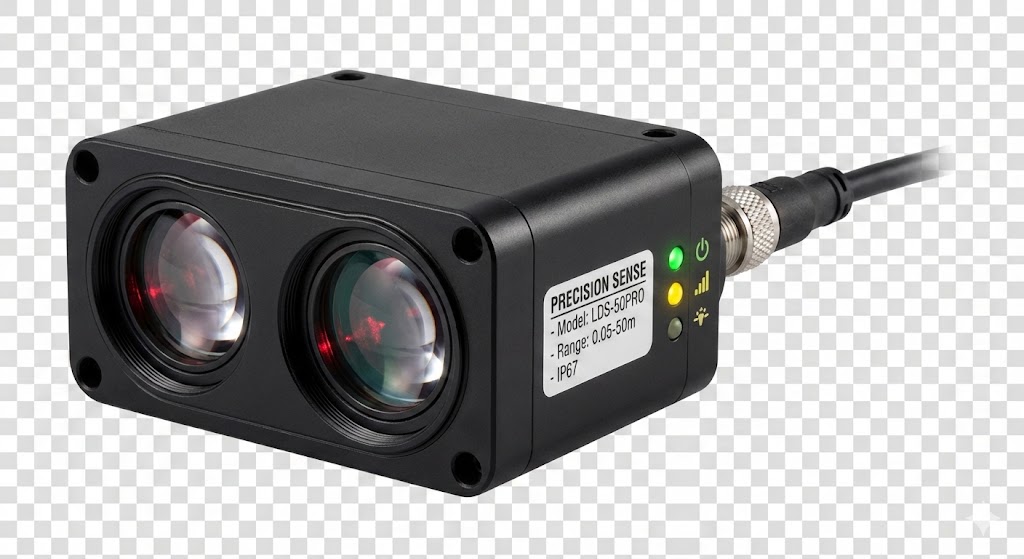
Integration with industrial networks is seamless, supporting standard interfaces like analog voltage/current outputs, digital I/O, and fieldbus protocols (EtherCAT, PROFINET, IO-Link). This connectivity allows sensors to feed data directly into PLCs or supervisory control systems, forming a closed-loop control for enhanced process automation.
Selecting the appropriate laser sensor requires careful consideration of the target surface properties, environmental factors, and required precision. Highly reflective, transparent, or dark surfaces may pose challenges, often addressed by sensors with automatic gain control or specialized algorithms. Safety is paramount; most industrial lasers are Class 1 or Class 2, deemed eye-safe under normal use, complying with international standards like IEC 60825.
The future of laser positioning technology points toward miniaturization, smarter onboard processing with AI capabilities, and multi-point measurement using array detectors. Integration with machine vision systems is also expanding, combining precise distance data with visual context for more sophisticated inspection tasks. As Industry 4.0 and smart manufacturing evolve, the demand for high-speed, accurate, and networked laser position sensors will continue to grow, driving innovation and efficiency across the industrial landscape. Their role in enabling precision, reducing waste, and improving product quality solidifies their status as a cornerstone technology in modern industrial engineering.