In the realm of industrial automation and precision measurement, laser displacement sensors have become indispensable tools. Their ability to provide non-contact, high-accuracy measurements across various materials and surfaces makes them critical for quality control, robotics, and process monitoring. This article provides a detailed technical comparison of key laser displacement sensor types, focusing on their operating principles, performance characteristics, and optimal application scenarios to guide selection for specific engineering needs.
The fundamental operating principle of most laser displacement sensors involves triangulation. A laser diode projects a focused beam onto the target surface. The reflected light is then captured by a receiving element, typically a CMOS or PSD (Position Sensitive Device). The position of the light spot on the receiver shifts proportionally to the target's distance. By calculating this shift, the sensor determines the displacement or distance with high precision. Variations in this principle, such as confocal or interferometric methods, cater to more specialized requirements.
1. Laser Triangulation Sensors
These are the most common and versatile type. They offer a good balance of speed, accuracy, and cost.
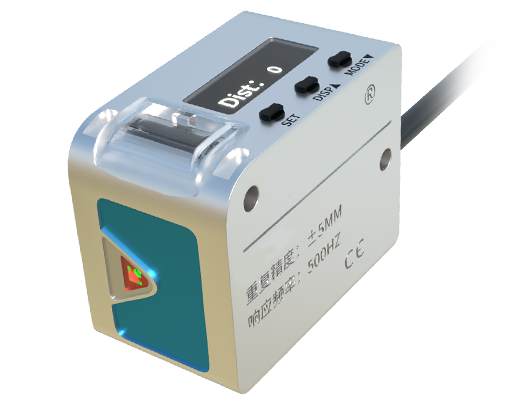
* Principle: Standard triangulation as described.
* Accuracy & Range: Typically offer accuracies from sub-micron to several microns. Measurement ranges vary from a few millimeters to several hundred millimeters.

* Spot Size: Small, focused spot, suitable for measuring small features or edges.
* Surface Dependency: Performance can be affected by the target's color, reflectivity, and surface texture. Highly reflective or transparent materials may require special models with adjustable sensitivity or filters.
* Best For: General-purpose distance and thickness measurement, profile scanning, vibration analysis, and part presence detection on opaque, diffusely reflecting surfaces.
2. Confocal Chromatic Sensors
These sensors utilize a different optical principle for exceptional performance on challenging surfaces.
* Principle: A white light source is focused through a multi-lens optical system. Different wavelengths (colors) of light focus at different distances. Only the wavelength that is perfectly focused on the target surface is reflected back dominantly to the spectrometer, which identifies the wavelength and thus the distance.
* Accuracy & Range: Capable of nanometer-level resolution. Measurement ranges are typically shorter than triangulation sensors, often up to 10-30mm.
* Spot Size: Very small, spherical spot.
* Surface Dependency: Largely independent of the target's angle, color, and transparency. They excel at measuring glossy, mirrored, transparent, or even liquid surfaces.
* Best For: Ultra-high precision measurement of film thickness, transparent materials (glass, plastics), highly reflective metals, and applications requiring immunity to surface tilt.
3. Laser Interferometer Sensors
These represent the pinnacle of measurement precision, often used as calibration standards.
* Principle: Based on the interference of two coherent laser beams. The measurement beam reflects off the target, while the reference beam travels a fixed path. Displacement causes a phase shift between the beams, generating interference fringes that are counted to determine movement with extreme precision.
* Accuracy & Range: Sub-nanometer resolution and accuracy over long ranges (meters).
* Spot Size: Small, coherent beam.
* Surface Dependency: Requires a retro-reflector or a cooperative, reflective surface. Not suitable for rough or diffusely scattering surfaces without a target mirror.
* Best For: Calibration of machine tools and stages, semiconductor lithography, precision stage positioning, and vibration measurement in R&D environments.
Key Comparison Parameters for Selection:
* Measurement Range: The distance over which the sensor operates accurately.
* Resolution: The smallest detectable change in distance.
* Linearity Error: The deviation from a perfect straight-line response across the range.
* Sampling Rate/Speed: How quickly the sensor outputs measurements (Hz). Critical for dynamic or high-speed processes.
* Spot Size: Determines the minimum feature size that can be measured.
* Environmental Robustness: Resistance to ambient light, dust, temperature fluctuations, and vibrations. Many industrial models feature IP67 or higher ratings.
* Output Interface: Common options include analog (4-20mA, 0-10V), digital (RS-485, Ethernet), and fieldbus protocols (PROFINET, EtherCAT).
Application-Specific Guidance:
* Roughing/Machining: Laser triangulation sensors with robust housings and resistance to coolant/oil are preferred.
* Electronics Assembly: Confocal sensors are ideal for measuring solder paste height, component coplanarity, and transparent substrates.
* Rolling Mills & Web Processes: High-speed triangulation sensors are used for thickness and vibration monitoring.
* Precision Metrology: Interferometers or high-end confocal sensors are chosen for laboratory-grade measurements.
In conclusion, there is no universal "best" laser displacement sensor. The choice hinges on a meticulous analysis of the application requirements: required accuracy, target surface properties, measurement range, environmental conditions, and budget. Laser triangulation sensors offer versatile, cost-effective solutions for most industrial tasks. Confocal chromatic sensors solve the challenges posed by difficult surfaces at a higher cost. Laser interferometers deliver unparalleled precision for critical calibration and research. By understanding these core technologies and their comparative strengths, engineers can specify the optimal sensor to enhance system reliability, improve product quality, and drive manufacturing efficiency.