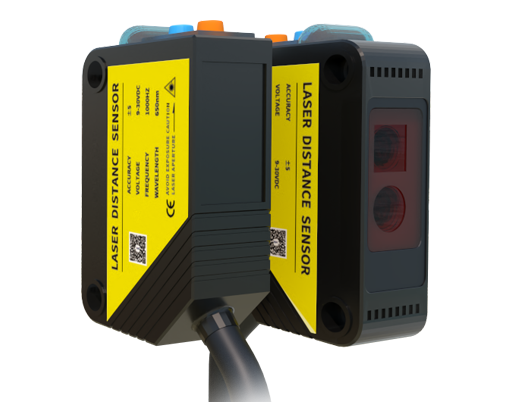
In the rapidly evolving landscape of industrial automation and precision engineering, laser distance control sensors have emerged as pivotal components, driving efficiency, accuracy, and safety across diverse sectors. These sensors utilize laser technology to measure distances with exceptional precision, often achieving micrometer-level accuracy, which is crucial for applications ranging from manufacturing and robotics to construction and logistics. The fundamental principle involves emitting a laser beam toward a target object and analyzing the reflected light to calculate the distance based on time-of-flight, phase shift, or triangulation methods. This non-contact measurement capability minimizes wear and tear, reduces maintenance costs, and enhances operational reliability in harsh environments where physical contact is impractical or hazardous.
Recent advancements in laser sensor technology have significantly expanded their capabilities. For instance, the integration of high-speed processors and advanced algorithms allows for real-time data processing, enabling dynamic adjustments in automated systems. Innovations such as multi-echo technology improve performance in challenging conditions, like detecting objects through transparent surfaces or in dusty atmospheres, by filtering out irrelevant reflections. Additionally, the miniaturization of components has led to compact, robust designs that can be easily integrated into existing machinery without extensive modifications. These developments are complemented by enhanced connectivity features, including IoT compatibility and wireless communication, facilitating seamless integration into Industry 4.0 frameworks for smart monitoring and predictive maintenance.
The applications of laser distance control sensors are vast and continually growing. In manufacturing, they are indispensable for quality control, ensuring precise positioning of components on assembly lines, monitoring thickness in material processing, and verifying dimensional tolerances. Robotics relies on these sensors for navigation, obstacle avoidance, and precise manipulation tasks, enhancing autonomy and safety in collaborative environments. In construction, laser sensors aid in leveling, alignment, and volume measurement, improving accuracy in projects such as tunneling or structural monitoring. Logistics and warehousing benefit from automated inventory management and palletizing systems that use laser sensors to optimize space utilization and streamline operations. Moreover, emerging fields like autonomous vehicles and drone technology leverage laser distance sensing for environmental mapping and collision prevention, underscoring their versatility.
Despite their advantages, implementing laser distance control sensors requires careful consideration of factors such as environmental interference, target surface properties, and calibration needs. For example, highly reflective or absorbent surfaces can affect measurement accuracy, necessitating sensor selection based on specific application requirements. Regular calibration and maintenance are essential to sustain performance over time, especially in demanding industrial settings. Looking ahead, ongoing research focuses on improving energy efficiency, reducing costs, and enhancing multi-sensor fusion techniques to address complex measurement challenges. As industries increasingly prioritize automation and data-driven decision-making, laser distance control sensors are poised to play an even more critical role, fostering innovation and competitiveness in the global market. By understanding their principles, advancements, and practical applications, engineers and industry professionals can harness their full potential to drive progress and solve real-world problems efficiently.