Laser distance sensors, also known as laser rangefinders or LiDAR sensors in specific configurations, are pivotal instruments in modern industrial automation, robotics, and surveying. Their core function is to determine the distance to a target object with high accuracy and speed, utilizing the principle of laser light reflection. The efficacy and precision of these sensors are fundamentally dictated by their internal structure. This article delves into the detailed structural composition of a typical time-of-flight (ToF) based laser distance sensor, explaining the role of each component.
At the heart of the sensor lies the Laser Diode. This semiconductor device emits a focused, coherent beam of light, typically in the visible red or, more commonly for longer ranges and eye safety, infrared spectrum. The wavelength, power, and beam quality are critical parameters. A pulsed laser diode is standard for ToF measurement, emitting short, intense bursts of light. The laser output is precisely controlled by the driver circuitry to ensure consistent pulse characteristics.
Adjacent to the laser diode is the Transmit Optics. This assembly, often comprising one or more lenses, shapes and collimates the raw laser beam. Its primary functions are to minimize divergence, ensuring the beam remains tight over distance, and to direct it accurately towards the target. The quality of these optics directly impacts the sensor's spot size and maximum operational range.
The emitted laser pulse travels to the target and is reflected back. The returning, often vastly attenuated, signal is collected by the Receive Optics. This separate lens system gathers the scattered or reflected light and focuses it onto a highly sensitive detector. To filter out ambient light (e.g., sunlight or room lighting) which would saturate the detector, an Optical Filter is placed in the receive path. This is typically a narrow-bandpass filter matched precisely to the laser's wavelength, dramatically improving the signal-to-noise ratio.
The focused return light strikes the Photodetector, the component that converts optical signals into electrical ones. For high-speed ToF sensors, an Avalanche Photodiode (APD) or a Single-Photon Avalanche Diode (SPAD) is commonly used due to their exceptional sensitivity and fast response times. The APD operates with internal gain, multiplying the photocurrent generated by incoming photons, making it capable of detecting very weak return signals.
The electrical signal from the photodetector is weak and noisy. It is fed into the Signal Conditioning and Processing Circuitry. This sophisticated electronic section includes a transimpedance amplifier to convert the current pulse into a voltage, followed by further amplification and filtering stages. The key component here is the high-precision timing circuit or Time-to-Digital Converter (TDC). Its sole purpose is to measure the elapsed time between the emission of the laser pulse (a start signal) and the detection of the return pulse (a stop signal) with picosecond or nanosecond resolution. Since distance (d) is calculated as d = (c * Δt) / 2, where c is the speed of light and Δt is the measured time-of-flight, the timing circuit's accuracy is paramount.
All these components are governed by the sensor's Microcontroller or Digital Signal Processor (DSP). This unit manages the laser pulse triggering, coordinates the timing circuit, processes the raw time measurement, and executes complex algorithms. These algorithms handle tasks like background noise subtraction, signal averaging for improved accuracy, and compensation for temperature-induced drifts in electronic components. The processed distance value is then communicated to an external system via standard industrial interfaces such as RS-485, Ethernet/IP, PROFINET, EtherCAT, or simple analog voltage/current outputs.
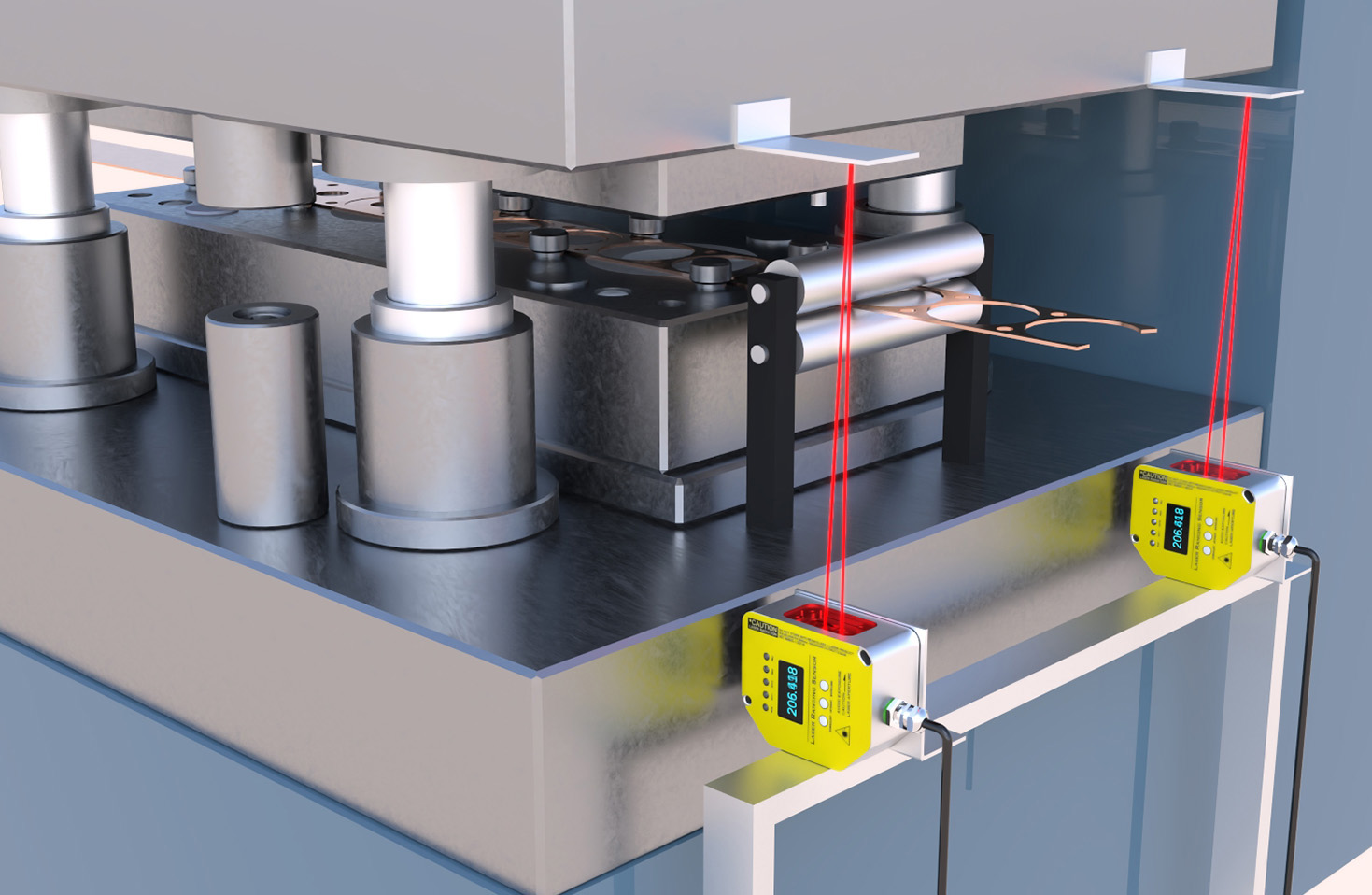
The entire assembly is housed in a robust Sensor Housing. This enclosure is designed to be mechanically stable, providing precise alignment for the optical axes. It also offers protection against environmental factors like dust, moisture (often rated IP67 or IP69K), and mechanical shock. Thermal management, through heat sinks or careful design, is integrated to ensure stable operation across a specified temperature range, as laser wavelength and electronic timing can drift with temperature.
In more advanced phase-shift laser sensors, the structure is similar, but the laser is amplitude-modulated with a continuous wave. The photodetector and processing circuitry then measure the phase difference between the emitted and received modulated signal to calculate distance. Triangulation-based laser sensors, used for very short, high-accuracy measurements, have a different structural layout where the positions of the laser, a receiving lens, and a position-sensitive detector (PSD) or CMOS array form a triangle for geometric calculation.
Understanding this intricate structure is essential for selecting the right sensor for an application. Factors like required range, accuracy, speed, target surface properties, and environmental conditions all influence which structural design—be it pulsed ToF, phase-shift, or triangulation—is most appropriate. The continuous evolution in laser diode efficiency, detector sensitivity, and high-speed processing power is driving the development of ever-smaller, more accurate, and more robust laser distance sensor structures.