Laser sensors have become indispensable tools in modern industrial automation, offering unparalleled precision, speed, and reliability. At their core, these devices operate on fundamental principles of optics and photonics, tailored to deliver exceptional value through robust performance and cost-effectiveness. Understanding these principles is key to leveraging their full potential in diverse applications, from manufacturing and robotics to quality control and logistics.
The fundamental operating principle of a laser sensor involves the emission, reflection, and detection of coherent light. A laser diode generates a highly focused, monochromatic beam of light. This coherence—where light waves are in phase—allows the beam to travel long distances with minimal dispersion, enabling precise measurements over considerable ranges. The emitted laser beam is directed towards a target object. Upon striking the surface, the light is reflected or scattered. A photodetector, typically a photodiode or a position-sensitive device (PSD), then captures the returning light signal.
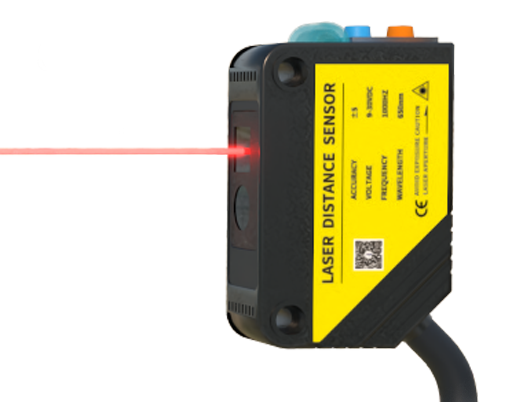
The method of analyzing this returned signal defines the primary measurement principles. Two of the most common and valuable types are triangulation and time-of-flight (ToF).
Triangulation-based laser sensors are renowned for high-resolution displacement and profile measurements. In this setup, the laser emitter, the point of reflection on the target, and the receiving photodetector form a triangle. The laser projects a spot onto the target. The reflected light is focused through a receiving lens onto the PSD. As the target's distance changes, the position of the light spot on the PSD shifts. By precisely calculating this shift using trigonometric principles, the sensor determines the exact distance to the target with micron-level accuracy. This principle is supremely valuable for applications requiring extreme precision, such as inspecting component thickness, monitoring vibration, or controlling robotic positioning.
Time-of-Flight (ToF) sensors, on the other hand, measure distance by calculating the time delay between the emission of a laser pulse and the detection of its reflection. The formula is straightforward: Distance = (Speed of Light × Time Delay) / 2. Modern ToF sensors use advanced circuitry to measure these incredibly short time intervals (picoseconds to nanoseconds) with high accuracy. This principle allows for longer measurement ranges and faster data acquisition compared to triangulation, making ToF ideal for applications like bulk level sensing, vehicle detection, or large-volume 3D scanning. The value proposition here lies in robust performance over long distances and in challenging environmental conditions.
Another critical principle is confocal measurement, often used for chromatic confocal sensors. Here, a white light source is focused through a special lens so that only a specific wavelength (color) is sharply focused at a given working distance. The reflected light is analyzed spectrally. The wavelength of the peak intensity directly correlates to the distance of the target. This principle allows for measurements on reflective, transparent, or even liquid surfaces with high precision, offering tremendous value in specialized industries like semiconductor or glass manufacturing.
The "high-value" aspect is engineered into these sensors through several key features. First is environmental robustness. Industrial-grade laser sensors incorporate housings rated for IP67 or higher, protecting against dust, moisture, and mechanical shock. They are designed to compensate for ambient light interference and varying surface colors or textures through advanced signal processing algorithms. Adaptive threshold settings and background suppression modes ensure reliable operation despite changing conditions.
Second is integration ease and intelligence. Modern value-driven laser sensors come with programmable logic, digital interfaces (IO-Link, Ethernet/IP), and analog outputs, allowing seamless integration into control systems. Built-in teach-in functions and intuitive software simplify setup and parameterization, reducing commissioning time and cost.
Third is longevity and maintenance-free operation. Using durable components and stable laser diodes with long service lives minimizes downtime and total cost of ownership. The non-contact nature of the measurement principle itself eliminates wear and tear on the sensor.
In conclusion, the high value of contemporary laser sensors stems from a deep integration of solid physical principles—triangulation, time-of-flight, and confocal imaging—with rugged industrial design and smart electronics. They transform simple light into precise, reliable data, driving efficiency, quality, and automation across countless industrial processes. By selecting a sensor based on the appropriate underlying principle for the application, engineers can achieve an optimal balance of performance, durability, and cost, securing a significant return on investment in their automation infrastructure.