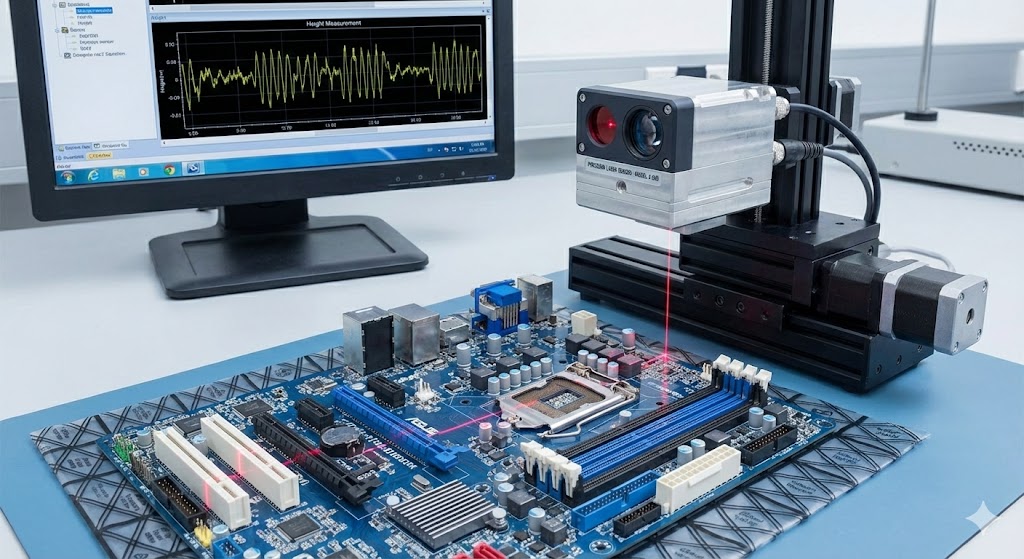
Laser sensor detection has become a cornerstone technology in modern industrial automation, offering unparalleled precision, speed, and reliability. The fundamental principle behind laser sensors involves emitting a focused beam of light—typically from a laser diode—toward a target object. The sensor then analyzes the reflected or scattered light to determine critical parameters such as distance, displacement, presence, thickness, or profile. This non-contact measurement method is vital in environments where physical contact could damage delicate components or introduce inaccuracies.
The evolution of laser sensing technology is deeply intertwined with advancements in optics, electronics, and digital signal processing. Early systems, emerging in the latter half of the 20th century, were often bulky, expensive, and limited to laboratory settings. However, the miniaturization of laser diodes and the development of sophisticated CMOS (Complementary Metal-Oxide-Semiconductor) and CCD (Charge-Coupled Device) detectors have driven their widespread industrial adoption. Today, laser sensors are integral to quality control on production lines, robotic guidance, and precision alignment in sectors ranging from automotive manufacturing to semiconductor fabrication.
A key advantage of laser sensors is their ability to perform measurements with micrometer-level accuracy, even on high-speed moving targets. Techniques such as triangulation, time-of-flight (ToF), and confocal measurement are employed based on specific application needs. Triangulation sensors, for instance, are excellent for short-range, high-accuracy distance measurement, while ToF sensors are suited for longer ranges. Furthermore, the coherence and monochromatic nature of laser light allow it to maintain a tight beam over long distances and penetrate certain environmental interferences like dust or vapor better than conventional light sources, though excessive contamination remains a challenge.

The integration of laser sensors with Industry 4.0 frameworks and the Industrial Internet of Things (IIoT) represents the current frontier. Modern laser sensors are equipped with smart features like Ethernet connectivity, PROFINET, or IO-Link interfaces, enabling real-time data transmission to central control systems for predictive maintenance and process optimization. This connectivity transforms raw measurement data into actionable intelligence, facilitating adaptive manufacturing processes.
Despite their robustness, selecting the right laser sensor requires careful consideration of the target surface properties (color, reflectivity, texture), environmental conditions (ambient light, temperature, vibrations), and required measurement range. Ongoing research focuses on enhancing robustness against difficult surfaces (e.g., transparent or shiny materials), increasing measurement rates for ultra-fast processes, and reducing power consumption. As industries continue to demand higher precision and efficiency, laser sensor technology will undoubtedly evolve, solidifying its role as an indispensable tool in the automated industrial landscape.