In the realm of precision measurement and industrial automation, laser displacement sensors have become indispensable tools. Their ability to provide non-contact, high-speed, and high-accuracy measurements makes them ideal for a vast array of applications, from quality control on production lines to vibration analysis in R&D labs. While specifications like resolution, repeatability, and sampling speed are often highlighted, one critical parameter that fundamentally dictates sensor performance in real-world applications is linearity. This article delves into the concept of linearity in laser displacement sensors, its importance, influencing factors, and best practices for ensuring optimal performance.
What is Linearity in Laser Displacement Sensors?
Linearity, in this context, refers to the degree to which the sensor's output signal (typically a voltage or digital value) deviates from a perfectly straight line when plotted against the actual physical displacement of the target object. Imagine a graph where the X-axis is the true distance measured by a traceable standard (e.g., a high-precision stage), and the Y-axis is the distance value reported by the laser sensor. A perfectly linear sensor would produce a straight diagonal line with a slope of 1. In reality, all sensors exhibit some deviation from this ideal line. Linearity error is the maximum positive or negative deviation of the sensor's output from this best-fit straight line, usually expressed as a percentage of the full measurement range (F.S.) or in absolute units like micrometers (µm).
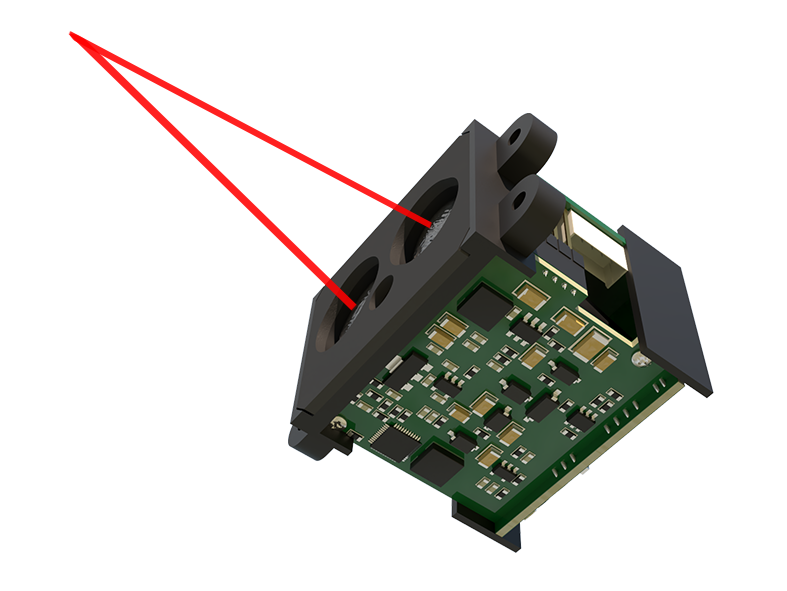
For example, a sensor with a ±30mm range and a specified linearity of ±0.1% F.S. has a maximum potential error of ±30µm across the entire 60mm span, regardless of the measured point. This error is distinct from accuracy, which is a broader term encompassing linearity, zero-point error, and temperature drift.
Why is High Linearity Crucial?
High linearity is paramount for applications where the absolute position or precise contour of an object must be known, not just relative changes. Consider these scenarios:
* Dimensional Gauging: Measuring the thickness of a wafer or the diameter of a shaft requires a linear output across the entire range. Non-linearity would mean the measurement error is not constant, leading to incorrect pass/fail decisions.
* Profile and Contour Scanning: When a sensor is scanned across a surface to create a 2D or 3D profile, any non-linearity in the sensor's output directly distorts the reproduced shape. High linearity ensures the scanned profile is a true representation.
* Precision Alignment: Aligning optical components, semiconductor masks, or robotic arms often depends on absolute distance feedback. Non-linearity introduces unpredictable errors in the alignment process.
* Control System Feedback: In closed-loop control systems where sensor data directly drives actuator movement, non-linearity can cause instability or failure to achieve the target position.
Factors Affecting Sensor Linearity
Several intrinsic and extrinsic factors influence the linearity of a laser displacement sensor:
1. Optical System Design: The core of the linearity performance lies in the sensor's optics and detection method. Triangulation-based sensors, the most common type, use the position of the reflected laser spot on a CMOS or PSD detector. Imperfections in lens geometry, detector pixel alignment, and the algorithm used to convert spot position to distance can introduce non-linearities, especially at the edges of the measurement range.
2. Target Surface Characteristics: The sensor's calibration and specified linearity are typically valid for a specific surface type, usually a matte white ceramic standard. Measuring surfaces with different colors, reflectivity, roughness, or material transparency (e.g., glass, shiny metal) can significantly degrade linearity. The laser spot may scatter, penetrate, or reflect specularly, causing the detector to misinterpret the true position.
3. Environmental Conditions: Temperature fluctuations are a major concern. Changes in ambient temperature can cause thermal expansion of the sensor's housing and internal components, including the laser diode and lenses, shifting the optical path and introducing linearity drift. High-quality sensors incorporate temperature compensation circuits to mitigate this.
4. Electrical Noise and Signal Integrity: Noise in the power supply or in the analog signal path can manifest as non-random, structured error that affects linearity. Proper shielding, grounding, and using stable power sources are essential.
Best Practices for Maximizing Linear Performance
To ensure you are getting the best possible linearity from your laser displacement sensor:
* Select the Right Sensor for the Application: Carefully match the sensor's specified linearity to your tolerance requirements. Do not assume a sensor with excellent repeatability also has excellent linearity.
* Understand the Calibration Conditions: Always review the manufacturer's datasheet to see under what conditions (target surface, temperature) the linearity specification is guaranteed.
* Perform On-Site Calibration (if possible): For critical applications, consider calibrating the sensor using a traceable standard (e.g., gauge blocks, a precision linear stage) under conditions identical to the actual use case—same target material, same environment. Some advanced sensors allow for multi-point linearity correction via software.
* Control the Environment: Stabilize the temperature around the measurement station. Avoid drafts, direct sunlight, or proximity to heat sources.
* Use Appropriate Targets: If the target material differs from the calibration standard, be prepared for potential linearity error. For shiny surfaces, use a diffuse coating or employ sensors designed for specular reflection (e.g., confocal chromatic or through-beam types, which often have inherently better linearity but different range limitations).
* Verify Periodically: Implement a regular calibration check schedule to detect any drift in linearity over time due to aging components or environmental changes.
In conclusion, linearity is a fundamental specification that goes to the heart of a laser displacement sensor's capability to provide truthful measurement data. By understanding its definition, its impact on application outcomes, and the methods to control it, engineers and system integrators can make informed sensor selections and implement robust measurement solutions that deliver reliable, high-fidelity data for demanding industrial and scientific tasks. Always look beyond the headline specifications and scrutinize the linearity parameter to ensure it aligns with your precision goals.