In the rapidly evolving landscape of industrial automation and precision measurement, laser area ranging sensors have emerged as a cornerstone technology. Unlike traditional point-based laser sensors that measure distance to a single spot, these advanced devices capture distance data across a two-dimensional area or even a three-dimensional field, providing a comprehensive spatial profile. This capability is revolutionizing quality control, robotics, logistics, and safety systems across numerous sectors.
The core principle of laser area ranging sensors typically involves the time-of-flight (ToF) or phase-shift measurement method. A laser emitter projects a modulated infrared or visible light pulse onto a target area. A high-speed CMOS or CCD sensor then captures the reflected light. By calculating the time delay or phase difference between the emitted and received signals for each pixel in the sensor array, the device constructs a precise distance map, often referred to as a depth map or point cloud. This data-rich output allows systems to perceive not just the presence of an object, but its exact contour, volume, and position in space.
The applications for this technology are vast and growing. In manufacturing, laser area sensors are indispensable for robotic bin picking, where a robot arm must identify and grasp randomly oriented parts from a container. The sensor provides the 3D data needed for the robot to calculate the optimal grasp point. Similarly, in assembly verification, these sensors can scan an entire component to ensure all parts are present and correctly mounted, far surpassing the capabilities of traditional vision systems that rely solely on 2D imaging.
Logistics and warehousing have been transformed by the integration of area ranging sensors. Automated guided vehicles (AGVs) and autonomous mobile robots (AMRs) use them for navigation and pallet detection, creating a real-time understanding of their environment to avoid obstacles and locate loads with millimeter accuracy. Volume measurement systems in shipping and storage facilities use overhead area sensors to quickly and accurately calculate the dimensions of packages on a conveyor belt, optimizing space utilization and billing.

Furthermore, laser area ranging plays a critical role in enhancing workplace safety. Safety laser scanners create two-dimensional protective fields around hazardous machinery. If the sensor detects an intrusion into a predefined warning or stop zone, it can immediately signal the machine to slow down or halt, preventing accidents. This non-contact safety solution is more flexible and reliable than physical barriers or light curtains.
Recent advancements are pushing the boundaries of what these sensors can achieve. Improvements in laser diode efficiency and sensor resolution are yielding devices with higher accuracy over longer ranges and in challenging ambient light conditions. The integration of artificial intelligence and machine learning algorithms directly onto sensor hardware, known as edge computing, enables real-time object classification and anomaly detection without relying on a central processor. This reduces latency and is crucial for high-speed applications.
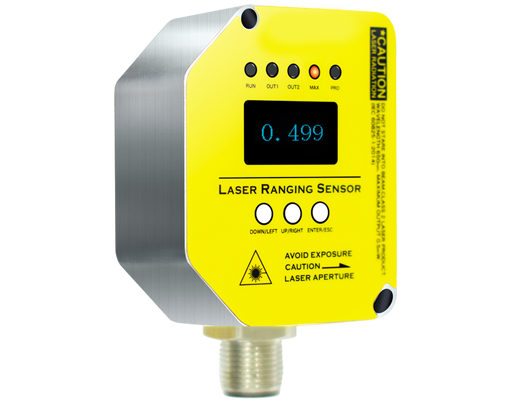
Another significant trend is miniaturization and cost reduction. As components become smaller and more affordable, laser area ranging technology is becoming accessible for a wider array of applications, from consumer electronics like smartphones for facial recognition to agricultural robots for crop monitoring and yield estimation.
Despite their advantages, selecting the right laser area sensor requires careful consideration of key parameters. The field of view (horizontal and vertical angles), measurement range, resolution, scanning rate (frame rate), and environmental robustness (IP rating, resistance to dust, vibration, and temperature fluctuations) must all align with the specific application needs. For instance, a sensor for outdoor autonomous vehicle navigation requires a long range and high immunity to sunlight, while a sensor for close-range electronic component inspection demands extremely high resolution.
In conclusion, laser area ranging sensors represent a paradigm shift in spatial awareness for machines. By providing rich, real-time 3D data, they are the enabling eyes for the next generation of intelligent systems. As technology continues to advance, making these sensors faster, more accurate, and more economical, their adoption will undoubtedly expand, driving further innovation in automation, safety, and efficiency across the global industrial ecosystem. The future points towards even more sophisticated sensor fusion, where laser area data is seamlessly combined with 2D vision, radar, and other sensing modalities to create a complete and reliable digital twin of the physical world.