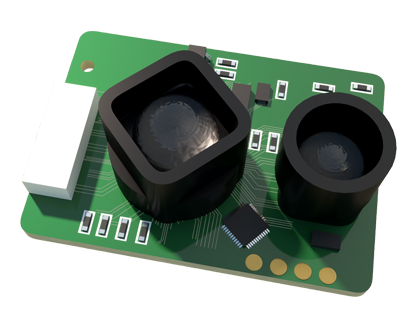
In the realm of industrial automation and precision metrology, the demand for accurate, non-contact measurement solutions is paramount. Among the array of available technologies, angle laser displacement sensors have carved out a critical niche. These sophisticated devices offer a unique approach to measuring distance, height, and thickness by triangulation, providing high-resolution data where traditional contact methods fail or are impractical. This article delves into the operational principles, key advantages, diverse applications, and essential selection criteria for these powerful sensors.
At its core, an angle laser displacement sensor operates on the principle of laser triangulation. A precisely focused laser beam is projected from the sensor's emitter onto the target surface. The diffuse reflection from this point is then captured by a high-resolution receiver element, typically a CCD or CMOS linear image sensor, positioned at a known angle relative to the emitter. The position of the reflected light spot on the receiver shifts linearly with changes in the target's distance. This shift is analyzed by the sensor's internal processor, which calculates the exact displacement value with remarkable speed and accuracy. The "angle" in the name refers to this fixed, triangulated geometry between the laser emitter, the measured point, and the receiver.
The benefits of utilizing angle laser displacement sensors are substantial. Firstly, their non-contact nature eliminates the risk of damaging delicate surfaces or being worn down themselves, ensuring long-term stability and repeatability. They are capable of extremely high-speed measurements, often in the microsecond range, making them ideal for dynamic processes or high-throughput production lines. Furthermore, they offer excellent resolution, down to the sub-micron level for some models, and can measure a wide variety of materials, including metals, plastics, ceramics, and even liquids, regardless of color in many cases (though surface reflectivity must be considered). Their compact size allows for integration into tight spaces within machinery and automated systems.

The applications for these sensors span virtually every manufacturing sector. In the automotive industry, they are deployed for gap and flush measurement on car body assemblies, brake disc thickness inspection, and piston position verification. In electronics manufacturing, they ensure the coplanarity of BGA (Ball Grid Array) components, measure solder paste thickness, and inspect wafer warpage. The semiconductor industry relies on them for critical dimension control and wafer mapping. In general assembly, they verify part presence, measure height steps, and control robotic guidance systems. They are also indispensable in quality control labs for material thickness testing and surface profile analysis.
Selecting the appropriate angle laser displacement sensor requires careful consideration of several parameters. The measurement range and stand-off distance define the working envelope. The spot size determines the minimum feature that can be resolved; a smaller spot allows for more precise measurements on edges or small objects. Resolution and linearity specify the sensor's accuracy. The sampling rate must match the required inspection speed. The material and surface properties of the target are crucial; highly reflective or transparent materials may require specialized models with adjustable sensitivity or through-beam laser line options. Environmental factors like ambient light, temperature fluctuations, and vibrations must be accounted for, often necessitating sensors with robust housings (IP ratings) and built-in environmental immunity features. Finally, the output interface (analog voltage/current, digital RS-422, Ethernet, etc.) must be compatible with the existing data acquisition or control system.

In conclusion, angle laser displacement sensors represent a versatile and powerful tool for modern industry. By understanding their operating principle—laser triangulation—engineers can leverage their non-contact, high-speed, and high-precision capabilities to solve complex measurement challenges. From ensuring vehicle safety to enabling miniaturized electronics, their role is foundational. A methodical selection process, focusing on the specific application requirements and environmental conditions, is key to unlocking their full potential and achieving new levels of quality, efficiency, and automation in manufacturing processes.