In the realm of industrial automation and precision measurement, laser sensors are indispensable tools, offering high accuracy, non-contact operation, and rapid response times. A critical parameter that significantly influences their performance is the laser spot size—the diameter of the focused beam at the target surface. Determining the optimal spot size is not a one-size-fits-all decision; it depends on various factors including application requirements, material properties, environmental conditions, and sensor specifications. This article delves into the technical considerations for selecting an appropriate laser sensor spot size to ensure reliable and efficient operation.
Firstly, understanding the basics of laser spot formation is essential. The spot size is primarily determined by the laser's wavelength, lens optics, and beam divergence. In general, a smaller spot size allows for higher spatial resolution, enabling the detection of fine details or small features on a surface. For instance, in applications like semiconductor inspection, micro-part alignment, or precision engraving, a spot diameter as small as a few micrometers is often necessary to capture intricate patterns or edges accurately. However, achieving such a small spot requires high-quality optics and stable mounting to avoid vibrations that could distort measurements.
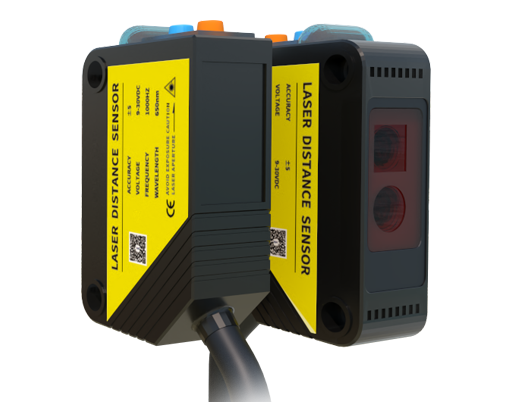
Conversely, a larger spot size can be advantageous in scenarios where surface roughness, reflectivity variations, or target movement pose challenges. When measuring rough or uneven surfaces, a larger beam can average out irregularities, providing a more stable and consistent signal. This is particularly useful in industries like metalworking, wood processing, or textile manufacturing, where materials may have inherent texture or inconsistencies. Additionally, for dynamic applications involving fast-moving objects, a larger spot reduces the risk of missing the target due to minor misalignments or fluctuations, enhancing robustness in harsh environments.
The choice of spot size also interacts with other sensor parameters, such as working distance and measurement range. Typically, laser sensors with longer working distances tend to have larger spot sizes due to beam divergence over distance. Engineers must balance these factors based on the installation constraints. For example, in confined spaces where the sensor must be mounted far from the target, a larger spot might be unavoidable, but this can be mitigated by selecting sensors with adjustable focus or custom optics. Moreover, the material's optical properties—like color, transparency, and reflectivity—play a crucial role. Dark or absorptive surfaces may require a larger spot to gather sufficient reflected light for accurate detection, while shiny surfaces might benefit from a smaller spot to minimize glare or specular reflections that could interfere with readings.
Environmental factors cannot be overlooked either. In settings with dust, smoke, or humidity, a larger spot size can help penetrate contaminants and maintain signal integrity, whereas a smaller spot might be more susceptible to scattering or attenuation. Similarly, temperature fluctuations can affect beam focus, so robust design considerations are needed for consistent performance. It is advisable to consult sensor datasheets and conduct real-world tests under simulated conditions to validate spot size suitability.
In practice, many modern laser sensors offer adjustable or selectable spot sizes through interchangeable lenses or electronic settings, providing flexibility across diverse applications. For instance, in logistics for barcode scanning, a larger spot may cover more area quickly, while in laboratory research for surface profiling, a minute spot ensures high-resolution data. Always prioritize the specific accuracy, speed, and reliability needs of your task when making a selection.
To summarize, there is no universal answer to how large a laser sensor spot should be. It requires a holistic analysis of the target characteristics, operational environment, and performance goals. By carefully evaluating these aspects, engineers can optimize sensor configurations to achieve precise, stable, and cost-effective solutions. As technology advances, innovations in laser design continue to expand possibilities, making informed spot size choices more accessible for enhanced industrial efficiency.