The EM005 proximity sensor represents a significant advancement in industrial automation, offering reliable non-contact detection capabilities for diverse manufacturing environments. As an inductive proximity sensor, the EM005 utilizes electromagnetic fields to detect metallic objects without physical contact, ensuring minimal wear and extended operational lifespan. This sensor operates on the principle of electromagnetic induction, where an oscillator generates a high-frequency field that interacts with metallic targets. When a metal object enters the detection range, eddy currents are induced, causing a change in oscillation amplitude that triggers the sensor's output signal.
Engineers favor the EM005 for its robust construction, typically featuring a stainless-steel housing rated IP67 or higher for resistance to dust, moisture, and mechanical impacts. The sensor supports various output configurations, including NPN, PNP, and analog outputs, allowing seamless integration with PLCs, motor controllers, and other industrial systems. Detection ranges vary by model, with standard versions offering sensing distances from 2mm to 15mm, while specialized models can achieve up to 30mm for specific applications. Key performance parameters include repeat accuracy within ±0.5%, response frequencies up to 2kHz, and operating temperatures from -25°C to 70°C, ensuring stable performance in harsh conditions.

Installation considerations for the EM005 emphasize proper alignment, clearance from surrounding metals, and voltage compatibility with DC 10-30V systems. Maintenance requirements are minimal due to the non-contact design, though periodic calibration checks are recommended to maintain detection consistency. Common applications include position verification in conveyor systems, part counting in assembly lines, and safety interlocks in machinery. The sensor's LED status indicator provides immediate operational feedback, while short-circuit and reverse-polarity protection circuits enhance system reliability.
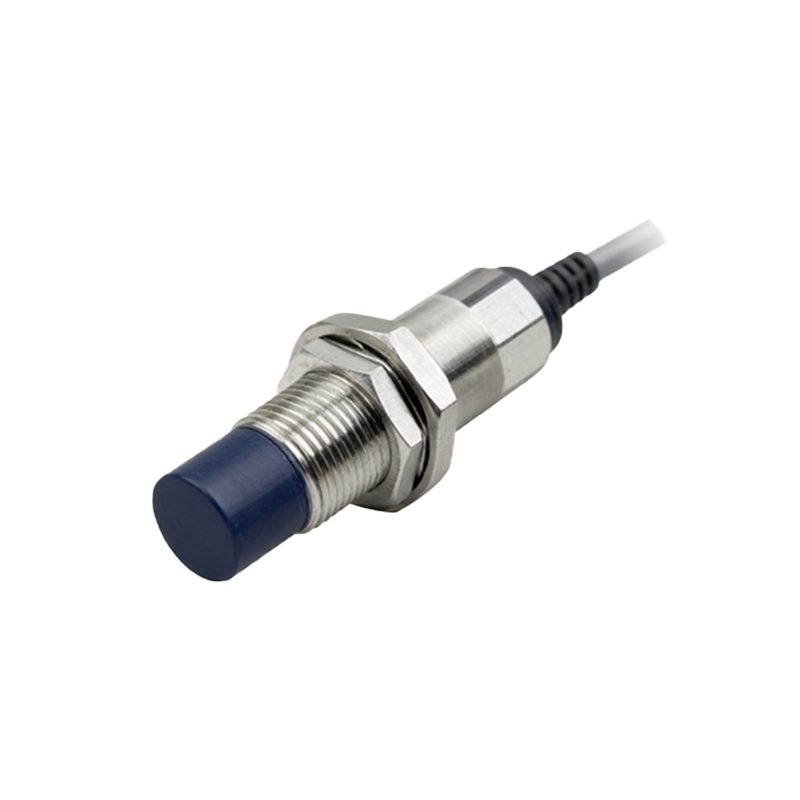
When selecting proximity sensors, the EM005 stands out for its balance of precision, durability, and cost-effectiveness. Compared to capacitive or ultrasonic alternatives, inductive sensors like the EM005 excel in metal detection scenarios but are unsuitable for non-metallic materials. Future developments may incorporate IO-Link communication for enhanced diagnostics and parameter adjustment capabilities. For optimal performance, follow manufacturer guidelines regarding shielding, cable routing, and environmental factors such as temperature fluctuations and electromagnetic interference.
In summary, the EM005 proximity sensor delivers consistent, maintenance-free operation for industrial automation tasks involving metal object detection. Its versatility across industries—from automotive manufacturing to packaging machinery—makes it a preferred component in modern production facilities. By understanding its technical specifications and application boundaries, engineers can implement this sensor to improve system efficiency, reduce downtime, and enhance safety protocols.