In the realm of precision measurement and industrial automation, red laser displacement sensors have established themselves as indispensable tools. Their ability to provide non-contact, high-accuracy distance and position measurements makes them critical for quality control, process monitoring, and robotic guidance. This article delves into the operational principles, key advantages, diverse applications, and crucial selection criteria for these sensors, providing a comprehensive guide for engineers and technical professionals.
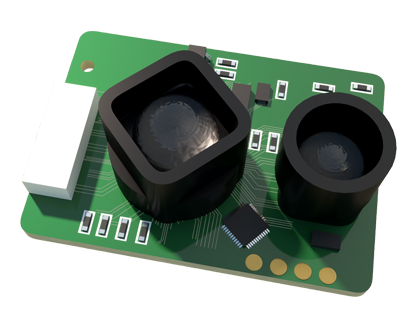
At its core, a red laser displacement sensor operates on the principle of optical triangulation. The sensor projects a focused beam of visible red laser light onto the target surface. The diffusely reflected light from this point is then captured by a receiving lens at a known angle and focused onto a position-sensitive detector, typically a CCD or CMOS linear array. The position of the light spot on this detector shifts precisely with changes in the target's distance. By calculating this shift, the sensor's internal processor determines the exact displacement or distance with remarkable resolution, often down to the micron level. The use of a visible red laser (commonly 650nm wavelength) offers a significant practical advantage: the laser spot is easily visible, simplifying initial setup, alignment, and troubleshooting on the factory floor.
The benefits of employing red laser displacement sensors are manifold. First and foremost is non-contact measurement. This eliminates any risk of damaging delicate or soft surfaces, such as rubber, foam, or painted materials, and prevents sensor wear. They offer high-speed response, capable of taking thousands of measurements per second, which is essential for inline inspection of fast-moving production lines. Their precision and repeatability are superior to many contact-based methods. Furthermore, their compact size allows for integration into tight spaces within machinery and robotic cells. The visible beam simplifies optical axis alignment compared to invisible infrared lasers, reducing commissioning time.
The applications span virtually every manufacturing sector. In the automotive industry, they are used to measure body panel gaps, inspect weld seam profiles, and control robot positioning for assembly. In electronics manufacturing, they verify component coplanarity (e.g., BGA balls), measure solder paste thickness, and inspect micro-connectors. In metal processing, they monitor thickness, vibration, and runout. They are pivotal in controlling roll gap in paper and plastic film production to ensure consistent thickness. Furthermore, they enable precise profiling of objects for 3D inspection and reverse engineering.

Selecting the right red laser displacement sensor requires careful consideration of several parameters. Measurement Range and Stand-off Distance: This defines the working distance from the sensor head to the target and the span over which it can accurately measure. Choosing a sensor with a range suited to the specific task is critical. Spot Size: A smaller spot allows for measurement on edges and small features, but can be affected by surface texture. Linearity and Resolution: Linearity indicates the accuracy across the entire measurement range, while resolution is the smallest detectable change. High-precision tasks demand excellent specifications in both. Sampling Rate: For dynamic or high-speed targets, a high sampling rate is necessary to capture data without aliasing. Target Surface Properties: The sensor's performance can be affected by color, material, and finish. Dark, matte, or transparent surfaces may require sensors with enhanced sensitivity or specialized models. Many modern sensors feature "Teaching" functions to compensate for different surface conditions. Environmental Robustness: Industrial environments present challenges like ambient light, dust, oil, and vibration. Selecting sensors with adequate IP ratings, robust housings, and optical filters for ambient light rejection is essential for reliable operation. Outputs and Interfaces: Standard analog outputs (0-10V, 4-20mA) and digital interfaces (Ethernet, EtherCAT, RS-232) facilitate integration with PLCs, data acquisition systems, and robotic controllers.
In conclusion, red laser displacement sensors are a mature yet continuously evolving technology that provides a perfect blend of visibility, precision, and speed for non-contact metrology. Their versatility addresses countless measurement challenges in automation and quality assurance. A thorough understanding of their operating principles, coupled with a methodical approach to selection based on the application's specific demands—considering range, surface type, speed, and environment—enables engineers to deploy these powerful tools effectively, driving improvements in product quality, manufacturing efficiency, and process control.