Inductive proximity sensors are fundamental components in industrial automation, playing a critical role in non-contact detection of metallic objects. Their robust, wear-free operation makes them indispensable in manufacturing, packaging, and material handling. The core principle governing their function is electromagnetic induction, a phenomenon first described by Michael Faraday.
At the heart of an inductive proximity sensor lies a coil wound around a ferrite core. This assembly, along with an oscillator circuit, forms the sensor's active face. When powered, the oscillator generates a high-frequency alternating electromagnetic field that radiates from the ferrite core. This field is confined to a relatively short range in front of the sensor's face, defining its nominal sensing distance.
In the absence of a target, the oscillator operates at a constant amplitude. The key interaction occurs when a conductive metal object enters this oscillating electromagnetic field. According to Faraday's Law of Induction, a changing magnetic field induces circulating currents, known as eddy currents, on the surface of the conductive target. These eddy currents are not static; they flow in closed loops within the metal, opposing the very change that produced them, as described by Lenz's Law.
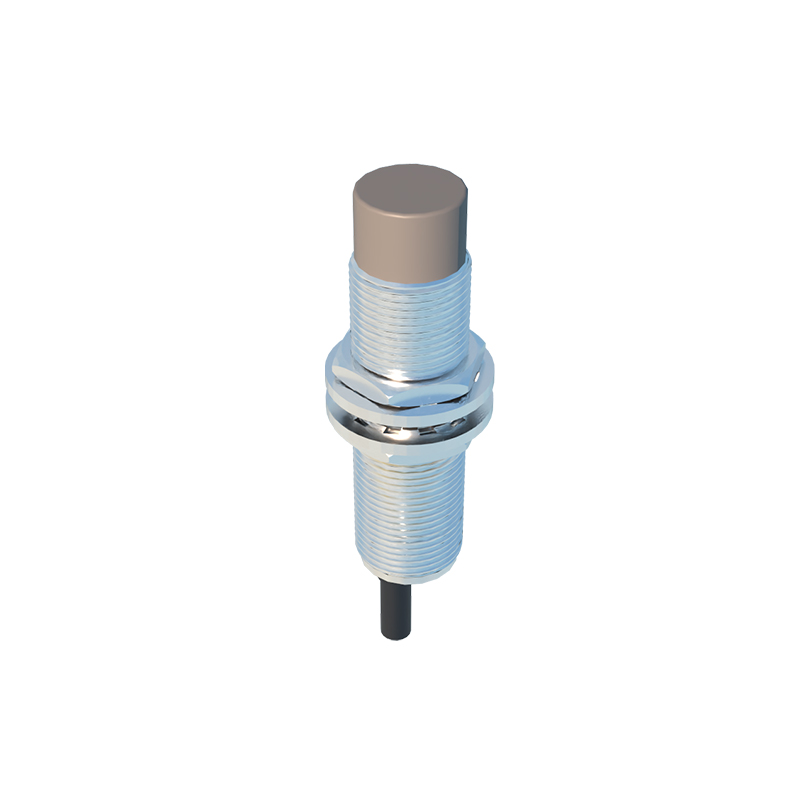
The generation of these eddy currents represents an energy loss from the sensor's oscillating circuit. The eddy currents dissipate energy as heat within the metal target, effectively loading the oscillator circuit. This energy absorption dampens the oscillation, causing a measurable decrease in the amplitude of the oscillator's signal. The sensor's integrated evaluation electronics continuously monitors this amplitude. Once the amplitude drop exceeds a predefined threshold—corresponding to the object being within the specified sensing range—the sensor's output state switches. This switch can be from On to Off (normally closed) or, more commonly in modern sensors, from Off to On (normally open), sending a discrete signal to a controller like a PLC.
The detection capability and sensing distance are not uniform for all metals. They depend significantly on the target material's electrical conductivity and magnetic permeability. Generally, metals are categorized into two groups: ferromagnetic and non-ferromagnetic.
Ferromagnetic metals, such as mild steel, iron, and nickel, possess high magnetic permeability. This property concentrates the sensor's magnetic field lines, enhancing the eddy current effect and resulting in a longer sensing range. For a standard inductive sensor calibrated for mild steel, the sensing distance is considered the nominal range, often denoted as 'Sn'.

Non-ferromagnetic metals include materials like aluminum, copper, brass, and stainless steel (austenitic grades like 304 and 316). These have lower permeability and higher resistivity compared to steel. The eddy currents induced in these metals are weaker or form less efficiently, leading to a reduced effective sensing distance. Engineers must account for this reduction using correction factors, typically provided in sensor datasheets. For instance, an aluminum target might only be detected at 40-50% of the sensor's nominal range for steel.
Modern inductive sensors incorporate sophisticated designs to overcome challenges. Shielding is a crucial aspect. Shielded (or embeddable) sensors have a metal ring surrounding the coil, which focuses the electromagnetic field radially forward. This design allows them to be flush-mounted in metal without triggering on the surrounding mounting material. Unshielded (non-embeddable) sensors have a wider, more extended field and must be installed with a clearance from adjacent metal to prevent false triggering.
Key performance characteristics include the switching frequency (how many detection cycles per second), hysteresis (the difference between the switch-on and switch-off points to prevent chatter), and environmental ratings like IP67 for protection against dust and water immersion. Temperature stability is also vital, as extreme temperatures can affect the oscillator's properties.
Applications are vast, from simple tasks like counting metal parts on a conveyor or detecting the position of a machine arm, to complex roles in robotic pick-and-place systems and safety interlocking. Their immunity to dirt, dust, oils, and non-metallic objects makes them exceptionally reliable in harsh industrial environments where optical sensors might fail.
In summary, the operation of an inductive proximity sensor is an elegant application of electromagnetic theory. By generating a high-frequency field and detecting the eddy current losses caused by a metallic intruder, it provides a solid-state, reliable solution for position sensing. Understanding the principles of electromagnetic induction, eddy current formation, and material-specific factors is essential for the proper selection, installation, and integration of these sensors into any automated system, ensuring optimal performance and reliability.