In the rapidly evolving landscape of industrial automation, robotic arm laser sensors have emerged as a cornerstone technology, enabling unprecedented levels of precision, flexibility, and efficiency. These sophisticated devices, which integrate laser-based measurement principles with advanced robotics, are fundamentally transforming manufacturing, logistics, and quality control processes across diverse sectors. This article delves into the operational mechanics, key types, and pivotal applications of these sensors, highlighting their critical role in modern smart factories.
At its core, a robotic arm laser sensor is a non-contact measurement system that utilizes laser light to detect, profile, or measure objects. The fundamental principle involves emitting a focused laser beam towards a target. The sensor then analyzes the reflected light—whether through triangulation, time-of-flight (ToF), or laser interferometry methods—to calculate precise distance, dimensions, or surface characteristics. When mounted on a robotic manipulator, this capability allows for dynamic, real-time spatial awareness. The robotic controller integrates this sensory feedback, enabling the arm to adjust its path, grip, or operation instantly based on the object's position, orientation, or geometry. This closed-loop control system is vital for tasks requiring sub-millimeter accuracy.
Several types of laser sensors are commonly deployed on robotic arms, each suited for specific applications. 2D Laser Profilers scan a laser line across a surface, generating a detailed cross-sectional profile ideal for contour inspection, weld seam tracking, or part alignment. 3D Laser Scanners capture comprehensive spatial data by sweeping a laser point or line across an area, creating dense point clouds for reverse engineering, bin picking, or assembly verification. Laser Distance Sensors, often based on ToF or phase-shift principles, provide high-speed, single-point distance measurements crucial for positioning, palletizing, or collision avoidance. Laser Triangulation Sensors offer exceptional resolution for height or thickness measurement on production lines. The choice depends on factors like required accuracy, measurement range, environmental conditions (e.g., ambient light, dust), and processing speed.
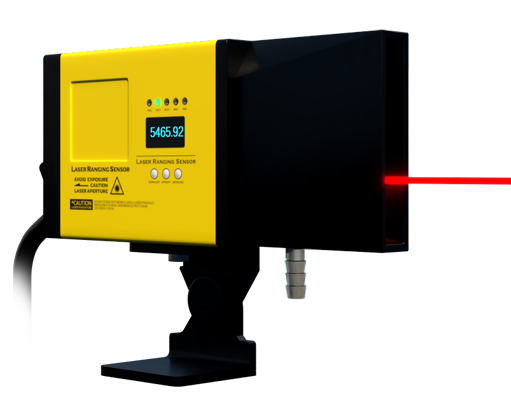
The integration of laser sensors dramatically expands the capabilities of robotic arms. In automotive manufacturing, robots equipped with laser vision systems perform precise welding, adhesive dispensing, and part fitting, ensuring consistent quality on complex assemblies like car bodies. The electronics industry relies on them for delicate PCB assembly, component placement, and solder paste inspection, where micron-level precision is non-negotiable. Logistics and warehousing benefit through automated guided vehicles (AGVs) and robotic arms that use laser sensors to identify, locate, and handle parcels of varying sizes and shapes in chaotic environments, optimizing sorting and packaging. Furthermore, in quality assurance, inline robotic inspection systems with laser scanners detect surface defects, measure critical dimensions, and verify tolerances without halting production, significantly reducing waste and rework.
Despite their advantages, implementing robotic arm laser sensors presents challenges. Calibration and synchronization between the sensor and robot kinematics require meticulous setup to ensure measurement accuracy in the robot's coordinate frame. Environmental interference from reflective surfaces, intense ambient light, or particulates can degrade sensor performance, necessitating protective housings or filtering algorithms. Additionally, the high initial investment and need for specialized programming expertise can be barriers for small to medium enterprises. However, ongoing advancements in sensor miniaturization, machine learning for adaptive perception, and plug-and-play integration software are steadily lowering these hurdles.
Looking ahead, the convergence of laser sensing with artificial intelligence and the Industrial Internet of Things (IIoT) promises even greater autonomy. Future robotic systems will likely feature multi-sensor fusion—combining laser data with vision and tactile feedback—for robust object recognition and manipulation in unstructured settings. Enhanced real-time processing will enable predictive maintenance and adaptive manufacturing, where robots can self-correct based on sensor trends. As industries stride toward fully lights-out factories, the precision and versatility afforded by robotic arm laser sensors will remain indispensable, driving the next wave of productivity and innovation in automation.
In conclusion, robotic arm laser sensors are not merely auxiliary components but pivotal enablers of intelligent automation. By providing accurate, real-time environmental data, they empower robots to perform complex, variable tasks with human-like dexterity and reliability. Their continued evolution will be central to achieving higher efficiency, quality, and flexibility in the automated industries of tomorrow.