Small proximity sensors are indispensable components in modern industrial automation, offering non-contact detection of objects within a specific range. Their compact size, reliability, and versatility make them ideal for applications with space constraints, such as robotic arms, assembly lines, and consumer electronics. This article delves into the fundamental structure and operating principles of these widely used devices.
At its core, a typical small proximity sensor consists of four main structural components: the sensing element, the oscillator circuit, the detection circuit, and the output circuit, all housed within a robust, often metallic or polymer, casing. The sensing element, usually a coil wound around a ferrite core, is the front-line component. It is responsible for generating an electromagnetic field. This coil is connected to the oscillator circuit, which produces a high-frequency oscillating magnetic field that radiates from the sensor's active face.
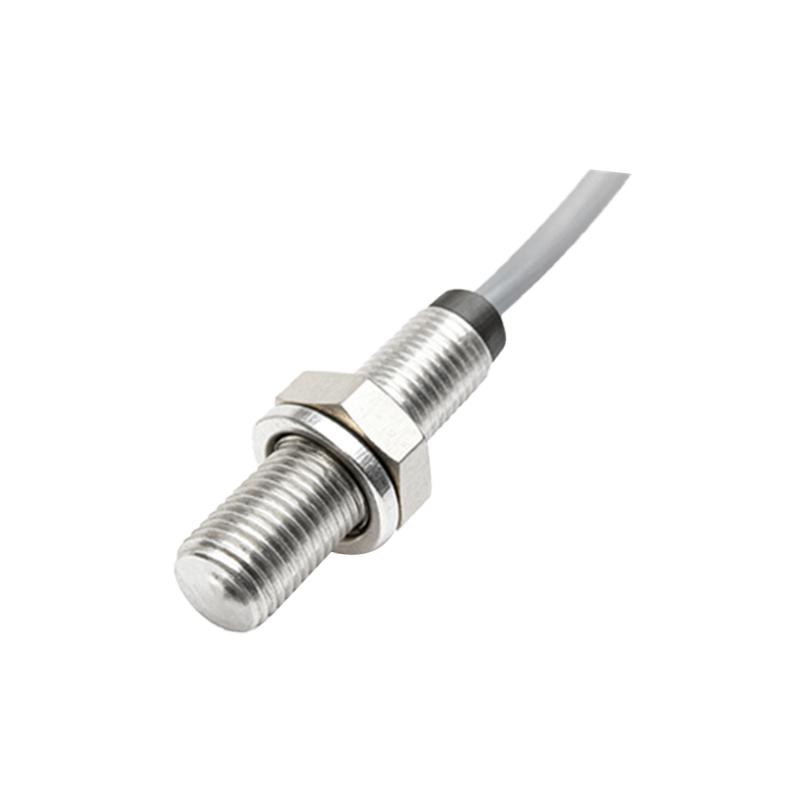
The working principle hinges on electromagnetic induction or changes in capacitance, depending on the sensor type. Inductive proximity sensors, the most common variant for metal detection, operate on the principle of eddy currents. When the oscillator's high-frequency field encounters a conductive (metallic) target object entering its detection range, eddy currents are induced on the surface of the target. These eddy currents draw energy from the oscillator circuit, causing a reduction in the oscillation amplitude. The detection circuit continuously monitors this amplitude. Once the amplitude drop exceeds a predefined threshold—signifying the presence of a target—the detection circuit triggers a signal.
This signal is then processed by the output circuit. Small proximity sensors commonly provide digital outputs, such as NPN (sinking) or PNP (sourcing) transistor outputs, which switch state (e.g., from OFF to ON) to indicate detection. Some advanced models may offer analog outputs proportional to the distance to the target. The entire process is remarkably fast, allowing for high-speed counting or positioning tasks.
Another prevalent type is the capacitive proximity sensor. Structurally similar, its sensing element is designed to create an electrostatic field instead of an electromagnetic one. It can detect both conductive and non-conductive materials (like plastics, wood, or liquids) by sensing changes in capacitance. When any material with a different dielectric constant than air enters the electrostatic field, it alters the capacitance of the circuit. This change is detected, processed, and converted into an output signal. The sensing range for capacitive sensors is often adjustable to compensate for different material properties.
Key to the performance of small proximity sensors is their shielding or non-shielding design. Shielded (flush-mountable) sensors have a metal ring surrounding the sensing coil, concentrating the magnetic field directly in front. This allows them to be embedded in metal mounting surfaces without false triggering. Non-shielded (non-flush) sensors have a wider, more extended sensing field but must be installed with clearance from surrounding metal.
The choice of housing material, typically stainless steel, nickel-plated brass, or PBT plastic, ensures durability against industrial contaminants like coolants, oils, and metal chips. The miniaturization of these components, achieved through surface-mount technology (SMT) and advanced circuit design, is what enables their small form factor without sacrificing sensing performance or switching frequency.
In summary, the elegant interplay between the oscillator's generated field, the target's physical interaction (eddy current loss or capacitance change), and the electronic circuits' detection and switching logic forms the basis of operation. Understanding this structure and principle is crucial for selecting the right sensor—be it inductive or capacitive, shielded or non-shielded—for precise, reliable non-contact detection in space-sensitive automated systems. Their role in enabling precise machine control, object counting, and position verification continues to be pivotal across manufacturing, packaging, and automotive industries.