In the rapidly evolving landscape of industrial automation, scanning laser vision sensors have emerged as a cornerstone technology, driving unprecedented levels of precision, efficiency, and flexibility. These sophisticated devices, which integrate laser scanning mechanisms with advanced vision processing, are fundamentally transforming quality control, measurement, and robotic guidance applications across diverse sectors, from automotive manufacturing to electronics assembly.
At its core, a scanning laser vision sensor operates by projecting a laser line or pattern onto a target object. A high-resolution camera, precisely calibrated and synchronized with the laser emitter, captures the deformation or profile of this line as it interacts with the object's surface. This captured profile data is then processed in real-time by powerful onboard algorithms to extract critical three-dimensional information. Unlike traditional 2D vision systems, this laser triangulation technique provides accurate height, depth, and contour data, enabling the system to perform complex inspections that are impossible with conventional imaging alone.
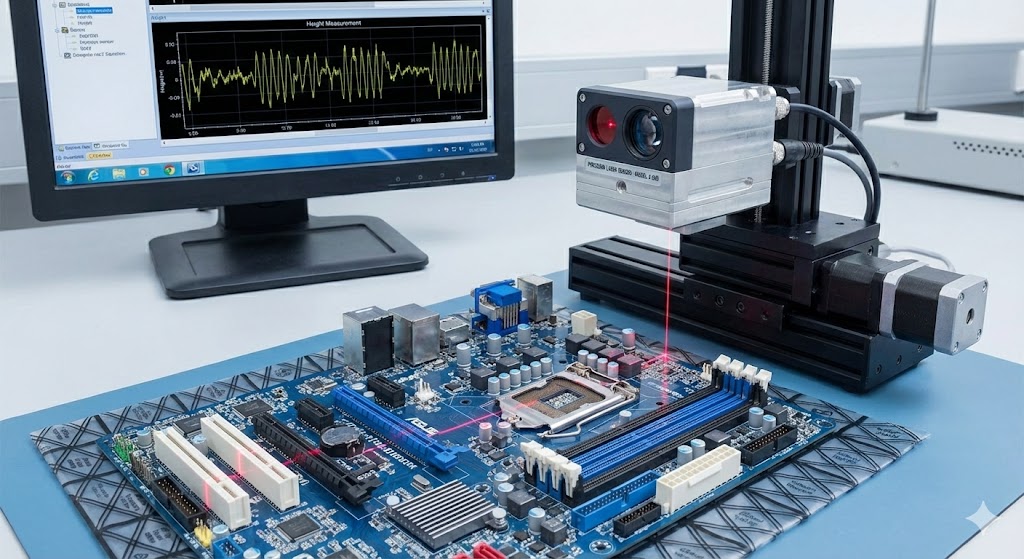
The operational principle is rooted in laser triangulation. The laser diode projects a thin, focused line of light. The camera, positioned at a known angle relative to the laser, views this line. Any variation in the object's surface height causes the laser line to appear displaced in the camera's field of view. By analyzing this displacement pixel by pixel, the sensor's software constructs a detailed height profile or a full 3D point cloud of the object. This capability allows for the precise measurement of dimensions, detection of surface defects like scratches, dents, or warping, and verification of assembly completeness with micron-level accuracy.
Key advantages of scanning laser vision sensors are manifold. First is their exceptional speed and accuracy. They can scan and process thousands of profiles per second, making them ideal for high-speed production lines. Second is their robustness in challenging environments. They are largely immune to ambient lighting variations that often plague standard machine vision cameras, as they rely on their own controlled, structured laser light. Third is their versatility. A single sensor can be programmed for multiple tasks—measuring multiple features, inspecting for various defect types, or guiding a robot to pick irregularly shaped parts—all through software changes without mechanical reconfiguration.
Applications are extensive and impactful. In automotive manufacturing, these sensors are indispensable for inspecting body panel gaps and flushness, ensuring critical safety components like brake pads meet thickness specifications, and verifying the correct application of adhesives and sealants. In the electronics industry, they measure solder paste volume on PCBs, inspect component coplanarity, and check for warpage in semiconductor packages. In logistics and packaging, they perform precise dimensional gauging for cubing and sorting, and verify package integrity. Furthermore, they are pivotal in robotic bin picking, where they provide the precise 3D location and orientation of randomly piled parts, enabling robots to grasp them reliably.
The integration of these sensors into smart factory frameworks, or Industry 4.0 ecosystems, represents the next frontier. Modern scanning laser sensors come equipped with Ethernet/IP, PROFINET, and other industrial communication protocols, allowing seamless data exchange with PLCs, robots, and Manufacturing Execution Systems (MES). The rich 3D data they generate can be used not only for real-time process control but also for predictive analytics and traceability, contributing to a closed-loop, adaptive manufacturing process.
Despite their power, successful implementation requires careful consideration. Factors such as the sensor's field of view, working distance, laser wavelength (often red or blue for different material properties), and environmental factors like reflective surfaces or extreme temperatures must be evaluated. Proper calibration and integration with the production line's control architecture are crucial to unlocking their full potential.
In conclusion, scanning laser vision sensors are more than just inspection tools; they are enablers of intelligent automation. By delivering reliable, high-resolution 3D data at production-line speeds, they provide the "eyes" for automated systems to make informed decisions, ensuring quality, reducing waste, and enhancing overall operational agility. As technology advances, with improvements in laser sources, camera sensors, and especially artificial intelligence for data analysis, their role in shaping the future of manufacturing will only become more profound and indispensable.