In the realm of industrial automation, precision measurement is paramount. Laser distance sensors have emerged as a cornerstone technology, offering non-contact, high-accuracy solutions for a vast array of applications. This article delves into the operational principles, key technologies, diverse applications, and critical selection factors for these sophisticated devices, providing essential knowledge for electrical engineers and system integrators.
At its core, a laser distance sensor operates by emitting a focused beam of coherent light—typically from a laser diode—towards a target object. The sensor then measures the time it takes for the reflected light to return to a detector. This fundamental principle is executed through two primary methodologies: time-of-flight (ToF) and triangulation.
Time-of-flight sensors calculate distance based on the precise time interval between the emission and reception of the laser pulse. The formula is straightforward: Distance = (Speed of Light × Time of Flight) / 2. Modern ToF sensors utilize advanced photodetectors and high-speed timing circuits to achieve resolutions in the millimeter range, even over distances of several hundred meters. They are particularly suited for long-range measurements and applications requiring rapid scanning, such as in logistics for warehouse volume measurement or in construction for terrain mapping.
Triangulation-based sensors, on the other hand, are designed for high precision at shorter ranges. Here, the emitted laser beam strikes the target, and the reflected light is focused onto a position-sensitive detector (PSD) or a CMOS/CCD array. The position of the light spot on this detector changes linearly with the target's distance. By calculating this angle, the sensor's internal processor determines the distance with exceptional accuracy, often down to the micrometer level. This makes triangulation sensors ideal for quality control on production lines, measuring small part dimensions, or monitoring minute displacements.

Several key specifications define a laser distance sensor's performance. Measurement Range indicates the minimum and maximum distances over which the sensor can operate reliably. Accuracy and Resolution are often confused; accuracy refers to how close the measured value is to the true distance, while resolution is the smallest change in distance the sensor can detect. Repeatability is the sensor's ability to produce the same reading under identical conditions. Response Time or sampling rate is critical for dynamic processes. Additionally, engineers must consider the laser class (with Class 2 being common for eye-safe industrial sensors), the spot size, and environmental factors like ambient light immunity and operating temperature.
The applications of laser distance sensors are extensive and cross-industry. In manufacturing, they are used for precise positioning of robotic arms, checking fill levels in containers, and inspecting part profiles. In the automotive sector, they assist in assembly line automation and vehicle guidance systems. They are indispensable in aerospace for component alignment, in agriculture for yield monitoring, and in emerging fields like robotics for navigation and obstacle avoidance. Their non-contact nature prevents damage to both the sensor and delicate targets, a significant advantage over mechanical probes.
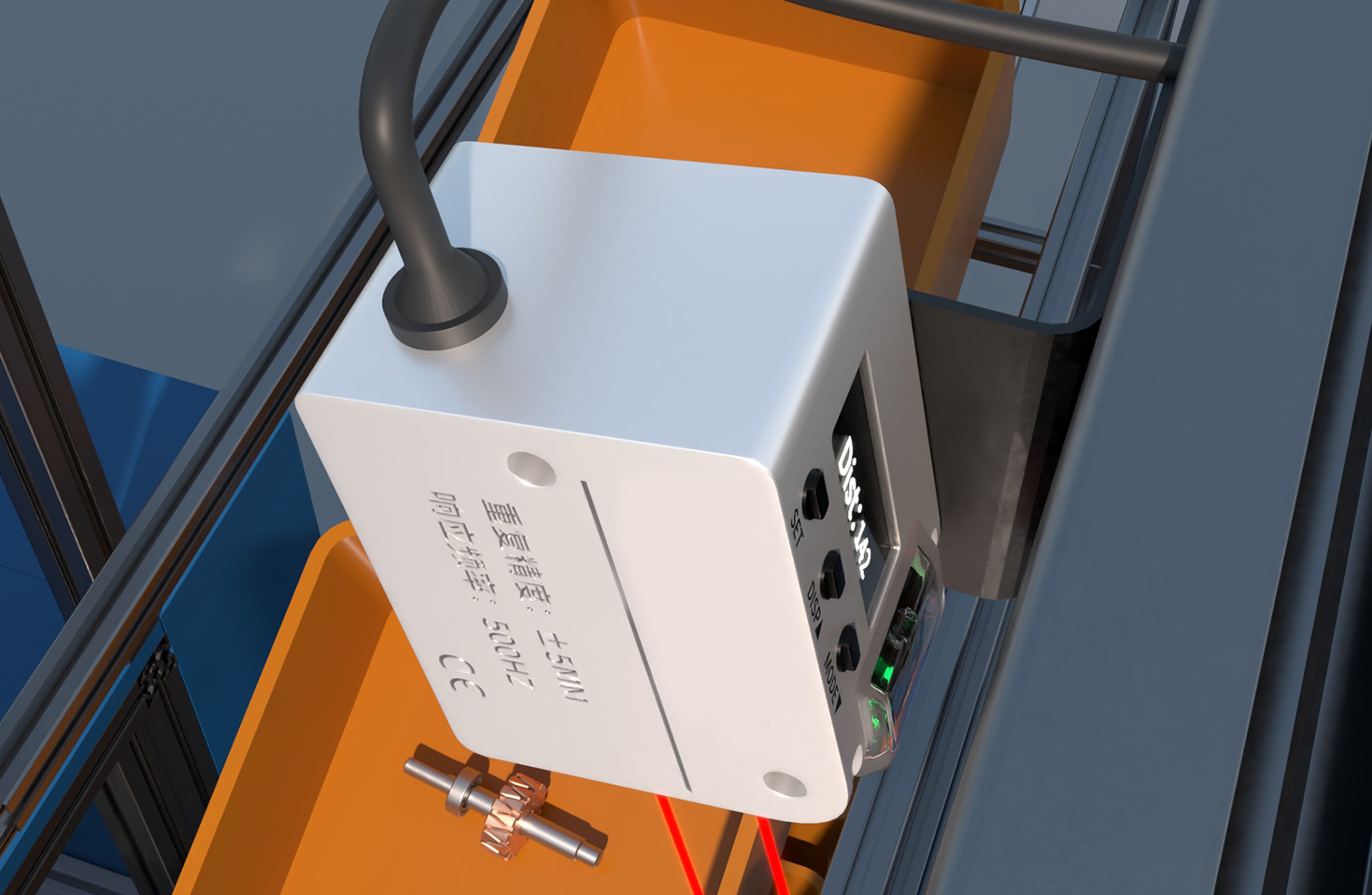
Selecting the right laser distance sensor requires a careful analysis of the application's needs. Engineers must first define the required measurement range, accuracy, and speed. The target's properties are equally important: a dark, matte surface absorbs more light than a bright, reflective one, potentially reducing signal strength. Some sensors feature automatic background suppression or teach-in functions to adapt to different surfaces. The physical environment—exposure to dust, moisture, vibration, or extreme temperatures—dictates the necessary ingress protection (IP) rating and housing material. Finally, the output interface (analog 4-20mA/0-10V, digital RS-232/RS-485, Ethernet/IP, PROFINET, etc.) must be compatible with the existing control system.
In conclusion, laser distance sensors are versatile and powerful tools that solve complex measurement challenges. Understanding the underlying technology—the choice between ToF and triangulation, the interpretation of datasheet parameters, and the assessment of application-specific conditions—enables engineers to specify and integrate these sensors effectively. As Industry 4.0 advances, the integration of laser measurement data with IoT platforms and predictive analytics will further expand their role in creating smarter, more efficient, and autonomous industrial systems.