Laser sensor fixtures are critical components in modern industrial automation, ensuring precise alignment, stability, and repeatability in measurement and detection tasks. The fundamental principle behind these fixtures revolves around providing a rigid, adjustable mounting structure that maintains the sensor's optical axis relative to the target object with micron-level accuracy. This is achieved through a combination of mechanical design, material science, and an understanding of laser optics.
The core mechanical principle involves kinematic mounting. A well-designed fixture uses kinematic constraints—typically three points of contact—to deterministically locate the sensor, minimizing stress and distortion from thermal expansion or external forces. Materials like aluminum alloys, stainless steel, or engineered polymers are selected for their low thermal expansion coefficients, damping properties, and machinability. For high-precision applications, materials are often anodized or coated to reduce light reflection that could interfere with the sensor's signal.
Adjustability is another key principle. Fixtures incorporate fine-threaded screws, goniometers, or linear stages to allow for precise adjustments in multiple degrees of freedom: X, Y, Z axes, as well as pitch, yaw, and roll. This adjustability compensates for installation tolerances and ensures the laser beam strikes the target at the optimal angle and focal point. Locking mechanisms, such as clamp screws or collets, then secure the sensor firmly after alignment to prevent drift during operation.

Vibration damping is a critical consideration. Industrial environments often contain sources of vibration from machinery, which can blur measurements or cause false triggers. Fixtures may include dampening elements like rubber isolators, viscoelastic pads, or tuned mass dampers to absorb high-frequency vibrations. The fixture's natural frequency is also designed to be far from the dominant vibration frequencies in the operating environment.
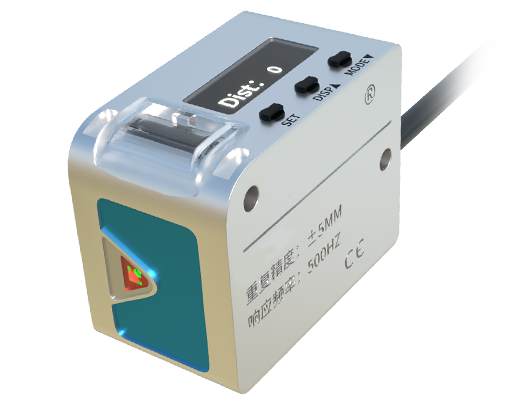
Thermal management principles are equally important. Lasers generate heat, and ambient temperature fluctuations can cause fixture expansion or contraction, leading to misalignment. Designs may incorporate thermal breaks, heat sinks, or active cooling channels. In some cases, materials with matched thermal expansion coefficients are used for the fixture and sensor housing to ensure they expand and contract uniformly.
Furthermore, the principle of modularity allows fixtures to be adaptable. Quick-release clamps, dovetail rails, or magnetic bases enable rapid sensor replacement or reconfiguration for different production lines. This reduces downtime and enhances flexibility in manufacturing processes.
From an optical standpoint, the fixture must prevent stray light interference. Baffles, shrouds, or threaded hoods are integrated to block ambient light or reflections from nearby surfaces. The internal surfaces are often blackened or textured to absorb stray laser light, ensuring the sensor receives only the intended signal.
In robotic applications, fixtures follow principles of lightweight design and dynamic balance. Using finite element analysis (FEA), engineers optimize the fixture's geometry to reduce mass while maintaining stiffness, which is crucial for high-speed robotic arms where inertia affects positioning accuracy.
Finally, safety and compliance principles are embedded into fixture design. Features include fail-safe locking, protective covers to prevent accidental exposure to laser beams, and compliance with international standards like ISO 13849 for safety-related parts. Proper grounding and shielding are also implemented to protect against electromagnetic interference (EMI) in electrically noisy environments.
In summary, the design of laser sensor fixtures is a multidisciplinary engineering task that integrates principles of precision mechanics, thermal dynamics, vibration analysis, and optics. A well-executed fixture ensures the laser sensor performs reliably, delivering accurate data that drives quality control, automation, and efficiency in industrial systems.