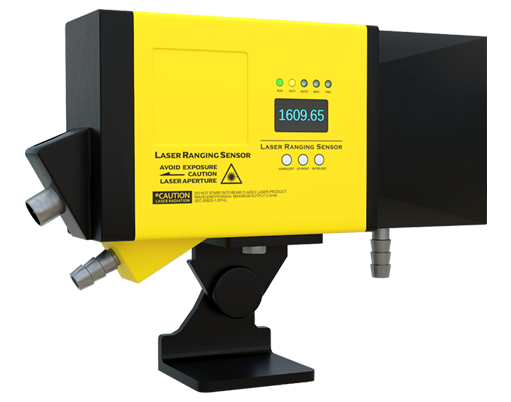
Laser sensors are pivotal components in modern industrial automation, offering non-contact, high-precision measurement capabilities across diverse applications. These devices operate by emitting a focused laser beam toward a target object and analyzing the reflected light to determine parameters such as distance, position, thickness, or presence. The core measurement principles primarily involve triangulation, time-of-flight (ToF), and interferometry methods, each suited to specific scenarios. Triangulation-based sensors project a laser spot onto the target, and a receiver lens captures the reflected light at an angle; displacement changes alter the spot position on a detector array, enabling precise distance calculations. This method excels in short-range measurements with micron-level accuracy, commonly used in quality control for semiconductor or automotive parts. Time-of-flight sensors measure the round-trip time of a laser pulse to compute distance, ideal for longer ranges up to several meters, applicable in logistics for pallet sizing or robotics for obstacle detection. Interferometry leverages wave interference patterns for ultra-high-resolution measurements, often in research or calibration environments.
Key advantages of laser sensors include their ability to measure without physical contact, eliminating wear and contamination risks. They provide rapid response times, often in microseconds, facilitating real-time monitoring in high-speed production lines. Additionally, laser sensors perform reliably in harsh conditions—resistant to dust, vibrations, or extreme temperatures—when properly housed. For instance, in manufacturing, they gauge material thickness in rolling mills or inspect surface defects on electronics. In automotive assembly, laser sensors ensure component alignment and weld quality, while in pharmaceuticals, they verify fill levels in containers. Environmental applications include monitoring air particulate concentrations or water clarity through laser scattering techniques.
To optimize measurement accuracy, factors like target surface properties, environmental interference, and sensor calibration must be considered. Reflective or transparent surfaces may require adjustments, such as using diffuse reflection models or polarizing filters. Regular maintenance, including lens cleaning and software updates, ensures longevity. Emerging trends integrate laser sensors with IoT and AI, enabling predictive analytics for smart factories. As industries advance toward Industry 4.0, laser sensors continue to evolve, offering enhanced resolution and connectivity, solidifying their role as indispensable tools for precise, reliable measurement in automation and beyond.