In the realm of industrial automation and precision engineering, columnar laser distance sensors have emerged as a cornerstone technology for non-contact measurement. These sensors, characterized by their cylindrical housing, utilize laser triangulation or time-of-flight principles to deliver highly accurate distance data. The core mechanism involves emitting a focused laser beam towards a target object. The reflected light is then captured by a receiving element, such as a CCD or CMOS array. By analyzing the position or the phase shift of the reflected beam, the sensor's internal processor calculates the exact distance with remarkable speed and resolution. This fundamental operation enables real-time monitoring and control in dynamic environments where physical contact is impractical or undesirable.
The advantages of columnar laser distance sensors are manifold, driving their widespread adoption across diverse sectors. Their primary benefit lies in exceptional accuracy, often achieving micron-level precision. This is paramount in applications like semiconductor wafer alignment, automotive part inspection, and robotic guidance systems. Furthermore, their non-contact nature eliminates the risk of damaging delicate surfaces or introducing measurement errors due to mechanical wear. The columnar form factor offers robust mechanical protection for the sensitive optical components within, making them suitable for harsh industrial settings involving dust, vibrations, or temperature fluctuations. Many models feature IP67 or higher ingress protection ratings, ensuring reliable operation. Additionally, modern sensors integrate advanced functionalities like background suppression, which filters out irrelevant reflections, and programmable logic controllers (PLCs) interfaces for seamless integration into automated production lines.
Typical applications span a broad spectrum of industries. In logistics and warehousing, these sensors are deployed for palletizing, box dimensioning, and level detection in silos. The manufacturing sector relies on them for thickness gauging of rolled metals, profile monitoring of extruded plastics, and precise positioning of assembly robots. In the burgeoning field of autonomous mobile robots (AMRs) and automated guided vehicles (AGVs), columnar laser sensors serve as critical components for obstacle detection and navigation, calculating safe distances to walls or other objects. The construction industry utilizes them for monitoring structural deformations or alignment of large components. Even in consumer electronics assembly lines, they ensure the precise placement of miniature components.
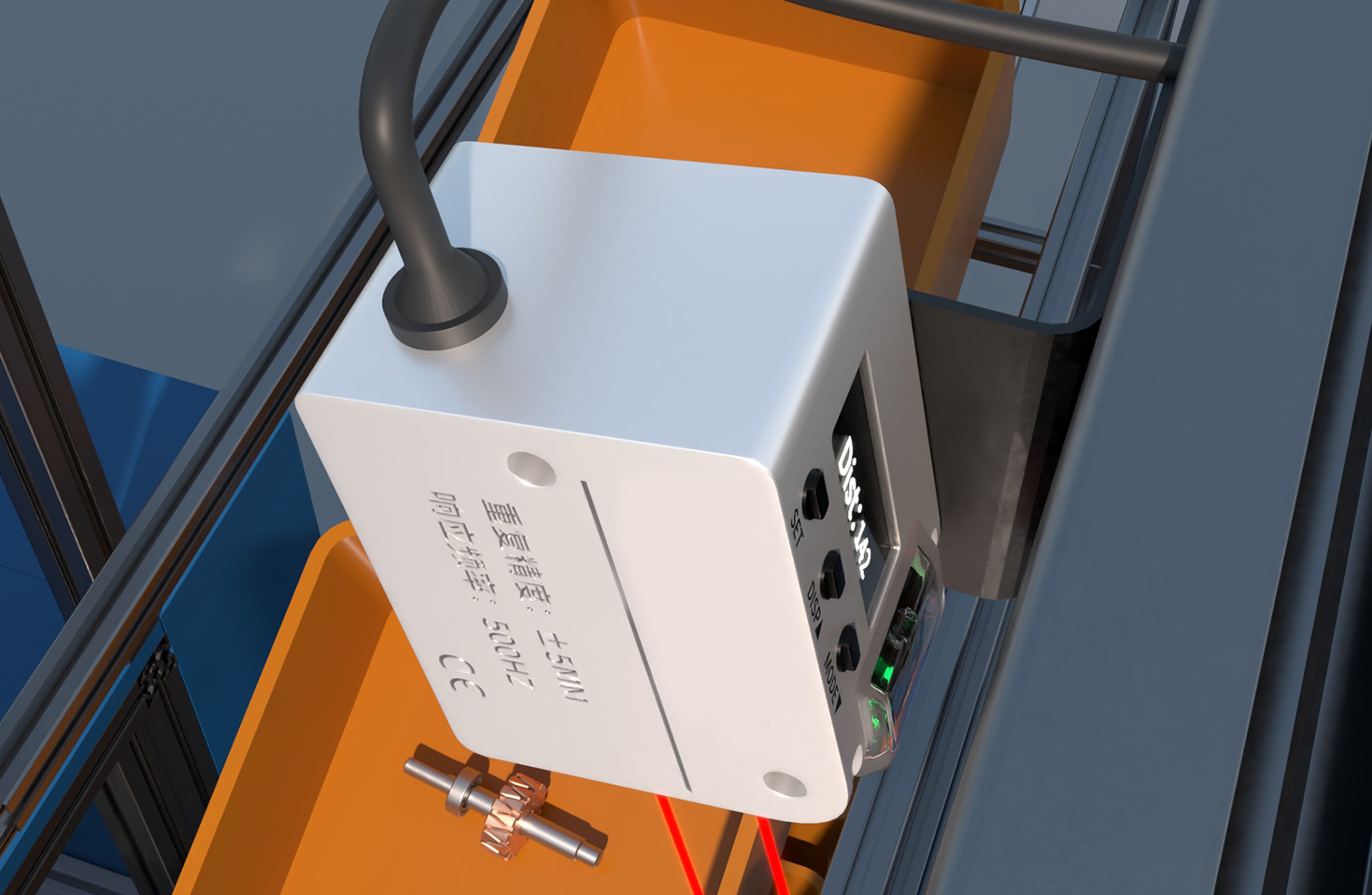
Selecting the appropriate columnar laser distance sensor requires careful consideration of several key parameters. Measurement range is the foremost criterion, with options available from a few centimeters to several hundred meters, depending on the technology (short-range triangulation vs. long-range time-of-flight). Resolution and repeatability define the sensor's precision and consistency. The response time, or measurement speed, is critical for high-speed production lines. Environmental factors cannot be overlooked; the sensor must withstand the ambient temperature range, potential exposure to coolants or oils, and intense ambient light conditions. Output interfaces—such as analog voltage/current, digital protocols like IO-Link, RS-485, or Ethernet/IP—must be compatible with the existing control system. Finally, the size and mounting options of the columnar housing must fit the mechanical constraints of the application.
The future trajectory of columnar laser distance sensor technology points toward greater intelligence, miniaturization, and connectivity. Integration with artificial intelligence for pattern recognition and predictive maintenance is on the horizon. Enhanced data fusion capabilities, combining laser data with inputs from other sensor types like vision cameras, will create more robust perception systems for complex tasks. The development of more cost-effective and power-efficient laser diodes will further democratize access to high-precision sensing. As Industry 4.0 and the Industrial Internet of Things (IIoT) mature, these sensors will evolve from mere data providers into intelligent nodes within a networked ecosystem, communicating directly with cloud platforms for centralized analytics and process optimization. This evolution will continue to unlock new possibilities for automation, quality control, and operational efficiency across the global industrial landscape.