Laser displacement sensors have become indispensable tools in modern industrial automation, offering non-contact precision measurement capabilities that traditional mechanical sensors cannot match. These devices operate on the principle of triangulation or time-of-flight measurement, emitting a focused laser beam toward a target surface and analyzing the reflected light to determine distance with micron-level accuracy. In triangulation-based sensors, a laser diode projects a spot onto the target, and a receiving lens focuses the reflected light onto a position-sensitive detector. Any change in the target's distance alters the angle of reflection, shifting the light's position on the detector and enabling precise displacement calculation. Time-of-flight sensors, often used for longer ranges, measure the round-trip time of laser pulses to compute distance.
The advantages of laser displacement sensors are numerous. Their non-contact nature eliminates wear and tear, making them ideal for measuring delicate, hot, or fast-moving objects. They provide high-speed response, with some models capable of thousands of measurements per second, essential for real-time quality control on production lines. Additionally, they exhibit excellent resolution and repeatability, often down to sub-micron levels, ensuring consistent performance in demanding environments like semiconductor manufacturing, automotive assembly, and aerospace engineering. Common applications include thickness gauging, vibration analysis, part presence detection, and surface profiling. For instance, in automotive brake disc production, laser sensors verify dimensional tolerances without touching the high-temperature components, while in electronics, they inspect solder paste height on circuit boards.
Selecting the right laser displacement sensor requires careful consideration of several parameters. Measurement range, resolution, and linearity are primary factors; a sensor with a 10mm range and 0.1µm resolution might suit precision machining, whereas a 500mm range sensor with 1mm resolution could be used for bulk material monitoring. The target surface properties also matter—highly reflective or transparent materials may require specialized models with adjustable sensitivity or diffuse reflection technology. Environmental conditions like dust, humidity, or ambient light must be accounted for, with industrial-grade sensors featuring IP67 enclosures or protective housings. Integration with PLCs and industrial networks (e.g., EtherCAT, PROFINET) is another key aspect, as seamless data communication enables automated feedback loops in Industry 4.0 setups.
Despite their robustness, laser displacement sensors face challenges. Beam interference from ambient light or multiple reflections can cause measurement errors, mitigated through optical filters or modulated laser signals. Surface variations, such as color or texture changes, may affect reflectivity, but advanced sensors with automatic gain control adapt to these conditions. Regular calibration against master samples ensures long-term accuracy, and maintenance typically involves lens cleaning to prevent contamination. Emerging trends include miniaturization for embedded systems, multi-point sensors for 3D scanning, and AI-enhanced data processing for predictive maintenance. As industries push toward smarter manufacturing, laser displacement sensors will continue evolving, offering even greater precision and connectivity to drive efficiency and quality assurance.
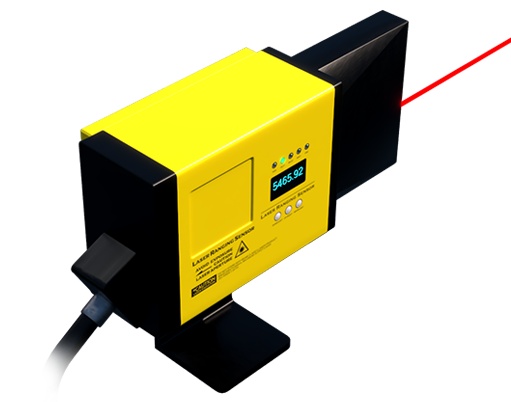
In summary, laser displacement sensors represent a critical technology for modern industrial measurement, combining speed, accuracy, and versatility. By understanding their operating principles and application criteria, engineers can leverage these devices to optimize processes, reduce waste, and enhance product reliability across diverse sectors.