In the realm of industrial automation and control systems, proximity sensors stand as fundamental components, enabling machines to "see" and interact with their environment without physical contact. Among the various types, distance-type proximity sensors, often referred to as analog or ranging sensors, are particularly crucial for applications requiring precise measurement of an object's position or distance. This article delves into the technology, operational principles, key varieties, and practical considerations for integrating these sensors into modern industrial setups.
At their core, distance-type proximity sensors detect the presence of an object and measure the exact gap between the sensor's face and the target. Unlike simple binary on/off proximity switches, these sensors provide a continuous analog output signal—typically voltage (0-10V) or current (4-20mA)—that is proportional to the measured distance. This capability is invaluable for tasks such as positioning, dimension checking, and monitoring fill levels, where granular data is essential for process control.
The working principle primarily hinges on electromagnetic or ultrasonic fields. The most common technologies include:
1. Inductive Sensors: These are used for detecting metallic objects. The sensor generates an oscillating electromagnetic field. When a metal target enters this field, it induces eddy currents, which dampen the oscillation. The sensor's electronics measure this change and convert it into a distance-proportional signal. Their effectiveness is influenced by the target's material properties, size, and shape.
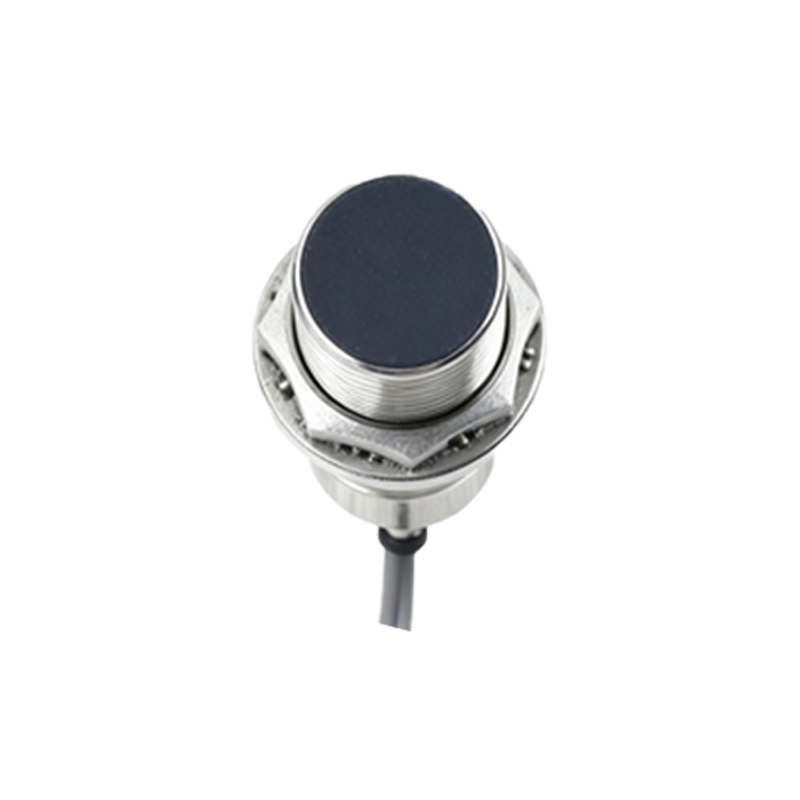
2. Capacitive Sensors: Capable of detecting both metallic and non-metallic materials (plastics, wood, liquids, etc.), these sensors function by generating an electrostatic field. The presence of any object alters the capacitance of this field. This change is measured and translated into a distance reading. They are ideal for level sensing of liquids or granular materials.
3. Ultrasonic Sensors: These sensors emit high-frequency sound waves and measure the time taken for the echo to return from the target object. The time-of-flight calculation provides an accurate distance measurement. They are highly effective for longer ranges, dirty environments, and detecting objects of virtually any material, though they can be affected by temperature variations and sound-absorbing surfaces.
Selecting the appropriate distance-type proximity sensor requires a careful analysis of several application parameters:
Sensing Range: This defines the minimum and maximum distances over which the sensor can operate reliably. It's critical to choose a sensor with a range that accommodates the expected operational variance.
Target Material: The object's composition directly dictates the suitable sensing technology. Inductive sensors are exclusive to metals, while capacitive and ultrasonic offer broader material compatibility.
Output Signal: The choice between analog voltage, analog current, or digital interfaces (like IO-Link) depends on the controller's input requirements and the need for diagnostics or parameterization.
Environmental Conditions: Factors such as ambient temperature, presence of dust, moisture, oils, or chemical vapors necessitate sensors with appropriate ingress protection (IP) ratings and robust housing materials (e.g., stainless steel).
Accuracy and Repeatability: Critical for precision applications. Specifications for linearity error and repeatability define how consistently and accurately the sensor can measure distance under identical conditions.
Response Time: The speed at which the sensor can update its output signal is vital for high-speed automation processes.
In practice, distance-type proximity sensors are deployed across diverse industries. In automotive manufacturing, they ensure precise robot arm positioning for welding and assembly. In packaging, they monitor material roll diameters to prevent breaks. In food and beverage, capacitive sensors control liquid levels in tanks, while ultrasonic sensors manage bulk solid inventories in silos. Their role in enabling Industry 4.0 is growing, with smart sensors providing predictive maintenance data by monitoring trends in distance measurements that may indicate machine wear or misalignment.
In conclusion, distance-type proximity sensors are sophisticated instruments that bridge the gap between simple detection and precise metrology. A thorough understanding of their operating principles, coupled with a meticulous assessment of the application's demands, is paramount for selecting a sensor that ensures reliability, accuracy, and longevity in today's complex and demanding industrial landscapes. Their continuous evolution, integrating digital intelligence and enhanced connectivity, promises to further solidify their position as indispensable tools for advanced automation.